AI Automation
AI Chatbot for UK Small Business: A 2026 Buyer's Guide
What an AI chatbot actually is, what it costs to deploy, where UK SMEs see real ROI, and the regulatory and integration realities you should know before buying. Includes vendor checklist, pricing benchmarks, and live deployment timeline.
If you run a UK small business and you've spent the last twelve months hearing that you should have an AI chatbot, but you have no idea what that actually means, what it costs, or whether it would do anything useful for you, this guide is for you. We'll cover what an AI chatbot is in 2026 (it has changed since 2023), where the genuine ROI sits for UK SMEs, what the realistic price tags look like across three deployment tiers, the regulatory and data-residency rules you cannot skip as a UK business, and a checklist for evaluating any vendor before you sign a contract.
What an AI chatbot actually is in 2026
An AI chatbot in 2026 is not the keyword-and-decision-tree bot you might have used in 2020. The dominant pattern now is retrieval-augmented generation (RAG): a large language model that, instead of answering from its training data, is constrained to answer only from a corpus of documents you control, your help centre, policy PDFs, past ticket resolutions, product documentation. Every answer cites the source. The model is instructed to refuse questions it cannot ground in retrieved content, and a confidence-based escalation layer routes ambiguous or sensitive conversations to a human with the full conversation transcript already attached.
This pattern has three big advantages over the older keyword-rule chatbots and the bare-LLM chatbots that briefly made headlines in 2023–2024: it can answer nuanced questions in natural language, it can be updated by editing a document instead of editing a decision tree, and it has a much narrower hallucination surface because it only speaks from your sources.
Where UK SMEs see real ROI
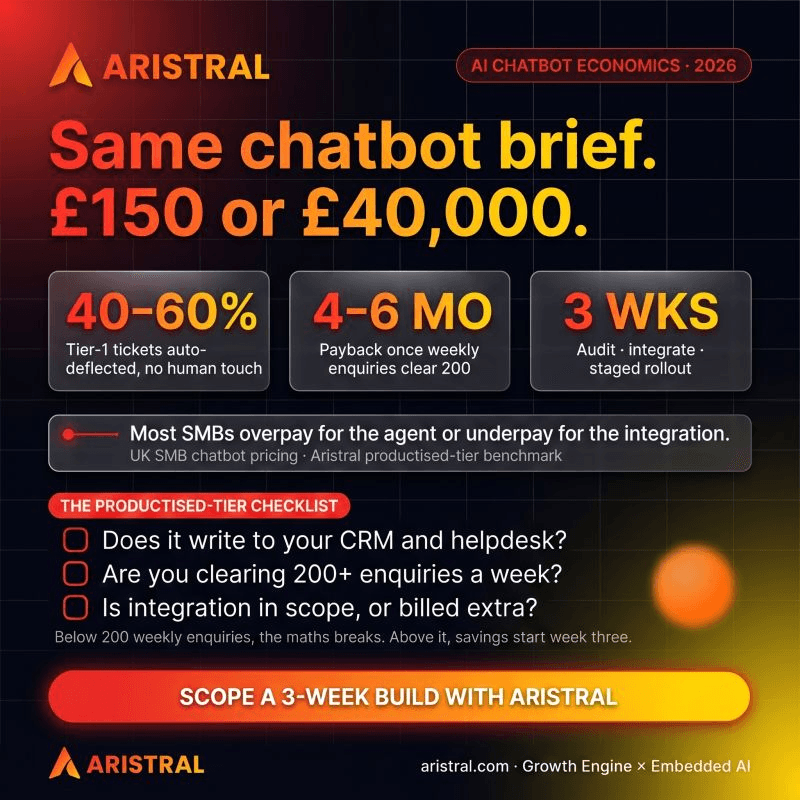
- Customer support deflection. A grounded chatbot typically resolves 40–60% of tier-1 support enquiries (opening hours, returns policy, order status, basic product questions) without human involvement, freeing staff for complex cases. This is the most common ROI driver for UK SMEs.
- Out-of-hours coverage. Most UK SMEs cannot afford a 24/7 support team. A chatbot that handles 70% of after-hours enquiries with the same accuracy as your daytime team converts visitors who would otherwise bounce.
- Multilingual support without multilingual headcount. UK businesses serving international customers can offer first-line support in a dozen languages without hiring native speakers, the cost is one carefully evaluated language model, not twelve people.
- Internal knowledge access. A chatbot trained on your internal docs (process notes, supplier policies, technical specs) means staff stop re-asking the same questions in Slack and stop re-deriving answers that already exist somewhere in your knowledge base.
- Lead qualification. A chatbot on your website can ask qualifying questions, score the lead, and book a meeting straight into your calendar: closing the gap between an enquiry arriving and a salesperson hearing about it from minutes to seconds.
Realistic 2026 cost bands
Pricing varies by deployment tier and integration depth. Three honest bands for UK SMEs in 2026:
- Off-the-shelf widgets (Intercom Fin, HubSpot AI, Zendesk Answer Bot, Tidio): £150–£600 per agent or per resolved conversation per month. Fastest to deploy. Limited customisation, often no UK data residency, and the chatbot's knowledge is constrained to whatever your helpdesk vendor lets it ingest.
- Productised AI chatbots from UK agencies: £4,000–£12,000 deployment plus £400–£1,500 per month for LLM and hosting. Built on LangChain or equivalent over your help centre and ticket history, with full UK data residency, CRM integration, and a real evaluation harness against your actual customer questions.
- Bespoke production chatbots: £15,000–£40,000 to build plus ongoing infrastructure. Role-based access, full audit logging, multi-channel deployment (web, WhatsApp Business API, email triage, in-app), and integration into your accounting or ERP stack. The right tier for regulated industries or UK businesses processing more than 1,000 weekly support enquiries.
UK regulatory and data-residency realities
If you process customer personal data through a chatbot, and you almost certainly will, even if it's just an email address, you fall under UK GDPR. That has three practical implications for vendor selection. First, your chatbot's data flows must be documented in your processing register; ask your vendor for a clear data-flow diagram. Second, if conversations leave the UK or EEA (e.g., to a US-hosted LLM API without an adequacy decision), you need a lawful transfer mechanism (typically Standard Contractual Clauses) and your privacy notice must say so. Third, the UK Information Commissioner's Office (ICO) expects you to apply data minimisation: do not store conversation transcripts longer than you need, and do not feed customer-identifying data into model training without an opt-in.
All three are solvable. The pattern that satisfies UK GDPR cleanly is: a UK or EEA-hosted vector store containing only your authorised content (no customer data), a model API call routed through a vendor with EU data residency where possible (Anthropic and OpenAI both offer this for enterprise plans), a conversation transcript retention policy under 90 days for routine queries, and explicit opt-in if you ever want to use real conversations for model improvement. Any vendor who cannot answer how their stack maps to these four points is not the right vendor.
Integration depth matters more than model choice
Founders often spend hours debating GPT vs Claude vs open-source. In practice, model choice matters far less than how well the chatbot integrates with your existing systems. A chatbot that can answer questions in beautiful natural language but cannot create a ticket in your helpdesk, update a contact in your CRM, or trigger a follow-up workflow is a fancy demo, not a production system. Before evaluating any vendor, list the systems the chatbot will need to read from and write to: helpdesk (Zendesk, HubSpot Service Hub), CRM (HubSpot, Salesforce, Pipedrive), calendar, email provider, accounting system, internal Slack or Teams. Ask each vendor specifically how their chatbot integrates with each, and ask for live demonstration, not slides.
Vendor checklist before you sign
- Where is the vector store hosted? Where is the LLM hosted? Where do conversation transcripts live, and for how long?
- Show me the citation in a sample answer. If your chatbot does not cite sources from my content, it can hallucinate freely.
- What is your evaluation methodology? Do you maintain a gold Q&A set built from real ticket history, and do prompt or model changes pass that set before going live?
- How do you handle escalation? When the chatbot is uncertain, what happens: does the conversation just end, or does a human pick up with full context?
- What is the rollback plan if a model update degrades quality? Can you pin a specific model version?
- What integrations are out-of-the-box vs custom? Demonstrate the integration with my helpdesk and CRM live, not in a presentation.
- What is the realistic deployment timeline from contract sign to live on my website? (For productised deployments, three weeks is the credible answer.)
- Who owns the prompts, the evaluation set, and the trained vector store at the end of the contract? (Answer should be: you do.)
Realistic deployment timeline
For a productised AI customer support chatbot grounded on your help centre and existing ticket history, three weeks from kickoff to live on your website is the realistic timeline assuming your documentation is reasonably organised. Week one is source audit, schema design, and infrastructure setup. Week two is retrieval pipeline build, prompt engineering against your gold Q&A set, and helpdesk integration. Week three is staged rollout, internal testing first, then live on a low-risk channel like web chat with confidence-based escalation, with escalation rates monitored daily for the first two weeks. Anyone selling you a one-week deployment is either selling a widget that won't actually deflect support volume, or skipping the evaluation work that prevents bad answers reaching customers.
If you want a deeper look at the productised approach, see our AI customer support chatbot solution page for the full how-it-works, integrations, and FAQ. Or book a 30-minute scoping call and we'll talk through what the right deployment tier looks like for your specific support volume, integrations, and regulatory profile.
Frequently asked questions
- How long does an AI chatbot take to deploy for a UK small business?
- Three weeks from kickoff for a productised deployment grounded on your existing help centre and ticket history, assuming documentation is reasonably organised. Off-the-shelf widgets are faster (1–3 days) but customise much less. Bespoke deployments with multi-channel coverage and complex integrations typically take 6–10 weeks.
- Do AI chatbots work for UK businesses with strict data residency requirements?
- Yes, but vendor selection matters. The compliant pattern is a UK or EEA-hosted vector store, an LLM API routed through a provider with EU data residency (Anthropic and OpenAI both offer this on enterprise plans), and a documented conversation retention policy under 90 days. Any vendor who cannot map their stack to these points is not the right fit for regulated UK SMEs.
- Will an AI chatbot replace my customer support team?
- No, it will deflect 40–60% of tier-1 enquiries (opening hours, returns, order status) so your team can spend time on complex cases that genuinely need a human. UK SMEs that try to fully replace human support typically see worse customer satisfaction and lose customers on the issues the chatbot mishandles. Use it as a force multiplier, not a replacement.
- What if the chatbot gives a wrong answer?
- A well-built chatbot constrained to retrieved content has a much smaller hallucination surface than an open-domain LLM, but no system is hallucination-free. The mitigations are confidence-based escalation, a gold Q&A evaluation set that gates every prompt and model change, and clear feedback channels on every answer so customers can flag wrong responses. If your vendor cannot show you their evaluation harness, walk away.
- Can I use an AI chatbot for lead generation as well as support?
- Yes, and many UK SMEs get more revenue impact from lead-qualification chatbots than from support deflection. The chatbot asks qualifying questions, scores the lead against your ICP rules, and books a meeting directly into your calendar. The integration with your CRM is critical: a lead-gen chatbot that does not write into your CRM is just a contact form with extra steps.
- What's the difference between an off-the-shelf widget and a custom AI chatbot?
- Off-the-shelf widgets (Intercom Fin, HubSpot AI) are fastest and cheapest but constrain you to their content ingestion model and rarely offer real UK data residency. Custom or productised chatbots cost more upfront but give you full control over the corpus, the model routing, the retention policy, and the integrations: and they tend to deflect more support volume because they're tuned to your specific content rather than a generic template.
- Do I need to worry about UK GDPR with an AI chatbot?
- Yes. Any chatbot that processes customer personal data falls under UK GDPR. You need a documented data flow, a lawful basis for international transfers if the model API is hosted outside the UK or EEA, a privacy notice that mentions chatbot processing, and a retention policy for conversation transcripts. The ICO has not published chatbot-specific guidance but applies the same principles as any other automated processing system.
Methodology
Every Aristral article is researched and written by the practitioners who build the systems they describe. We verify each statistic against its primary source at the time of writing, link out to that source, and date the claim. SERP and keyword figures are pulled from live commercial APIs rather than estimated. We don't accept affiliate revenue or sponsorship from any tool or vendor named in our content. Spotted something out of date? Email admin@aristral.com and we'll correct it.
About the author
Taha Bilal
Co-founder, Aristral
Taha Bilal is a co-founder of Aristral, a UK AI automation and SEO agency based in Clifton, Bristol. He has been running SEO and digital-growth campaigns for SMB and SaaS clients since 2018, and now leads Aristral's combined SEO + GEO programmes for service businesses across the UK and US. Corrections and source requests: admin@aristral.com.
LinkedIn →Filed under: AI Automation