SEO
Agentic SEO and GEO/AEO Statistics (2026): 55+ Data Points on AI Search Adoption, Citations, and CTR Impact
55 verified statistics on agentic search, GEO and AEO from Pew, Ofcom, BCC, McKinsey, Gartner, Bain, Cloudflare, Adobe, Conductor, Semrush, Ahrefs, Seer Interactive, BrightEdge and the Princeton/IIT Delhi GEO study. UK-anchored, with full source ledger.
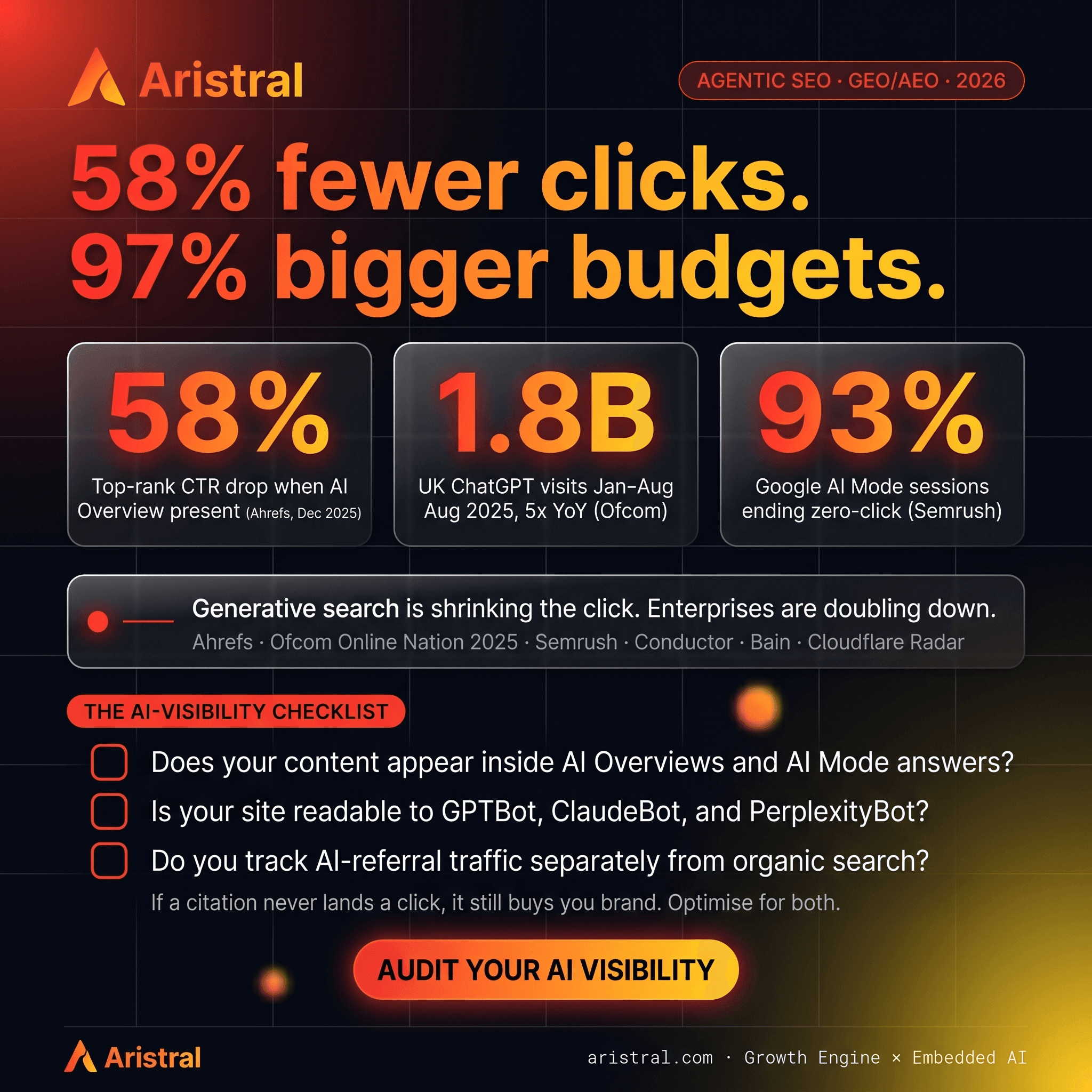
The presence of an AI Overview now correlates with a 58% lower clickthrough rate for the top-ranking page on Google, according to Ahrefs' December 2025 dataset: almost double the 34.5% drop the same team measured in April 2025 (Ahrefs, 2026). Bain & Company's consumer survey found 80% of consumers now rely on AI-written results for at least 40% of their searches, with around 60% of searches ending without a click (Bain & Company, 2025). Pew Research Center, tracking 68,879 real Google searches by 900 US adults, found people clicked a traditional result on just 8% of searches that produced an AI summary, against 15% when none was shown (Pew Research Center, 2025).
This article aggregates 55 verified statistics on agentic search, Generative Engine Optimisation (GEO) and Answer Engine Optimisation (AEO) from Pew Research Center, Ofcom, the British Chambers of Commerce, McKinsey, Gartner, Bain & Company, Cloudflare, Adobe Analytics, Conductor, Semrush, Ahrefs, Seer Interactive, BrightEdge, the Princeton/IIT Delhi GEO research team, HUMAN Security, Statcounter and Similarweb. Figures are predominantly drawn from 2025 and early 2026.
Key Takeaways
- 58%: drop in CTR for top-ranking pages when an AI Overview is present, December 2025 (Ahrefs).
- 61% organic / 68% paid. CTR decline on AI Overview queries in a 25.1 million-impression study (Seer Interactive, 2025).
- 80% of consumers rely on AI-written results for at least 40% of searches (Bain & Company, 2025).
- ~1.8 billion UK visits to ChatGPT in Jan–Aug 2025, up from 368 million in the same 2024 window (Ofcom Online Nation 2025).
- 54% of UK adults now use AI tools such as ChatGPT, Copilot or Gemini (Ofcom Online Nation 2025).
- 35% of UK SMEs actively use AI, up from 25% in 2024 (British Chambers of Commerce, 2025).
- 97% of digital leaders report a positive impact from AEO; 94% plan to increase investment in 2026 (Conductor State of AEO/GEO, 250+ enterprise leaders).
- 75 million US daily active users on Google AI Mode by December 2025, up 4x since the May 2025 launch (Google / Search Engine Journal, 2025).
- 93% of AI Mode sessions end without a click to any external site (Semrush AI Mode analysis, 2025).
- 62% of organisations already use or are experimenting with AI agents (McKinsey State of AI, 2025).
- 27.7% of organisations now have at least one user on ChatGPT Atlas; Atlas had 62x more enterprise downloads than Perplexity Comet within weeks of launch (Cyberhaven, 2025).
- Anthropic's ClaudeBot crawled 38,066 pages for every referral it sent in July 2025; OpenAI's GPTBot crawled 1,091 (Cloudflare Radar, 2025).
1. The Shift to Generative and Answer Engines
Generative answers are no longer a sidebar to search, they are increasingly the search interface. The data shows three movements happening in parallel: AI Overviews now sit on a fifth to a quarter of Google queries depending on the dataset, dedicated AI assistants (ChatGPT, Gemini, Perplexity, Claude) are absorbing a growing share of informational intent, and a new agentic browser layer is starting to act on the user's behalf rather than serve them links.
One stat to anchor the shift: 80% of consumers now rely on AI-written results for at least 40% of their searches, and around 60% of searches end without a click-through (Bain & Company, 2025).
| Metric | Value | Source |
|---|---|---|
| US consumers relying on AI-written results for ≥40% of searches | 80% | Bain & Company, 2025 |
| Searches now ending without a click | ~60% (Bain) / 58.5% (SparkToro 2024) | Bain, 2025 / SparkToro, 2024 |
| Google AI Overviews trigger rate on US queries, Pew sample, March 2025 | 18% of searches | Pew Research Center, 2025 |
| AIO prevalence, Semrush study, November 2025 (down from July peak of 24.61%) | 15.69% of queries | Semrush, 2025 |
| Google AI Mode US monthly active users, Dec 2025 (4x since May launch) | 75 million | Search Engine Journal / Google, 2025 |
| Average session length, AI Mode vs. AI Overviews | 49s vs. 21s | Semrush, 2025 |
| AI Mode sessions ending without a click | 93% | Semrush, 2025 |
| Gartner projection: traditional search engine volume decline by 2026 | -25% | Gartner, Feb 2024 |
2. AI Overviews and the Click-Through Rate Reset
Every published click-through-rate study reaches the same direction of travel: AI Overviews depress organic clicks. The magnitudes range from ~30% to ~80% depending on query type, position and measurement window, but no study has shown a positive effect at the top of the SERP. The pattern even bleeds into non-AIO queries, suggesting users are gradually clicking less everywhere.
The headline: position-one CTR dropped from 0.073 in March 2024 to 0.026 in March 2025 on Ahrefs' AIO sample, a 34.5% drop that widened to 58% by December 2025 (Ahrefs, 2025; Ahrefs, 2026).
| Metric | Value | Source |
|---|---|---|
| Top-ranking CTR drop when AIO is present, December 2025 data | -58% | Ahrefs, 2026 |
| Organic CTR change on AIO queries (3,119 informational queries, 25.1M impressions) | -61% (1.76% → 0.61%) | Seer Interactive / Search Engine Land, 2025 |
| Paid CTR change on the same AIO query set | -68% (19.7% → 6.34%) | Seer Interactive / Search Engine Land, 2025 |
| Pew: traditional-result click rate when AI summary present vs. absent | 8% vs. 15% | Pew Research Center, 2025 |
| Pew: session abandonment rate, AI-summary vs. non-AI-summary pages | 26% vs. 16% | Pew Research Center, 2025 |
| Pew: share of clicks on a link inside the AI summary itself | 1% of visits | Pew Research Center, 2025 |
| Ahrefs CTR drop at position 2 / position 3 on AIO queries | -50.8% / -46.4% | Ahrefs, 2026 |
| Lift for brands cited inside AI Overviews vs. non-cited brands (Seer) | +35% organic / +91% paid clicks | Seer Interactive / Search Engine Land, 2025 |
| Share of AI-search referrals coming from desktop devices | >90% | Search Engine Land, 2025 |
3. AI Search Adoption in the United Kingdom
The UK adoption picture is sharper than the global headlines suggest. Ofcom's Online Nation 2025 report shows AI is becoming a default rather than an experiment, and the British Chambers of Commerce confirms SMEs have crossed a one-third adoption threshold. Google still dominates UK web search, but the share moving to generative interfaces is rising fast from a small base. UK SMEs working on SEO services or local SEO are operating against this backdrop.
Anchor stat: ChatGPT generated ~1.8 billion UK web visits in the first eight months of 2025, against 368 million in the same window of 2024, close to a 5x increase year-on-year (Ofcom Online Nation 2025).
| Metric | Value | Source |
|---|---|---|
| UK adults using AI tools (ChatGPT, Copilot, Gemini) | 54% | Ofcom Online Nation 2025 |
| UK adults who say they see Google AI summaries "often" | 53% | Ofcom Online Nation 2025 |
| Google share of UK web searches that show AI overviews | ~30% of searches | Ofcom Online Nation 2025 |
| ChatGPT UK web visits, Jan–Aug 2025 vs. same period 2024 | ~1.8bn vs. 368m | Ofcom Online Nation 2025 |
| Google search engine share of the UK market, August 2025 | 93.35% | Statcounter, 2025 |
| UK SMEs actively using AI, 2025 vs. 2024 | 35% vs. 25% | British Chambers of Commerce, 2025 |
| UK SMEs in B2B services (finance, law, marketing) using AI | 46% | British Chambers of Commerce, 2025 |
| UK gov projection: additional GDP from AI adoption by 2030 | £400 billion | GOV.UK AI Opportunities Action Plan, 2025 |
4. GEO and AEO Investment in the Enterprise
GEO and AEO have moved from a sub-discipline of SEO to a standalone budget line. Conductor's two 2026 reports, one observational (3.3 billion sessions, 13,000+ domains), one survey-based (250+ enterprise digital leaders), give the clearest picture so far. The pattern: enterprises that have built AEO/GEO maturity are accelerating, while late movers face a widening gap. Marketing teams investing in this area typically engage a digital marketing agency or build the function in-house.
Anchor stat: 97% of digital leaders report a positive impact from AEO in 2025, and 94% plan to increase AEO/GEO investment in 2026 (Conductor, 2026).
| Metric | Value | Source |
|---|---|---|
| Digital leaders reporting positive impact from AEO in 2025 | 97% | Conductor State of AEO/GEO, 2026 |
| Enterprises planning to increase AEO/GEO investment in 2026 | 94% | Conductor State of AEO/GEO, 2026 |
| Average share of total digital marketing budget allocated to AEO/GEO | 12% | Conductor State of AEO/GEO, 2026 |
| High-maturity AEO/GEO orgs vs. low-maturity peers, likelihood to significantly increase spend | 3x more likely | Conductor State of AEO/GEO, 2026 |
| AI answers appearing in Google queries (Conductor sample of 3.3bn sessions) | ~25.11% | Conductor / BusinessWire, 2025 |
| Share of overall website traffic now arriving via AI referrals | ~1% | Conductor / BusinessWire, 2025 |
| Brands without a dedicated GEO strategy | 47% | Marketing LTB roundup, 2025 |
| Marketers currently tracking AI visibility and traffic | 22% | MarTech, 2025 |
5. Agentic Agents and Autonomous SEO Workflows
The agentic layer of SEO is splitting into two product categories: AI agents that operate inside marketing teams (researching, drafting, refreshing, monitoring rankings autonomously), and agentic browsers (ChatGPT Atlas, Perplexity Comet, Chrome with Gemini) that operate inside the user's browser to complete tasks. Adoption of both is moving faster than most teams' consultation and governance frameworks can cover.
Anchor stat: 62% of organisations already use or experiment with AI agents, and nearly a quarter are scaling them across at least one function (McKinsey State of AI, 2025).
| Metric | Value | Source |
|---|---|---|
| Organisations using or experimenting with AI agents | 62% | McKinsey State of AI, 2025 |
| Organisations actively scaling an agentic AI system in at least one function | 23% | McKinsey State of AI, 2025 |
| Gartner projection: enterprise applications embedding task-specific AI agents by end 2026 | 40% (up from <5% in 2025) | Gartner coverage, 2025 |
| McKinsey estimate of marketing activities ultimately powered by agentic AI | Up to two-thirds | McKinsey, 2025 |
| Acceleration in campaign brainstorm-to-execution from agentic workflows | 10–15x | McKinsey, 2025 |
| Organisations with at least one user on ChatGPT Atlas, weeks after launch | 27.7% | Cyberhaven, 2025 |
| Enterprise download ratio, ChatGPT Atlas vs. Perplexity Comet | 62:1 | Cyberhaven, 2025 |
| Increase in requests from AI agents and agentic browsers since July 2025 | +6,900% | HUMAN Security, 2025 |
6. AI Crawlers, Citations and the Visibility Layer
The infrastructure beneath generative search has its own data layer, and it is heavily skewed toward training rather than referral. Cloudflare's network-wide measurement shows that for every page Anthropic's crawler fetched in July 2025, only one in tens of thousands resulted in a referral click back to the source. This is one of the central tensions of GEO/AEO: the cost of being indexed by AI is high, the reward in direct traffic is small, and the reward in citation share is the new visibility currency. Schema, crawlability, and Core Web Vitals, all addressed at the web development layer, sit at the centre of how AI systems decide what to surface.
Anchor stat: Anthropic's ClaudeBot crawled 38,066 pages for every referral it sent in July 2025; OpenAI's GPTBot crawled 1,091 pages per referral; Google's bots crawled 5.4 pages per referral (Cloudflare Radar, 2025).
| Metric | Value | Source |
|---|---|---|
| Share of AI crawling done for model training (12-month average to July 2025) | 80% | Cloudflare Radar, 2025 |
| Share of AI crawling done for search vs. user-triggered actions | 18% / 2% | Cloudflare Radar, 2025 |
| GPTBot share of AI-only bot crawling, Jul 2024 → Jul 2025 | 11.9% → 28.1% | Cloudflare Radar, 2025 |
| ClaudeBot share of AI-only bot crawling, Jul 2024 → Jul 2025 | 15.0% → 23.3% | Cloudflare Radar, 2025 |
| Pew: share of AI summaries citing three or more sources | 88% | Pew Research Center, 2025 |
| Visibility lift from adding statistics to source content (Princeton GEO study) | +41% | Aggarwal et al., KDD 2024 |
| Visibility lift from quotation addition (same study) | +28% | Aggarwal et al., KDD 2024 |
| Visibility lift for lower-ranked content when external sources are cited | +115% | Aggarwal et al., KDD 2024 |
7. Industry and Vertical Patterns
AI Overview presence is not evenly distributed across industries. Healthcare, education and B2B tech now see AI summaries on the majority of their queries, while finance is notable for citing pages that rarely appear in the top organic results. E-commerce shows the opposite shape, relatively low AIO presence in some samples, but the strongest direct-revenue impact from generative-AI referrals, particularly during the 2025 holiday season.
Anchor stat: 88% of healthcare queries triggered an AI Overview by December 2025, up from 72% a year earlier; education jumped from 18% to 83% in the same window (BrightEdge / ALM Corp, 2026).
| Metric | Value | Source |
|---|---|---|
| Healthcare queries triggering an AI Overview, December 2025 | 88% | BrightEdge / ALM Corp, 2026 |
| Education queries triggering an AI Overview, May → December 2025 | 18% → 83% | BrightEdge / ALM Corp, 2026 |
| B2B tech queries triggering an AI Overview, year-on-year | 36% → 82% | BrightEdge / ALM Corp, 2026 |
| Restaurant-category queries triggering an AI Overview, year-on-year | 10% → 78% | BrightEdge / ALM Corp, 2026 |
| Finance: overlap between AI Overview citations and the top-10 organic results | 11% | BrightEdge, 2025 |
| AI-driven traffic to US retail websites, 2025 holiday season YoY | +693.4% | Adobe Analytics, 2026 |
| AI-driven revenue per visit (RPV) to US retail, 2025 holiday season YTD | +254% | Adobe Analytics, 2026 |
| Time on retailer site for AI-referred shoppers vs. other channels | +45% | Adobe Analytics, 2026 |
Methodology and Sources
This article prioritised primary sources and named research reports over second-hand summaries. Where a stat is widely repeated on aggregator sites, the underlying paper, report or dataset has been verified and linked directly. Where two reputable sources reach different figures (for example, the various AI Overview trigger-rate measurements), each is reported with the source, time period and sample so readers can judge for themselves rather than averaging. Stats marked "most recent available data" indicate that a newer measurement is not yet published at the time of writing.
- Pew Research Center (2025): Google users are less likely to click on links when an AI summary appears in the results
- Ofcom (2025): From apps to AI search: how the UK goes online in 2025
- British Chambers of Commerce (2025): Turning Point as More SMEs Unlock AI
- Cloudflare Radar (2025): The crawl-to-click gap: AI bots, training, and referrals
- McKinsey & Company (2025): The state of AI in 2025
- McKinsey & Company (2025): Reinventing marketing workflows with agentic AI
- Gartner (2024): Search engine volume will drop 25% by 2026
- Bain & Company (2025): Consumer reliance on AI search results signals a new era of marketing
- Adobe (2026): Holiday Shopping Season Drove a Record $257.8 Billion Online
- Conductor (2026): State of AEO/GEO Report
- Semrush (2025): AI Overviews study, 10M+ keywords
- Semrush (2025): Google AI Mode's early adoption and SEO impact
- Ahrefs (2026): Update: AI Overviews reduce clicks by 58%
- Seer Interactive / Search Engine Land (2025): Google AI Overviews drive drop in organic and paid CTR
- BrightEdge (2025): AI search 2025: three key insights
- Aggarwal et al. (2024): GEO: Generative Engine Optimization (KDD 2024)
- HUMAN Security (2025): ChatGPT Atlas vs. Perplexity Comet
- Cyberhaven (2025): Browser agent security risk: ChatGPT Atlas report
- Statcounter (2025): Search engine market share
- GOV.UK (2025): AI Opportunities Action Plan
- SparkToro (2024): Zero-Click Search Study
Methodology
Every Aristral article is researched and written by the practitioners who build the systems they describe. We verify each statistic against its primary source at the time of writing, link out to that source, and date the claim. SERP and keyword figures are pulled from live commercial APIs rather than estimated. We don't accept affiliate revenue or sponsorship from any tool or vendor named in our content. Spotted something out of date? Email admin@aristral.com and we'll correct it.
About the author
Taha Bilal
Co-founder, Aristral
Taha Bilal is a co-founder of Aristral, a UK AI automation and SEO agency based in Clifton, Bristol. He has been running SEO and digital-growth campaigns for SMB and SaaS clients since 2018, and now leads Aristral's combined SEO + GEO programmes for service businesses across the UK and US. Corrections and source requests: admin@aristral.com.
LinkedIn →Filed under: SEO