SEO
Why Most "AI SEO Audits" Miss the Structural Issues That Actually Matter
Most AI SEO audits flag technical errors but miss topical authority gaps, entity deficits, and cannibalisation. Here's what a structural AI SEO audit actually checks, and the seven-step framework we run once the technical scan comes back clean.
Key takeaways
- Technical audits and structural audits are different jobs. A technical AI SEO audit checks whether pages can be crawled and rendered. A structural audit checks whether they deserve to rank.
- Tools surface what they can automate cheaply. Crawl errors are easy to score; topical authority and intent overlap are not, so most AI SEO audits skip them.
- Four structural issues do most of the damage: topical authority gaps, entity coverage deficits, keyword cannibalisation, and SERP feature displacement.
- AI Overviews change the question. In our own SERP monitoring, AI Overviews fired on roughly 80% of US and 85% of UK queries in this category, so "are we cited?" now matters as much as "where do we rank?".
- A real structural audit needs both agents and judgement. Agents gather and cluster the signals at scale; a human decides what they mean.
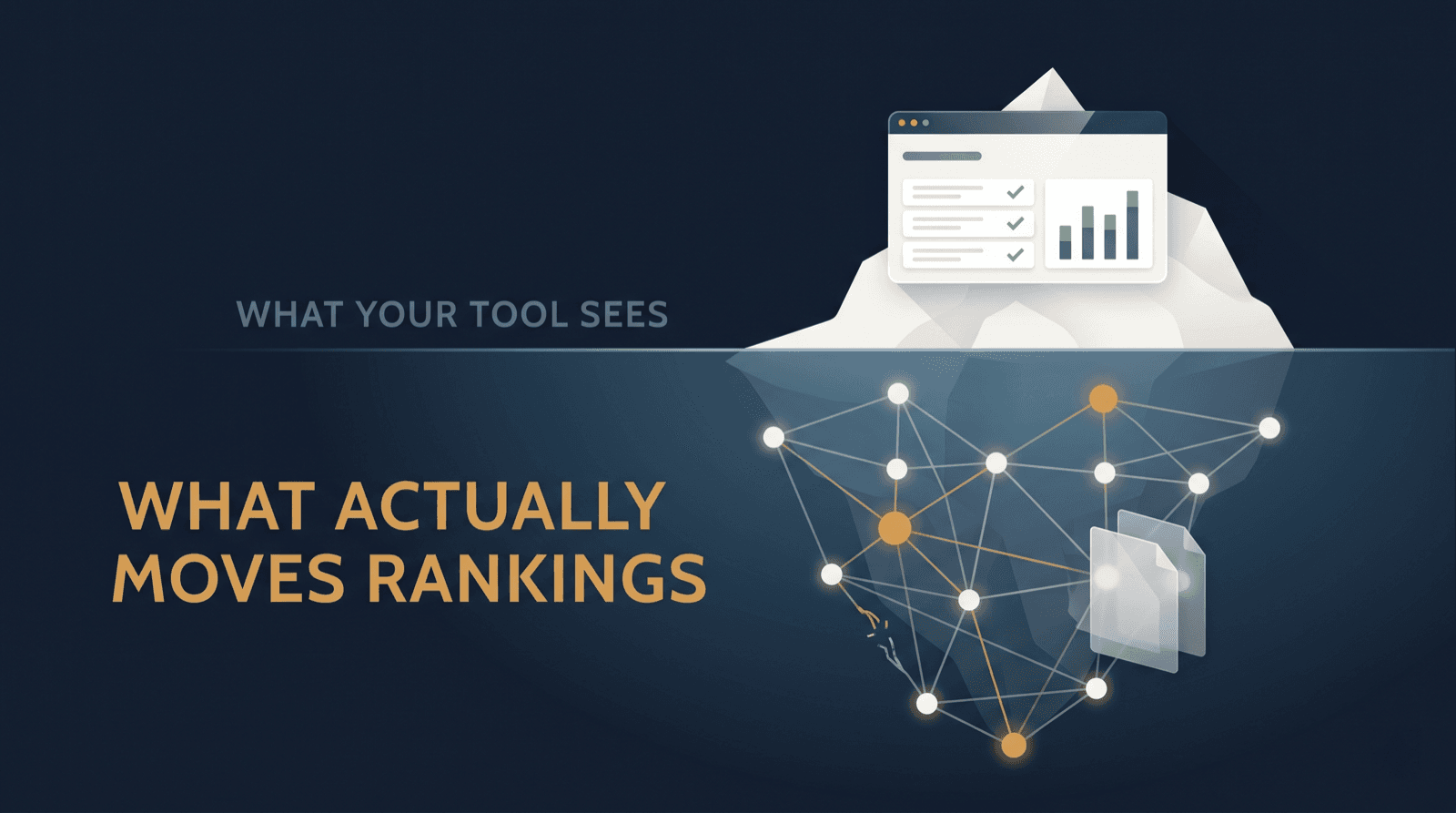
Run a website through almost any AI SEO audit tool and you get a tidy list back: broken links, missing meta descriptions, slow images, a handful of 4xx errors. All real. All worth fixing. And almost none of it explains why the site isn't ranking. The problems that actually decide rankings are different: shallow topical coverage, missing entities, pages quietly competing with one another. None of them surface reliably in an automated audit, because they aren't the kind of thing a crawler can score with a red or green tick.
This piece is about that gap. Not the technical layer your tools already handle well, but the structural layer underneath it that decides whether you appear in Google's organic results and in AI answers at all.
What an AI SEO audit actually is
Start with the term, because vendors use it loosely. Most "AI SEO audit" tools are classic site crawlers with a language model bolted on to write the recommendations in plainer English. Useful, but the audit itself is still a technical scan.
The problem is that the word "audit" quietly narrows to mean "crawl". A crawl tells you whether a page can rank: is it reachable, indexable, fast, valid. It says very little about whether it should. That second question is structural, and it is where most audits go quiet.
Why most AI SEO audits stop at the technical layer
There is a simple reason audits cluster around technical issues: those issues are cheap to detect and easy to score. A missing canonical tag is binary. A broken link is binary. A model can flag a thousand of them in seconds and rank them by severity without ever understanding the site's topic.
Structural issues don't score that way. Whether a page has enough topical depth to compete is a relative judgement against a live SERP, not a fixed rule. So the economics of tooling push audits toward the checklist and away from the strategy. It isn't a conspiracy; it's what is automatable at low cost.
The table below is the line most reports never draw clearly.
| Layer | What automated AI SEO audits check well | What they routinely miss |
|---|---|---|
| Crawl and index | Status codes, robots rules, sitemaps, canonicals, indexation | Whether the indexed page deserves the position it's chasing |
| On-page | Titles, meta descriptions, heading tags, alt text, word count | Entity completeness vs the entities the topic requires |
| Performance | Core Web Vitals, render-blocking resources, image weight | Whether speed is even the constraint on ranking |
| Architecture | Orphan pages, click depth, internal link counts | Whether internal equity flows to the pages that need authority |
| Intent | Keyword presence and density | Two pages chasing the same intent and splitting the signal |
Read the right-hand column again. Every item there is a structural question, and every one of them moves rankings more than a missing alt attribute ever will.

The four structural issues AI SEO audits miss
In practice, four problems account for most of the damage we find when a technically "clean" site still won't rank. None of the four shows up reliably in a standard crawl report.
1. Topical authority gaps
A crawler counts your pages. It cannot tell you that you have written about "symptoms" five times and never once about "diagnosis", "cost", or "aftercare". Those are the sub-topics a searcher (and an AI Overview) expects a genuine authority to cover. Topical gaps are visible only when you compare your coverage against what currently ranks and what AI answers actually cite, not against an internal checklist. This is the difference between keyword targeting and earning a topic, and it is the single most common structural miss we see.
2. Entity coverage deficits
Generative engines assemble answers from entities and the relationships between them, not from keyword strings. The foundational Generative Engine Optimization research (Aggarwal et al., 2023) found that adding cited sources, statistics, and clear entities lifted a page's visibility inside AI answers far more than keyword tuning did. A word-count check passes a thin page; an entity check fails it, because the page never names the things the topic is made of. Almost no off-the-shelf AI SEO audit measures this.
3. Keyword cannibalisation
Tools that flag "duplicate content" only catch near-identical text. Cannibalisation is subtler: two genuinely different articles that happen to answer the same question. Detecting it means clustering pages by intent (ideally by comparing the live SERP each page targets) rather than by string similarity. We treat an embedding-similarity pass against the live sitemap as table stakes before any new page is even briefed, precisely because a crawler will never raise the flag.
4. SERP feature displacement
This is the newest miss and the most expensive. You can hold position three and still lose traffic because an AI Overview now sits where the eyes go first. In a live pull across 55 SERPs in this category on 20 May 2026, we recorded AI Overviews firing on roughly 80% of US queries and 85% of UK queries. The sources cited inside them were led by Reddit (24 citations) and YouTube (14), not by SEO tool vendors. A ranking-only audit reports "you're fine, position three". A structural audit reports "you rank, but a feature is eating the click, and the page isn't built to be the source it quotes." That shift is what generative engine optimisation is about, and it doesn't appear in a crawl at all. The industry has spent 2026 catching up to it (WordStream; Semrush).
A structural AI SEO audit framework
Here is the seven-step sequence we run after the technical scan comes back clean. It is the part most audits never reach, and each step answers a structural question a crawler can't.
- Map the topic, not the page. Define the full entity and sub-topic set the subject requires before you look at a single URL.
- Score coverage against the SERP. Compare your depth to what ranks and what AI answers cite today, not to a fixed word count.
- Cluster pages by intent. Group URLs by the query intent they target to expose cannibalisation a duplicate-content checker can't see.
- Audit entities per page. Check each page against the entities and citations present on top-ranked and AI-cited sources.
- Check SERP feature exposure. For every priority query, record whether an AI Overview or snippet is displacing the click.
- Trace internal equity. Confirm links actually flow to the pages you need to win, not just that no page is orphaned.
- Verify with retrieval, not memory. Confirm every claimed fix and finding against live data, never against a model's recollection.
The mapping below pairs each structural issue with the signal to look for and why a tool tends to miss it.
| Structural issue | Signal to look for | Why most tools miss it |
|---|---|---|
| Topical authority gap | Sub-topics that rank for rivals but are absent on your site | Requires a live SERP comparison, not an internal rule |
| Entity coverage deficit | Missing people, products, places, or concepts the topic needs | Word count passes; entity completeness is never measured |
| Keyword cannibalisation | Two distinct pages targeting one search intent | Duplicate-checkers only match near-identical text |
| SERP feature displacement | Rank held, clicks falling, AI Overview present | Rank trackers report position, not the feature above it |
Why a structural audit needs human judgement plus agent tooling
None of this is an argument against automation. It's an argument for the right automation. The structural layer is exactly where multi-step agentic SEO earns its place: agents that crawl, pull live SERP and AI Overview data, cluster pages by intent, and compare entity coverage at a scale no person can match by hand. The category was named in the industry press in early 2026 for good reason (Search Engine Land; Backlinko), and a structural audit is one of its clearest use cases.
The judgement, though, stays human. An agent can tell you a page is missing eight entities; a person decides whether adding them serves the reader or pads the page. An agent can flag two URLs competing for one intent; a person decides which to keep, which to merge, and which to redirect. And every structural finding has to be verified against live data rather than a model's memory. AI Overviews themselves are only about 90% factually accurate, which means roughly one claim in ten is wrong unless a retrieval check catches it.
That last point is not theoretical. After the March and August 2025 spam updates, sites that had scaled thin, structurally weak pages were hit hardest. Documented cases include programmatic page sets losing the large majority of their organic traffic, with one large set almost entirely deindexed within months (SEO Sherpa). A technical audit would have called those pages clean. A structural audit would have called them what they were.
Worth saying plainly: schema and technical hygiene still matter. Validate structured data in the Schema Markup Validator before you ship, because a missing datePublished alone can keep an otherwise citable page out of AI Overviews. The point isn't that the technical layer is unimportant. It's that passing it is the floor, not the finish line.
A quick structural AI SEO audit checklist
If you only have an afternoon, run these eight checks. They catch most of what an automated AI SEO audit leaves on the table.
- List the sub-topics that rank for competitors but are missing from your site.
- Pick five priority pages and name the entities each one fails to mention.
- Group your URLs by search intent and look for two pages chasing one query.
- For each money query, check whether an AI Overview or snippet sits above organic.
- Confirm your strongest internal links point at the pages you most need to rank.
- Check that every page has a visible, accurate published and updated date.
- Read your top page aloud. Would an AI engine quote a clean sentence from it?
- Verify one "fix" your tool recommended against live SERP data before acting.
If you would rather not run this by hand each month, this is the work we automate as AI SEO audit automation, and it sits inside our wider AI SEO services. Either way, the principle holds: audit the structure, not just the surface.
FAQ
What is an AI SEO audit?
An AI SEO audit is an automated review of a website's technical, content, and authority signals, run with AI tooling, to find what is stopping its pages from ranking in classic search and in AI answers. Most tools cover the technical layer well but miss structural issues such as topical authority gaps and keyword cannibalisation.
Can ChatGPT do an SEO audit?
ChatGPT can interpret SEO data and explain it, but on its own it cannot crawl your site or pull live SERP and AI Overview data, and it will sometimes state findings that aren't true. It is useful as a reasoning layer over real data from a crawler and a SERP API, not as the audit itself. Always verify its output against live sources.
How is a structural SEO audit different from a technical SEO audit?
A technical audit checks whether a page can be crawled, indexed, and rendered. A structural audit checks whether it deserves to rank, by examining topical authority, entity coverage, intent overlap between pages, and whether SERP features are displacing the click. A page can pass the technical audit completely and still fail the structural one.
Do AI SEO audit tools replace SEO specialists?
No. Tools and agents gather and cluster signals at a scale no person can match, but deciding what those signals mean (what to merge, what to cut, what serves the reader) is judgement work. The reliable model is agents for gathering, humans for deciding, and a retrieval check before anything is treated as fact.
How often should you run an AI SEO audit?
Run a technical scan monthly and after any large change or migration. Run the deeper structural audit quarterly, and immediately after a confirmed Google core or spam update, since those updates tend to hit structurally weak pages hardest even when they are technically clean.
Is there a downside to using AI for SEO audits?
The main risk is misplaced trust. AI can produce confident, wrong findings and tends to over-weight the issues it can score easily, the technical ones. Used with live data and human review it speeds the work up considerably; used as an unverified oracle it produces tidy reports that miss the issues that actually matter.
Further reading
Frequently asked questions
- What is an AI SEO audit?
- An AI SEO audit is an automated review of a website's technical, content, and authority signals, run with AI tooling, to find what is stopping its pages from ranking in classic search and in AI answers. Most tools cover the technical layer well but miss structural issues such as topical authority gaps and keyword cannibalisation.
- Can ChatGPT do an SEO audit?
- ChatGPT can interpret SEO data and explain it, but on its own it cannot crawl your site or pull live SERP and AI Overview data, and it will sometimes state findings that aren't true. It is useful as a reasoning layer over real data from a crawler and a SERP API, not as the audit itself. Always verify its output against live sources.
- How is a structural SEO audit different from a technical SEO audit?
- A technical audit checks whether a page can be crawled, indexed, and rendered. A structural audit checks whether it deserves to rank, by examining topical authority, entity coverage, intent overlap between pages, and whether SERP features are displacing the click. A page can pass the technical audit completely and still fail the structural one.
- Do AI SEO audit tools replace SEO specialists?
- No. Tools and agents gather and cluster signals at a scale no person can match, but deciding what those signals mean (what to merge, what to cut, what serves the reader) is judgement work. The reliable model is agents for gathering, humans for deciding, and a retrieval check before anything is treated as fact.
- How often should you run an AI SEO audit?
- Run a technical scan monthly and after any large change or migration. Run the deeper structural audit quarterly, and immediately after a confirmed Google core or spam update, since those updates tend to hit structurally weak pages hardest even when they are technically clean.
- Is there a downside to using AI for SEO audits?
- The main risk is misplaced trust. AI can produce confident, wrong findings and tends to over-weight the issues it can score easily, the technical ones. Used with live data and human review it speeds the work up considerably; used as an unverified oracle it produces tidy reports that miss the issues that actually matter.
Methodology
How we put this together. The SERP-feature and AI Overview figures cited here come from Aristral's own live monitoring of 55 SERPs in the AI-SEO category on 20 May 2026, alongside structural audits we run for service-business clients. External claims are linked to their sources inline and were accurate as of the last-updated date. Aristral provides AI SEO services, including audit automation, so treat this as practitioner guidance from an interested party: the framework stands on its own, and you can apply it with any toolset. We don't make guaranteed-ranking claims, and we've flagged where AI output should be verified rather than trusted. Written by Taha Bilal, who founded Aristral in 2024 and runs its SEO, GEO, and local-search delivery himself. Questions or corrections: admin@aristral.com.
About the author
Taha Bilal
Co-founder, Aristral
Taha Bilal is a co-founder of Aristral, a UK AI automation and SEO agency based in Clifton, Bristol. He has been running SEO and digital-growth campaigns for SMB and SaaS clients since 2018, and now leads Aristral's combined SEO + GEO programmes for service businesses across the UK and US. Corrections and source requests: admin@aristral.com.
LinkedIn →