SEO
The MENA SEO Landscape in 2026: What's Different from the UK, and Why It Matters for Agencies
MENA SEO is not UK SEO in Arabic. A practitioner breakdown of the Arabic NLP gap, AI Overview maturity, the TikTok and Snapchat search shift, and the UAE-Saudi-Egypt split, and what each one means for agencies scoping regional work.
Key takeaways
- MENA SEO is a different market, not a translation job. Arabic morphology, mixed-language behaviour, and a younger, social-first audience all change the playbook.
- Most AI SEO tools are English-first. Their Arabic output quality drops noticeably, which is precisely where a careful operator beats the toolchain.
- The UAE, Saudi Arabia, and Egypt are three markets, not one region. Language mix, regulation, and platform habits differ sharply between them.
- GEO in Arabic is earlier-stage than in English. The AI Overview citation game is still being defined, which is why early movers win.
- For agencies, MENA is largely uncontested. Few competitors offer real Arabic capability, regional case studies, or Gulf-specific local SEO.
MENA SEO means winning search and AI-answer visibility across the Middle East and North Africa. It behaves differently from the UK in three ways that matter: language, the platforms people actually search on, and how mature the answer engines are. Run a UK agency and treat MENA as "UK SEO, translated", and you will price the work wrong and publish Arabic content that under-performs. Here is what actually changes.
What "MENA SEO" actually means in 2026
MENA SEO is search optimisation for the Middle East and North Africa, where the goal is visibility in both classic Google results and AI answers, in Arabic as well as English. The region spans high-income Gulf markets (UAE, Saudi Arabia, Qatar, Kuwait) and large Arabic-language populations (Egypt, Morocco, Iraq), and search behaviour is not uniform across them.
MENA SEO is not UK SEO rendered into Arabic. It is a different search market with its own surfaces, its own languages, and answer engines that are years behind the English ones.
The category language is the same as everywhere else: traditional SEO, AI-assisted SEO, generative engine optimisation (GEO), answer engine optimisation (AEO), and agentic SEO. What differs is the substrate those disciplines run on. The same FAQ schema and definition-first passages that earn an AI Overview citation in English do not automatically transfer, because the Arabic answer-engine surface is younger and the content competing for it is thinner.
Five structural differences between MENA and UK search
The differences that matter operationally are structural, not cosmetic. These five change how you brief, write, and measure.
1. Language is bilingual and morphologically harder
UK audiences search in one language. Gulf audiences switch between English and Arabic, often inside a single session, and Arabic itself is morphologically rich: root-and-pattern word formation, optional diacritics, and right-to-left rendering. That breaks naive keyword matching and degrades machine translation. A page that ranks for an English query in Dubai can be invisible for its Arabic equivalent, and the reverse happens just as often.
2. The dominant search surface skews social and video
In the Gulf, search does not always start on Google. Among younger users, product and local discovery frequently begins on TikTok, YouTube, or Snapchat, all of which have unusually high adoption in Gulf markets. That makes video and short-form content a first-class SEO surface in MENA rather than an afterthought bolted onto a blog programme.
In the Gulf, plenty of under-35s start a search on TikTok, YouTube, or Snapchat before they ever open Google.
3. AI Overview maturity lags English
Google's AI Overviews and the wider answer-engine layer matured first in English. Across our own May 2026 DataForSEO pull of 55 English-language SERPs in the AI-SEO niche, AI Overviews fired on roughly 80% of US and 85% of UK queries. Arabic-language coverage is later and more uneven. I have not measured Arabic AIO trigger rates with the same rigour, so treat that as observation. The direction, though, is clear, and it favours early movers.
4. Regulation and YMYL thresholds are stricter in places
Saudi Arabia and the UAE apply content, advertising, and licensing rules that shape what you can publish, particularly in finance, health, and regulated professional services. The Your-Money-Your-Life (YMYL) caution that already governs UK legal and medical content applies in the Gulf with an extra regulatory layer on top. That is a content-governance problem, not only an SEO one.
5. The market is fragmented by country and dialect
"MENA" is a convenience label. Modern Standard Arabic is the written default, but spoken and increasingly written dialects (Gulf, Egyptian, Levantine) diverge enough to affect tone, trust, and conversion. A single regional page rarely satisfies UAE, Saudi, and Egyptian intent at once.
Why most AI SEO tools underperform in Arabic
Most AI SEO and content tools are English-first, and their Arabic output quality drops the moment you leave English. This is the single most exploitable gap in the MENA market.
Most AI writing tools are English-first; Arabic is where their quality quietly collapses.
The cause is structural. Large language models are trained on disproportionately English corpora, so tokenisation and generation are weaker in Arabic. Arabic's morphology means a single root spawns many surface forms, which inflates token counts and confuses keyword-density logic built for English. Dialect is the second trap: a model tuned on Modern Standard Arabic can produce text that reads as stiff or foreign to a Gulf or Egyptian reader.
This is not theoretical. Documented user complaints about leading content tools cite "poor quality for non-English content", a recurring criticism of tools sold as all-purpose. For an agency, the lesson is plain. In Arabic, the human editorial layer carries more weight than it does in English, and a tool-only workflow that passes in London will embarrass you in Riyadh.
| Dimension | UK | MENA (Gulf-weighted) |
|---|---|---|
| Primary language | English | Arabic and English code-switching |
| Dominant discovery surface | Google, then YouTube | Google, TikTok, YouTube, Snapchat (younger skew) |
| AI Overview maturity | High (about 85% trigger in our niche) | Later-stage, uneven (observational) |
| AI tool output quality | Strong in English | Noticeably weaker in Arabic |
| Regulatory load | ASA and standard YMYL | Country-specific content and licensing rules |
| Market shape | Single national market | Several distinct national markets and dialects |
| Competitor depth (Arabic AI SEO) | Crowded | Largely uncontested |
UAE vs Saudi Arabia vs Egypt: three markets, not one
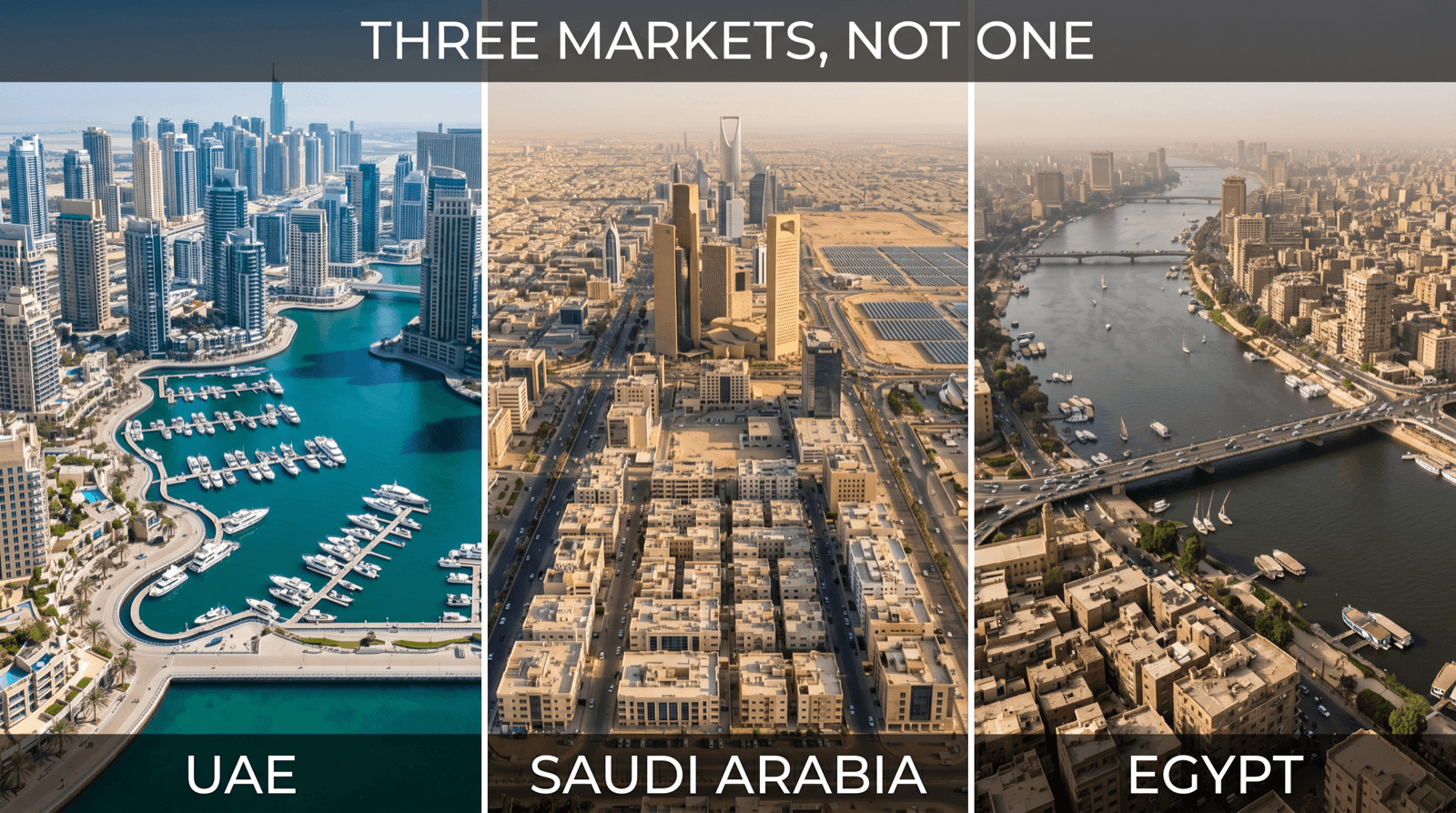
Treat the UAE, Saudi Arabia, and Egypt as three markets, not one region. They differ in language mix, buying power, regulation, and how crowded the local agency field is.
- UAE (Dubai, Abu Dhabi). The most English-heavy and expatriate-driven market in the region. Bilingual content earns its keep here, and the local agency field is crowded with directory-style listings. Even so, few competitors pair real Arabic capability with disciplined AI-search work.
- Saudi Arabia (Riyadh, Jeddah). Larger, more Arabic-dominant, and moving fast under national digital-investment programmes. Arabic-first content and local trust signals matter more than in the UAE, and the regulatory environment is stricter.
- Egypt. The largest Arabic-speaking population in the region, with a distinct dialect and lower commercial CPCs. Egyptian intent rarely maps cleanly onto Gulf phrasing, so a Gulf-tuned page under-serves it.
The practical implication: a single "MENA page" is usually the wrong unit. Country-level pages with the right language default, the right dialect register, and country-specific hreflang (ar-AE, ar-SA, ar-EG, plus en-AE where bilingual) will out-perform one regional catch-all.
GEO and AI Overviews in MENA: what we can and can't verify
GEO, generative engine optimisation, is the practice of structuring content so AI answer engines cite it. The term comes from a 2023 paper by researchers at Princeton, Georgia Tech, and the Allen Institute for AI (Aggarwal et al., "GEO: Generative Engine Optimization"), and it has since been adopted and stretched across the SEO industry. The discipline travels to MENA. The evidence base does not yet.
GEO in Arabic is earlier-stage than GEO in English. The citation game is still being defined, which is why early movers win.
Here is the honest version. In English-language results, our measurement showed Reddit and YouTube as the dominant AI Overview citation sources, with established SEO publications behind them. I have not run an equivalent verified Arabic pull, so any claim about which sources Arabic answer engines prefer is directional, not measured. What I can say with confidence is structural. The content patterns that earn citations (sub-60-word definitions, answer-first topic sentences, FAQ and HowTo schema, clear sourcing) are engine behaviours, not language quirks, and they are reasonable to apply in Arabic now while the field is open.
The opportunity is asymmetry. In English, you compete with Reddit threads and a decade of optimised content for a single AIO citation. In Arabic, far less content is structured for answer engines at all. The bar to be the citable source is lower today than it will be in twelve months.
What this means for agencies
For a UK or US agency, MENA is one of the few large, under-served markets left in AI search. The reason is not demand. It is capability. Most tool-led competitors cannot produce credible Arabic, most directories have no regional case studies, and almost none combine Arabic content with Gulf-specific local SEO and answer-engine work.
MENA is not under-served because demand is low. It is under-served because credible Arabic capability is rare.
That said, do not treat MENA as a bolt-on. The four ways agencies get it wrong are familiar: shipping machine-translated Arabic and calling it localisation; building one regional page instead of country pages; ignoring the social-video surface; and underestimating the regulatory layer in Saudi Arabia and the UAE. Each is avoidable, and each is a reason a client switches away from an incumbent who got it wrong.
If you are scoping the work, the upstream decisions matter more than tool choice: how the SEO system is run and how GEO is approached. For the commercial specifics of how we deliver this, see our SEO services page. This article is the landscape, not the service.
A MENA-ready content checklist
Use this as a pre-flight before publishing anything aimed at a MENA market. It is the same discipline we apply internally, condensed.
- Pick the country, then the language. Decide UAE, Saudi, or Egypt first; the language default follows from that.
- Have a native speaker edit the Arabic in the right dialect register. Never ship tool-only Arabic.
- Set correct hreflang and inLanguage tags (ar-AE, ar-SA, ar-EG, en-AE) so the right page serves the right market.
- Structure for answer engines. Lead with a sub-60-word definition, answer-first topic sentences, and FAQ schema mirrored verbatim on the page.
- Plan the social-video surface. Map at least one TikTok, YouTube, or Snapchat asset to each priority topic for Gulf audiences.
- Run the regulatory check. Confirm finance, health, and professional-services claims meet country-specific rules before publishing.
- Localise trust signals. A local address, local reviews, and Arabic business-profile content beat a translated UK page on local intent.
FAQ
Is MENA SEO just UK SEO translated into Arabic?
No. MENA SEO differs from UK SEO in language behaviour (Arabic and English code-switching), dominant surfaces (a strong TikTok, YouTube, and Snapchat skew among younger users), answer-engine maturity, and regulation. Translation alone produces content that under-performs in Arabic.
Why do AI SEO tools struggle with Arabic?
Because most large language models are trained on predominantly English data, and Arabic is morphologically richer, right-to-left, and split across dialects. The result is weaker tokenisation and output that can read as stiff or foreign. In Arabic, the human editorial layer carries more weight than it does in English.
Do AI Overviews work the same in MENA as in the UK?
Not yet. AI Overviews matured first in English; Arabic coverage is later and more uneven. We have measured high AI Overview trigger rates on English-language SERPs (about 80% US, 85% UK in our niche) but have not run an equivalent verified Arabic pull, so we treat Arabic behaviour as observational.
Should I build one MENA page or country pages?
Country pages, in almost every case. The UAE, Saudi Arabia, and Egypt differ in language mix, dialect, regulation, and competition. Country-level pages with correct hreflang and the right dialect register out-perform a single regional catch-all.
Why is MENA a good opportunity for agencies right now?
Because credible Arabic capability is rare. Most tool-led competitors cannot produce strong Arabic, few have regional case studies, and almost none pair Arabic content with Gulf-specific local SEO and answer-engine work. The market is large and largely uncontested for operators who get the basics right.
Further reading
Frequently asked questions
- Is MENA SEO just UK SEO translated into Arabic?
- No. MENA SEO differs from UK SEO in language behaviour (Arabic and English code-switching), dominant surfaces (a strong TikTok, YouTube, and Snapchat skew among younger users), answer-engine maturity, and regulation. Translation alone produces content that under-performs in Arabic.
- Why do AI SEO tools struggle with Arabic?
- Because most large language models are trained on predominantly English data, and Arabic is morphologically richer, right-to-left, and split across dialects. The result is weaker tokenisation and output that can read as stiff or foreign. In Arabic, the human editorial layer carries more weight than it does in English.
- Do AI Overviews work the same in MENA as in the UK?
- Not yet. AI Overviews matured first in English; Arabic coverage is later and more uneven. We have measured high AI Overview trigger rates on English-language SERPs (about 80% US, 85% UK in our niche) but have not run an equivalent verified Arabic pull, so we treat Arabic behaviour as observational.
- Should I build one MENA page or country pages?
- Country pages, in almost every case. The UAE, Saudi Arabia, and Egypt differ in language mix, dialect, regulation, and competition. Country-level pages with correct hreflang and the right dialect register out-perform a single regional catch-all.
- Why is MENA a good opportunity for agencies right now?
- Because credible Arabic capability is rare. Most tool-led competitors cannot produce strong Arabic, few have regional case studies, and almost none pair Arabic content with Gulf-specific local SEO and answer-engine work. The market is large and largely uncontested for operators who get the basics right.
Methodology
How we put this together. This analysis combines first-party SERP data with structural reasoning about Arabic search. The English-language AI Overview figures come from our own DataForSEO SERP Live pull of 55 results across the AI-SEO category in May 2026. Claims about Arabic-language behaviour (AI Overview maturity, citation-source mix, social-surface dominance) are observational: I have not run an equivalent verified Arabic pull, and I have flagged each such claim in the text rather than dress it up as measurement. Definitions of GEO, AEO, and agentic SEO follow the category framing from the 2023 generative engine optimisation research and the industry coverage that followed. I will update this page when we publish verified Arabic SERP data. Written by Taha Bilal, who founded Aristral in 2024 and runs its SEO and GEO work across UK and MENA markets himself. Questions or corrections: admin@aristral.com.
About the author
Taha Bilal
Co-founder, Aristral
Taha Bilal is a co-founder of Aristral, a UK AI automation and SEO agency based in Clifton, Bristol. He has been running SEO and digital-growth campaigns for SMB and SaaS clients since 2018, and now leads Aristral's combined SEO + GEO programmes for service businesses across the UK and US. Corrections and source requests: admin@aristral.com.
LinkedIn →