SEO
AI Overviews Optimisation: The Technical Side Nobody Explains
AI Overviews optimisation from the technical side. The schema, citation-density and entity signals that actually correlate with Google AI Overview inclusion, drawn from our own monitoring of 55 live SERPs.
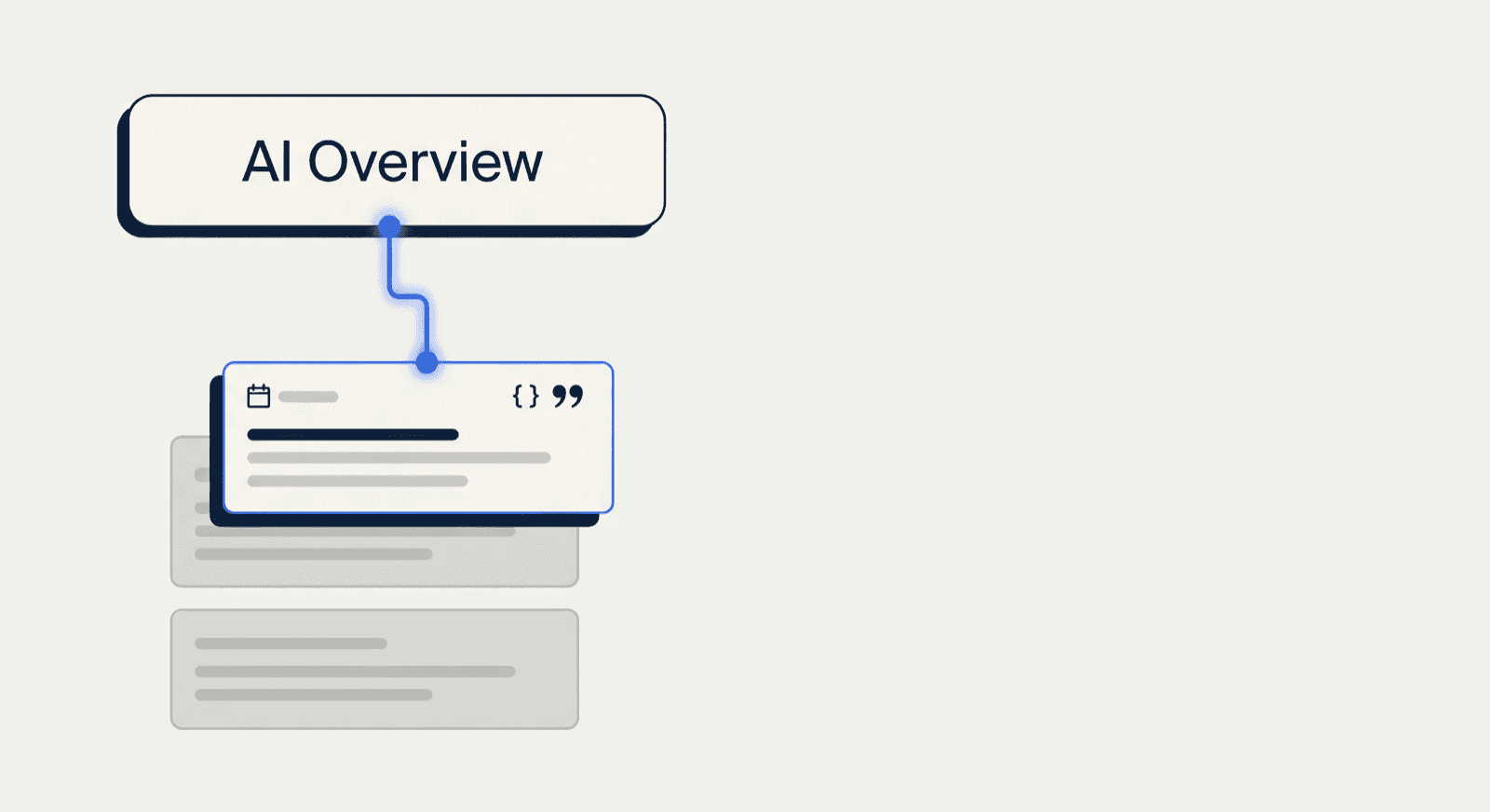
Key takeaways
- AI Overviews optimisation is a citation problem, not a ranking problem. You are competing to be quoted, not just listed.
- Google draws AI Overview sources from the top 8–10 organic results, then weights toward pages with clean schema and self-contained, extractable passages.
- Reddit and YouTube are the citation gateways. Across 55 live SERPs we monitored, Reddit was cited 24 times and YouTube 14, more than any agency or vendor domain.
- The quietest reason good pages get skipped is a missing publish date. Freshness signals are load-bearing in 2026.
- Entity authority beats keyword density. AI engines cite sources they can identify and trust, not pages that repeat the query.
What AI Overviews optimisation actually is
AI Overviews optimisation is the practice of structuring a page so a generative search engine can lift a self-contained, attributable passage from it, then choose to cite your domain as the source. It is the slice of generative engine optimisation (GEO) aimed at one surface specifically: the AI-generated answer box that now sits above Google's classic blue links.
The distinction that trips most teams up is this: a traditional result rewards the page that best matches a query. An AI Overview rewards the page that gives the model the cleanest sentence to quote. Those are not always the same page, and optimising for one does not automatically win you the other.
The term GEO comes from a 2023 academic paper by researchers at Princeton, Georgia Tech and the Allen Institute for AI, which first measured how content changes affect visibility in generative engines (Aggarwal et al., 2023). AI Overviews optimisation is what happens when you apply that discipline to Google's specific implementation. It overlaps with answer engine optimisation (AEO), but AEO is the broader category covering ChatGPT, Perplexity and Copilot too.
Why most advice on this is either vague or self-serving
Search “how to optimise for AI Overviews” and you get two kinds of result. The first is Google's own guidance, which is honest but deliberately non-specific: write helpful content, follow E-E-A-T, the usual. True, and unactionable. The second is tool-vendor content that quietly concludes the answer is “buy our software.”
Neither tells you the mechanical part: which schema types, which passage structures, and which entity signals correlate with a page actually being cited. That is the gap this piece fills, using what we observed rather than what we hope is true.
A short honesty note before the tactics: nobody outside Google has the ranking function. What follows are correlations from observation, not a leaked algorithm. Industry guides from Search Engine Land and Semrush point in the same direction, which raises confidence. But treat all of it as a working model you test, not gospel.
How Google selects the sources for an AI Overview
Google builds an AI Overview by retrieving a candidate set, almost always the top 8–10 organic results, then choosing which of those to quote and link. So the entry ticket is still ranking on page one. The second, separate contest is being the passage the model finds easiest to extract and trust.
This is why the old reflex of “get to position one” only half works. Position one gets you into the candidate pool. Whether you get quoted depends on signals most ranking checklists ignore.
What our own monitoring showed
In May 2026 we ran 55 live SERPs across the AI-SEO and GEO category through DataForSEO's SERP API, capturing AI Overview triggers and the domains cited inside them. Two findings reset our priorities.
First, AI Overviews fire constantly in this category: 20 of 25 US SERPs (80%) and 17 of 20 UK SERPs (85%) returned an AI Overview. For these query types, classic rank-tracking measures the wrong thing; citation visibility is the game. The wider prevalence and click-through-impact numbers sit in our SEO, GEO and AEO statistics roundup.
Second, the cited domains were not who agencies assume. The leaderboard was dominated by community and video, not polished vendor pages:
| Rank | Domain | AIO citations |
|---|---|---|
| 1 | reddit.com | 24 |
| 2 | youtube.com | 14 |
| 3 | searchenginejournal.com | 8 |
| 4 | seo.co | 7 |
| 5 | seo.com | 7 |
| 6 | level.agency | 7 |
| 7 | searchengineland.com | 4 |
The implication is uncomfortable for polished marketing sites: Google's AI is quoting first-hand, practitioner-voiced content (Reddit threads, video) over vendor copy. If your page reads like a brochure, it is structurally disadvantaged against a Reddit answer that gets straight to the point. The lesson isn't to go and spam Reddit. It's to write pages that sound like a practitioner actually answering the question, because that register is what the model rewards.
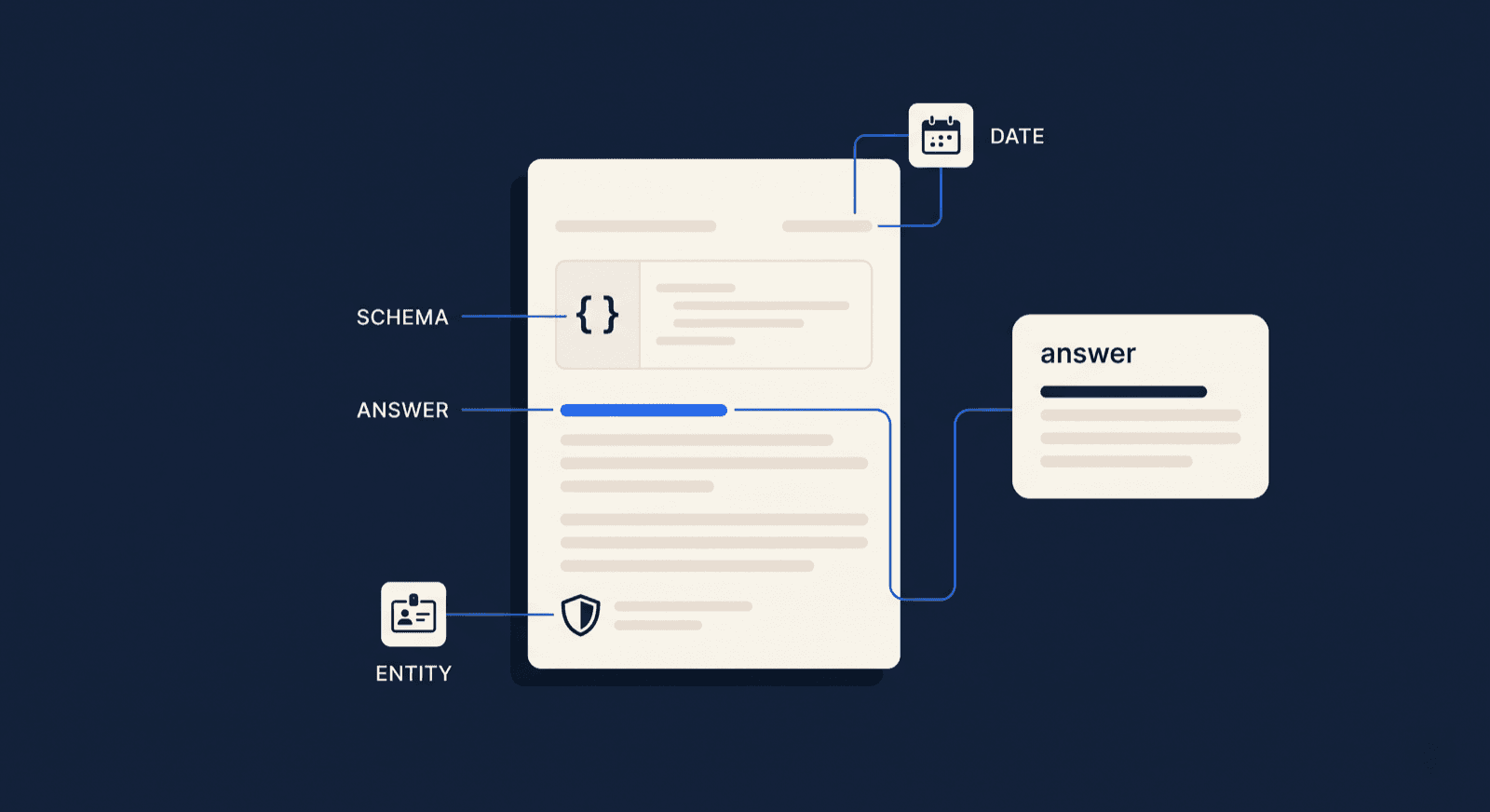
One more selection signal worth keeping in mind: entity authority beats keyword density. AI answer generation leans on whether the engine can identify your brand as a known entity (via consistent naming, an Organization profile, and corroborating mentions elsewhere) far more than on how many times your page repeats the target phrase. Repetition is not citability.
The seven technical signals that correlate with AI Overview inclusion
Here is the working model we ship against. Treat it as a checklist of correlated signals, ordered roughly by how often the absence of each one explains a missed citation.
- A visible, accurate publish and modified date. In our experience the single most common reason an otherwise-citable page gets skipped is a missing publish date in the markup. Stale or undated content is a quiet disqualifier. Put real dates in the Article schema and on the page.
- An answer-first passage in the first 60 words. If your strongest answer is buried in paragraph nine, the model will not dig for it. Lead each section with a self-contained, quotable sentence that resolves the question on its own.
- A clean schema stack: Article + FAQPage + HowTo where relevant. Cited pages skew heavily toward those with valid structured data. Schema does not force inclusion, but its absence makes you harder to parse than the competitor who has it.
- FAQ answers that mirror the on-page text verbatim. Your acceptedAnswer.text should match the paragraph a human reads. Mismatches between schema and visible content hurt eligibility, because the engine distrusts pages where the markup and the body disagree.
- Identifiable entity signals. A complete Organization profile (name, logo, founder, sameAs links, foundingDate) plus consistent brand naming across the page helps the engine resolve “who is saying this.” Unidentified sources are rarely cited.
- Extractable structure: short paragraphs, numbered steps, comparison tables. AI engines extract units: a definition, a step, a row. Two-to-four-sentence paragraphs, ordered lists and tables give them clean units to lift. Walls of text do not.
- Machine-readable site signals, including /llms.txt. LLM crawlers increasingly check for an /llms.txt index when deciding what to cite, and several prefer a concatenated /llms-full.txt over scraping individual URLs. It is cheap to ship and removes friction from the systems you want quoting you.
Which schema to ship, by page type
Schema is necessary but not sufficient. It earns you parse-ability, not a guaranteed citation. Match the type to the page rather than bolting FAQPage onto everything. This is the mapping we use:
| Page type | Primary schema | Why it helps citation |
|---|---|---|
| Definitional / “what is” page | Article + FAQPage | Pairs a citable lead definition with Q&A pairs the engine can lift individually. |
| Step-by-step / how-to guide | HowTo + Article | Each step becomes a self-contained, extractable unit with its own name and text. |
| Comparison / “X vs Y” | Article + FAQPage | Comparison tables map cleanly to the “structured answer” format AI Overviews favour. |
| Listicle / “best tools” | ItemList + FAQPage | Makes the page eligible for the AI Overview list presentation. |
| Every page (sitewide) | Organization | Resolves your brand as a known entity, the trust layer under every citation. |
Implementation note from our own builds: ship all applicable types in a single JSON-LD block per page rather than several competing tags, and validate against the Rich Results Test before publish, not after. Schema errors at scale are a documented failure mode, and a broken block is worse than no block.
AI Overviews vs featured snippets: where to put the effort
Treat these as two different prizes with two different tactics. Most SEO advice still conflates them, which leads to effort going to the wrong place. The structural difference dictates the play:
| Surface | How it's built | What wins it |
|---|---|---|
| AI Overview | Synthesis of multiple sources | Being citable: clean entity, extractable passages, valid schema, fresh dates. |
| Featured snippet | Single-source lift | Being the single best direct answer to one specific question. |
| Classic blue link | Ranked document | Topical relevance, authority and links: the traditional contest. |
The practical split: if a query reliably fires an AI Overview (and in the categories we monitor, most informational and comparison queries now do), invest in citability and entity strength. If it fires a featured snippet instead, write the single tightest answer to that exact question. You can pursue both, but know which surface you are actually competing for before you write.
A practical AI Overviews optimisation checklist
If you want the short, do-this version, here is the sequence we run on a page that should be earning citations but isn't.
- Confirm you rank top-10 for the query first. No top-10 position, no candidate-pool entry. Fix ranking before chasing citation.
- Front-load a 40–60 word answer directly under each heading, written to stand alone if quoted out of context.
- Add real publish and modified dates in both the visible page and the Article schema.
- Ship matched FAQPage markup where the answers copy the on-page text word for word.
- Tighten structure into short paragraphs, ordered steps and at least one comparison table.
- Complete your Organization schema and brand consistency so the engine can identify the source.
- Publish an /llms.txt indexing your key pages, and validate every schema block before release.
- Earn corroborating mentions (a Reddit answer, a YouTube video, a guest mention on an SEO publication) because the engines weight sources that appear in more than one place.
How to measure whether it is working
Rankings are an incomplete signal in AI search, so you need to track citation, not just position. A page can lose its blue-link click yet still get a brand mention inside the answer. Another can rank fine and stay invisible in the Overview. Three things worth monitoring:
- AI Overview appearance. Spot-check your priority queries manually, or pull AI Overview triggers and citations programmatically (we use DataForSEO's SERP API for this). Record whether the Overview fires and whether your domain is in it.
- Brand-mention velocity. Track how often your brand surfaces in answer engines over time. When rankings are a partial measure, mention frequency is the better proxy for GEO progress.
- Referral and traffic shifts. AI surfaces compress clicks even when they cite you; analyses of publisher traffic show the trade-off clearly (ALM Corp, 2025). Watch assisted conversions and direct/brand search, not just sessions.
One caveat on the numbers in this article: the 80–85% AI Overview trigger rate is specific to the AI-SEO and GEO categories we monitor. Your niche may fire far less often. Measure your own SERPs before assuming the same intensity.
FAQ
What is AI Overviews optimisation?
AI Overviews optimisation is the practice of structuring a page (its passages, schema, dates and entity signals) so Google's AI Overview can extract and cite it as a source. It is a subset of generative engine optimisation focused on Google's answer box specifically.
How do I get my page into a Google AI Overview?
Rank in the top 8–10 organic results for the query, then make your page the easiest to quote: a self-contained answer in the first 60 words, valid Article and FAQPage schema, accurate publish dates, and a clearly identifiable brand entity. Inclusion is a citation contest layered on top of ranking.
Is AI Overviews optimisation the same as SEO?
No. SEO gets you ranked; AI Overviews optimisation gets you quoted. Ranking is the entry ticket, citation is a separate signal set built on extractable passages, schema and entity authority. You need both, but they are not the same job. See our GEO vs SEO breakdown for the full split.
Does schema markup guarantee an AI Overview citation?
No. Schema makes your page easier to parse and trust, which correlates with citation, but it does not force inclusion. A clean schema stack with weak content still loses. Schema removes friction; it does not manufacture authority.
Why does Google cite Reddit and YouTube so often in AI Overviews?
Because both carry first-hand, practitioner-voiced answers that resolve a question directly. In 55 SERPs we monitored, Reddit was cited 24 times and YouTube 14, more than any vendor site. The takeaway is to write in that direct, experienced register, not brochure copy.
How is this different from agentic SEO?
AI Overviews optimisation is a content-and-markup discipline aimed at one surface. Agentic SEO is the broader system, autonomous agents that plan, execute and iterate across the whole SEO lifecycle, of which AI Overview citation is one output it optimises for. If you want the fuller picture, start with what agentic SEO actually means.
Frequently asked questions
- What is AI Overviews optimisation?
- AI Overviews optimisation is the practice of structuring a page (its passages, schema, dates and entity signals) so Google's AI Overview can extract and cite it as a source. It is a subset of generative engine optimisation focused on Google's answer box specifically.
- How do I get my page into a Google AI Overview?
- Rank in the top 8–10 organic results for the query, then make your page the easiest to quote: a self-contained answer in the first 60 words, valid Article and FAQPage schema, accurate publish dates, and a clearly identifiable brand entity. Inclusion is a citation contest layered on top of ranking.
- Is AI Overviews optimisation the same as SEO?
- No. SEO gets you ranked; AI Overviews optimisation gets you quoted. Ranking is the entry ticket, citation is a separate signal set built on extractable passages, schema and entity authority. You need both, but they are not the same job.
- Does schema markup guarantee an AI Overview citation?
- No. Schema makes your page easier to parse and trust, which correlates with citation, but it does not force inclusion. A clean schema stack with weak content still loses. Schema removes friction; it does not manufacture authority.
- Why does Google cite Reddit and YouTube so often in AI Overviews?
- Because both carry first-hand, practitioner-voiced answers that resolve a question directly. In 55 SERPs we monitored, Reddit was cited 24 times and YouTube 14, more than any vendor site. The takeaway is to write in that direct, experienced register, not brochure copy.
- How is this different from agentic SEO?
- AI Overviews optimisation is a content-and-markup discipline aimed at one surface. Agentic SEO is the broader system: autonomous agents that plan, execute and iterate across the whole SEO lifecycle, of which AI Overview citation is one output it optimises for.
Methodology
The citation and trigger-rate figures here come from a live SERP study Aristral ran in May 2026: 55 SERPs across the AI-SEO and GEO category, queried through DataForSEO's SERP API, capturing AI Overview triggers and cited domains. These are observed correlations within one category, not a guaranteed ranking formula, and AI Overview behaviour changes frequently, so re-test against your own SERPs before acting. We have no commercial relationship with any tool or publication linked here, and this was written by a practitioner who ships these pages, not a content mill. Spotted something out of date? Email admin@aristral.com and we'll correct it.
About the author
Taha Bilal
Co-founder, Aristral
Taha Bilal is a co-founder of Aristral, a UK AI automation and SEO agency based in Clifton, Bristol. He has been running SEO and digital-growth campaigns for SMB and SaaS clients since 2018, and now leads Aristral's combined SEO + GEO programmes for service businesses across the UK and US. Corrections and source requests: admin@aristral.com.
LinkedIn →