SEO
AI SEO for Ecommerce: The Category, Schema and AI Overview Playbook That Actually Works
AI SEO for ecommerce works when it builds genuinely distinct category and product pages with clean structured data. It fails when it churns out near-identical copy at scale. Here's the category architecture that survives core updates, the Product schema that earns AI Overview citations, and a straight answer on what AI can't do for a store.

Key takeaways
- AI SEO for ecommerce is not bulk product copy. It's using AI to research, structure and ship pages a shopper couldn't get anywhere else.
- Category pages are the most neglected asset in ecommerce SEO. They're also where AI helps most, once you build them to answer buying questions instead of just listing products.
- Schema is the differentiator for AI Overviews. Product, AggregateRating and FAQ markup tell an answer engine what your page is, instead of asking it to guess.
- Generative engine optimisation (GEO) is now part of the job. AI Overviews fired on the US SERP for “ai seo for ecommerce” in our May 2026 data; citation, not just rank, is the prize.
- The pages that survived the 2025 spam updates shared one trait: they were genuinely different from one another. Thin-at-scale is the thing Google demotes.
- Keep a human on YMYL content, claims and schema-at-scale. AI Overviews are right maybe nine times in ten. The tenth one goes out under your brand.
Table of contents
- What “AI SEO for ecommerce” actually means
- Why most AI ecommerce content never ranks
- The category page architecture that wins
- Product and reviewer schema
- GEO for ecommerce: getting cited
- A 30-day plan you can run
- What AI can and can't do
- FAQ
- The bottom line
What “AI SEO for ecommerce” actually means
Start with a clean definition, because the term gets used loosely.
The distinction matters. Most stores using “AI for SEO” are doing one thing: generating product descriptions in bulk and publishing them. That's automated content, and Google has spent two years getting better at catching it. Genuine AI SEO for ecommerce is closer to a pipeline: keyword and intent research, entity mapping, draft, fact-check, schema, internal links, with a human deciding what's actually worth publishing.
It also sits next to two adjacent ideas people conflate with it:
- Ecommerce SEO automation, the mechanical side: pulling product feeds, generating attribute descriptions, validating schema. Useful, but it's plumbing, not strategy.
- Programmatic SEO for ecommerce: templating pages from a data source. Powerful at scale and dangerous when the template produces thin, interchangeable pages.
The job AI does well is the one humans hate doing at volume: producing distinct content for hundreds of pages without copy-pasting. The job it does badly is deciding which of those pages should exist at all. Keep that line clear and most of the common failures disappear.
Why most AI ecommerce content never ranks
The usual diagnosis is that an AI detector flagged the page for being AI-written. That's wrong. Google has said plainly that how content gets made matters less than whether it's helpful. The real failure is structural, and it shows up in three ways.
1. Thin content at scale. Thin doesn't mean short. It means a page with no entity coverage a shopper couldn't get from any other store. A product page that lists the same five spec lines the manufacturer ships to every retailer is thin even at 400 words. The 2025 spam updates hit this hard: per practitioner postmortems referenced in our build research, one 12,000-page templated set lost 87% of its organic traffic, and a 50,000 city-page build was 98% deindexed within three months. The survivors were the sets where each page was genuinely different.
2. Category pages treated as product grids. Most ecommerce category pages are a heading, a filter bar and a wall of products. To a search engine that's a navigation element, not an answer. The category page is where buying intent concentrates, and it's the single biggest wasted opportunity in most stores.
3. Missing or broken structured data. If your pages don't carry clean Product, review and FAQ schema, you're asking an AI engine to infer what the page is from raw HTML. As Shopify's own guidance and most current ecommerce SEO analyses point out, structured data is now table stakes for rich results, and increasingly for AI Overview inclusion.
“Thin content isn't short content. It's content with no information a shopper couldn't get anywhere else.”
The category page architecture that wins
This is where AI earns its place. A category page wins when it answers a buying question instead of just listing products. Here's the architecture we ship, in order of impact.
- Lead with a real answer, not a keyword sentence. The top of a “running shoes for flat feet” category should answer which features matter (stability, arch support, heel drop) in 40–60 words. That passage is what an AI Overview can lift.
- Differentiate by entity, not adjective. Two category pages are only distinct if their entities differ (brands, materials, use cases, compatible models), not because one says “premium” and the other says “best”. That's the test that separates a survivable programmatic build from a thin one.
- Handle faceted navigation deliberately. Decide which filter combinations deserve an indexable URL and which should be canonicalised or noindexed. Uncontrolled faceted navigation is how a 200-product store generates 40,000 crawlable thin pages. AI helps here by clustering which facets actually have search demand.
- Use AI-generated attribute descriptions as a layer, not the whole page. Automated attribute copy (“breathable mesh upper, 8mm drop”) is fine for coverage. It is not a substitute for an editorial intro that reflects genuine product knowledge.
- Add a buying-guide block and an FAQ. A short “how to choose” section plus three to five real questions turns a grid into a resource: and feeds your FAQ schema directly.
The mechanical build, feed ingestion, attribute generation, bulk publishing, is something we run as a managed AI SEO for ecommerce service. Treat the framework above as the editorial spec that sits on top of it.
| Element | Thin (demoted) | Distinct (wins) |
|---|---|---|
| Intro | Keyword-stuffed sentence | 40–60 word buying answer |
| Differentiation | Adjectives (“best”, “top”) | Entities: brand, use case, spec |
| Facets | All combinations indexed | Demand-validated facets only |
| Attribute copy | The entire page | One coverage layer of several |
| Schema | Missing or invalid | ItemList + FAQ + breadcrumbs |
Product and reviewer schema: the AI Overview differentiator
Schema is how you tell an AI engine what your page is. Without it, you're asking the model to guess. For ecommerce, the product-schema deep dive is the single clearest place to out-execute competitors, because most stores ship it incompletely.
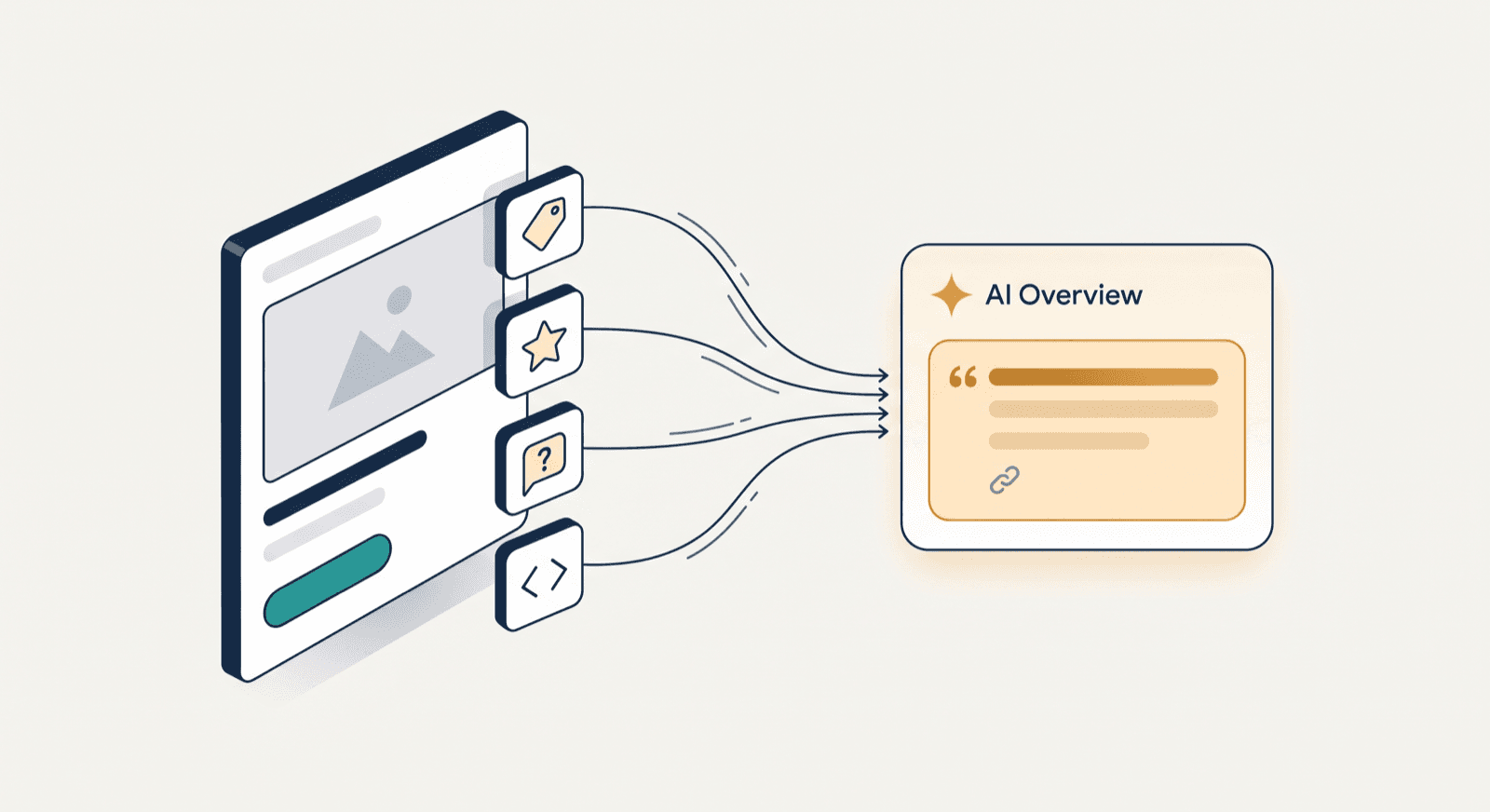
Four types carry most of the weight:
| Schema | Page | Why it matters for AI search |
|---|---|---|
| Product + Offer | Product pages | Price, availability, GTIN: eligibility for rich results and shopping surfaces |
| AggregateRating + Review | Product pages | Reviewer schema density was a survival factor for ecommerce pages through the 2025 updates |
| FAQPage | Category + product | Direct feedstock for AI Overview and “People also ask” answers |
| ItemList / BreadcrumbList | Category pages | Tells engines the page is a curated set, not a stray list |
Two rules we apply on every build. First, your FAQPage answer text has to mirror the visible on-page answer word-for-word. A mismatch between markup and copy is a fast way to lose AI Overview eligibility. Second, never invent reviews or ratings to fill AggregateRating. Fabricated review markup is a manual-action risk, not a shortcut.
One practical detail that quietly costs citations: a missing datePublished. In current AI search behaviour, an absent or stale publish date is one of the most common reasons an otherwise-citable page gets skipped. Ship datePublished and dateModified on every page, and keep them honest.
“Schema is how you tell an AI engine what your page is. Without it, you're asking the model to guess.”
GEO for ecommerce: getting cited, not just ranked
Generative engine optimisation has moved from a niche term to a working discipline. The term originates from a 2023 academic paper by researchers at Princeton, Georgia Tech and the Allen Institute (Aggarwal et al., 2023), and the practitioner framing has since been widened by sources like WordStream and Pimberly.
Why this matters now: in our own May 2026 SERP analysis, Google AI Overviews fired on the US result for “ai seo for ecommerce”, and across the wider niche we sampled they triggered on roughly 80% of US queries and 85% of UK queries. When the answer box sits above the organic results, citation is the game. Reddit and YouTube were the most-cited domains across those overviews, which tells you practitioner-voice content beats polished vendor copy for inclusion.
What earns an ecommerce citation, in practice:
- Self-contained answer passages. Each buying question answered in one liftable paragraph under 60 words.
- Original, checkable specifics. Real comparisons, real numbers, real prices: the stuff a thin page can't fake.
- Clean entity signals. Consistent product, brand and category entities reinforced by schema.
- A genuine point of view. “Here's what we'd actually buy and why” reads like a person, which is what answer engines are quietly rewarding.
GEO is a content and schema discipline rather than a separate channel, and it overlaps heavily with the work above. New to the distinction? Our GEO vs SEO explainer covers it in full. If you want the system built and run for you, our agentic SEO programme includes GEO and Local SEO on every tier.
“When the answer box sits above the results, citation is the game, and practitioner voice beats vendor copy for inclusion.”
A 30-day plan you can actually run
No transformation programme. A sequence a single operator or a small team can ship in a month, ordered by return.
- Week 1. Audit, don't generate. Crawl the store. Find duplicate and thin category pages, broken or missing Product schema, and uncontrolled faceted URLs. Fix indexation before adding content.
- Week 2. Rebuild your top 10 category pages. Add a 40–60 word buying answer, a how-to-choose block and an FAQ to each. These are the highest-intent pages you own.
- Week 3. Ship complete schema. Product + Offer + AggregateRating on products; FAQPage + ItemList on categories. Validate every type before publishing, not after.
- Week 4: Add the GEO layer. Convert your strongest buying guides into self-contained answer passages, confirm publish dates are present, and submit updated URLs for indexing.
Run that loop, measure the category pages specifically, and you'll have a defensible baseline before you scale anything programmatically.
What AI can and can't do here
Honesty is part of the methodology, so here's the line we hold.
AI does well: entity research, drafting distinct attribute and category copy at volume, generating and validating schema, finding internal-link opportunities, and monitoring SERPs and AI Overview inclusions. These are the tasks where automation genuinely outperforms a person doing it by hand.
AI does badly: deciding which pages should exist, judging brand voice, and getting facts right on its own. AI Overviews are accurate maybe nine times in ten, which means the tenth answer is wrong. On a YMYL or compliance-sensitive product, that's your liability, not the model's. So keep a human checkpoint on anything regulated, on brand-voice sign-off for the first drafts, and on any schema change you're pushing across thousands of pages at once.
Used that way, AI SEO for ecommerce is an execution multiplier, not an autopilot. If you'd rather have the pipeline built and run for you, that's what our AI SEO for ecommerce service does. But every technique here is yours to ship in-house.
FAQ
Can SEO be done with AI for an ecommerce store?
Yes, for research, drafting distinct product and category copy, generating schema and monitoring rankings. The pages that rank are the ones where a human decided what to publish and AI handled the volume. Fully unattended bulk-generation is what gets demoted.
What is the best AI tool for ecommerce SEO?
There's no single best tool, because most cover one stage of the pipeline. Judge any tool on whether it produces genuinely distinct pages, ships valid Product and FAQ schema, and keeps a human in the loop, not on word count or a quality score.
Is there a downside to using AI for SEO?
The real risk isn't detection, it's thin, near-identical pages at scale, which the 2025 spam updates demonstrably punished. The other downside is factual error: AI Overviews are right about nine times in ten, so unchecked AI content will publish the tenth mistake under your brand.
Will AI Overviews replace ecommerce SEO?
No, they change the prize. Instead of only ranking, you're competing to be the source an answer engine cites. That favours stores with clean schema, self-contained answer passages and genuine product knowledge, which is what traditional SEO rewards anyway.
How is AI SEO for ecommerce different from programmatic SEO?
Programmatic SEO templates pages from data; AI SEO uses models to make each of those pages genuinely distinct. Programmatic without real differentiation is the thin-at-scale pattern Google demotes. AI is what turns a template into something worth indexing.
The bottom line
AI SEO for ecommerce works when it makes pages more distinct, not when it makes more of them. Build category pages that answer buying questions, ship complete Product and FAQ schema, write self-contained passages an answer engine can lift, and keep a human on the decisions that carry risk. Do that and you're in the running for both the ranking and the citation, which in 2026 are two separate competitions.
Methodology
This piece reflects how Aristral builds and runs ecommerce SEO in production. SERP and AI Overview observations were pulled from live commercial SERP and keyword APIs in May 2026, a sample of 47 keywords and 55 SERPs across the US, UK, Germany and Canada, with AI Overview triggers API-confirmed rather than inferred. The 2025 core and spam-update figures are drawn from published practitioner postmortems, cited inline. Every third-party claim links to its primary source, dated at the time of writing. Aristral takes no affiliate revenue or sponsorship from any tool named here. Spotted something out of date? Email admin@aristral.com and we'll correct it.
About the author
Taha Bilal
Co-founder, Aristral
Taha Bilal is a co-founder of Aristral, a UK AI automation and SEO agency based in Clifton, Bristol. He has been running SEO and digital-growth campaigns for SMB and SaaS clients since 2018, and now leads Aristral's combined SEO + GEO programmes for service businesses across the UK and US. Corrections and source requests: admin@aristral.com.
LinkedIn →