Local SEO
Google Maps ranking: what 8 geo-grid scans show
Google Maps ranking reflects relevance, distance and popularity. Eight business scans show how far visibility reached and what changed after profile edits.
How local Maps rankings work
Google Maps ranking is the order of relevant local businesses shown for a search location. Google says local results are based mainly on relevance, distance and popularity (its local ranking guidance). Relevance is how well a profile matches a search; distance is how far the searcher is from the business. Google describes popularity as how well known a business is. Whitespark’s local search ranking survey reports practitioner opinion, not access to Google’s system.
A local pack is the group of nearby business profiles shown in Google Search. Maps app results are the list shown inside Google Maps. They draw on related local information, but a result can shift as the search location changes. A search from your office checks one point, not your whole service area. A location based check shows more of the service area than a screenshot from the owner's phone, which is why local pack SEO needs one.
Use these factors to order the work. Keep categories, services and business details accurate. Reviews and other mentions can support popularity. Distance is harder to change because the business usually cannot move closer to each searcher.
How we measured: geo-grids across 8 businesses
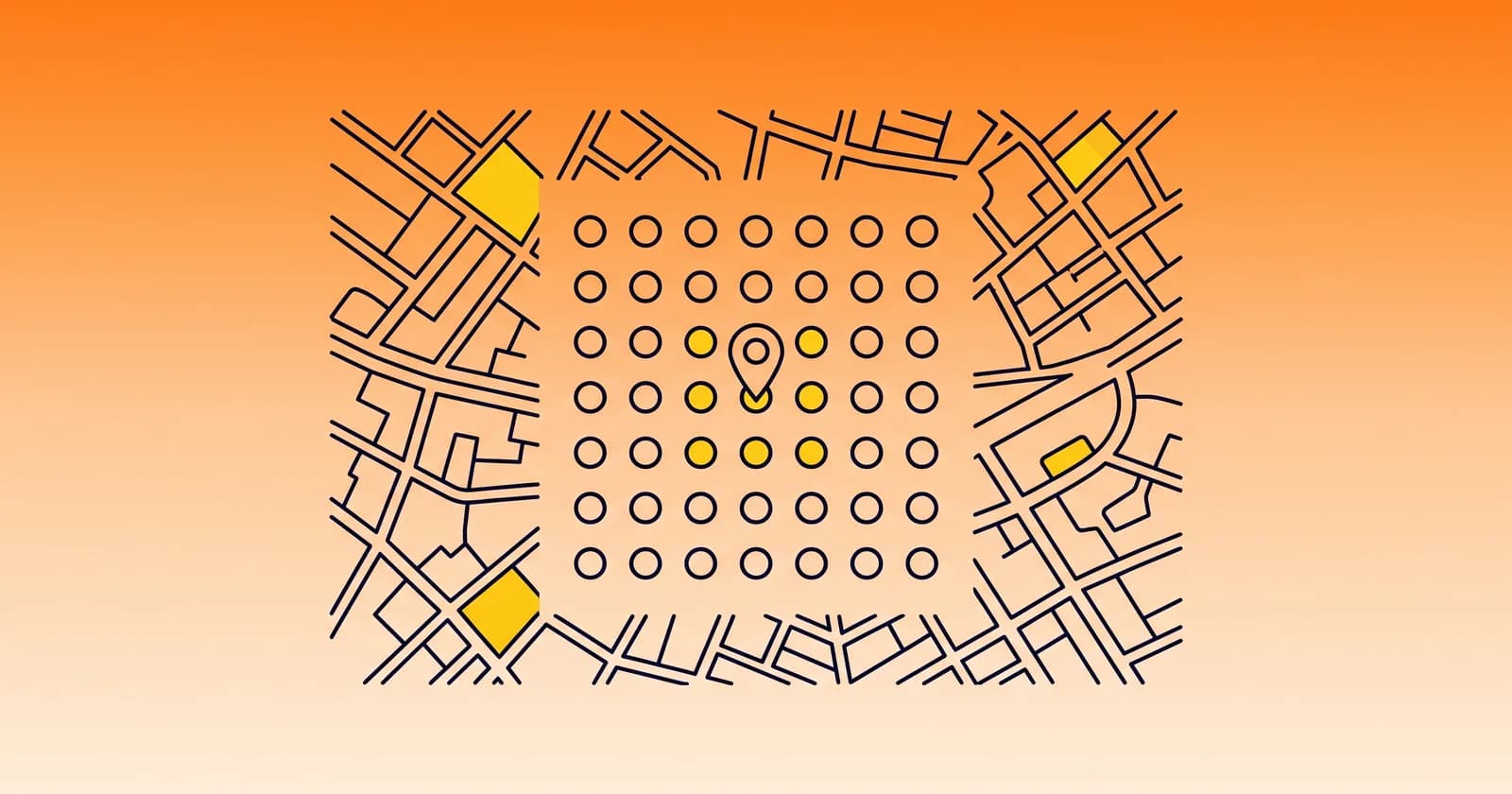
A geo-grid checks the same search from evenly spaced points around a business pin. We used square grids with either 7 by 7 points or 9 by 9 points. Each point produced a mobile Google Maps results list to depth 20. We matched the listing by Google CID, the profile's unique identifier, rather than trusting a similar business name.
A top-three cell means the profile appeared in the first three map results for that term at that grid point. Share of local voice, or SoLV, is the number of top-three cells divided by all cells. It gives a single summary of a map, but it can hide whether visibility is concentrated near the pin or spread out across the grid.
| Profile | Search area | Grid and sample | What the scan showed |
|---|---|---|---|
| Nata Beauty | Redland, Bristol | 7×7; 10 terms | #1 at the pin on 8 core terms; top 3 in 17 of 490 cells |
| Cooking It | Bishopston, Bristol | 7×7; 3 terms; 3 dates | Top 3 in 15 of 49 cells on each date |
| Aesthetics clinic group | Bristol; 3 branches | 7×7 per branch; 3 terms | Each branch top 3 at its own door only |
| Aristral | Clifton, Bristol | 9×9; 16 terms; 2 dates | First at pin on 9 terms, then 13 |
| CH Developments | Redditch | 7×7 plus 1 km pin grid; 15 terms | Secondary category qualified for some named queries |
| Premier Construction | Glyfada, Athens | 7×7; 3 terms | Facility management had the broadest reach |
| Personal injury firm | Near Toronto | 7×7; 1 term | Top 3 at 1 of 49 points |
| Saeed Law Firm | DHA, Lahore | 7×7; 12 terms; 2 dates | Top-three cells increased from 53 to 61 |
The samples vary. Nata Beauty’s 490 cells came from ten terms across one grid. Saeed Law Firm’s comparison used 296 comparable points across twelve terms. Branch scans and single-term scans answer different questions, so the table shows the sample beside each result.
Google's Business Profile API overview describes the profile and location data available through its APIs. For this study, we matched profiles by Google CID and recorded each search point so repeated scans could be compared. Google's Business Profile API overview documents the profile data model. The grid is our measurement method, not a Google ranking signal.

Finding 1: distance sets the radius
Five profiles were strongest at or near their own door, then lost visibility as the search point moved away. Cooking It’s top-three footprint ended at about 1.5 km. At 2 km or more in every direction, it fell out of the top 20.
Different terms and grid designs; use as examples, not a league table.
Aristral Google Maps geo-grid scans, 2026-08-03 to 2026-09-23.
Cooking It appeared in the top three at 15 of 49 points (30.6%). All 15 sat within about 1.5 km. From the city centre, a closer competitor could rank first despite having fewer reviews.
The multi-branch aesthetics clinic group reached the top three at one point per branch: its own door. That result was unchanged from August.
Finding 2: primary categories can shape visibility for head terms
The primary category is one of the most direct ways to describe a business to Google. In our own profile, we changed it from Software company to Internet marketing service on 10 September. At the next reading on 23 September, Aristral ranked first at its pin on 13 of 16 terms, up from 9 of 16.
Same profile and 16 search terms, before and after a primary-category change.
Aristral Google Maps scans, 2026-09-10 and 2026-09-23.
The profile’s top-20 presence grew from 26 to 33 cells out of about 1,200. Several terms appeared 1.5 km north for the first time. Rival Bristol agencies appeared in 45 to 90 cells each, so our radius remained small.
CH Developments shows the distinction between primary and secondary categories. With Home builder added as a secondary category, the profile appeared at #3 for home builder redditch and #5 for builders near me. It ranked #2 for house extensions redditch, a listed service. For builders redditch, it remained absent. The four leaders used Home builder as their primary category, including a profile with two reviews at #1.
| Query at the pin | CH Developments result | What it suggests |
|---|---|---|
| construction company redditch | #1 | Matches the primary category |
| home builder redditch | #3 | Secondary category matched a named query |
| builders near me | #5 | Related query had some visibility |
| house extensions redditch | #2 | Listed service matched the query |
| builders redditch | Absent | Head term leaders used the primary category |
Choose the primary category that best describes the main service people search for. Add only relevant secondary categories. Our scans suggest that a mismatch can cost visibility for the main term, even when other profile details are sound. The Aristral comparison covers one profile before and after a category change; CH Developments is a separate profile with different queries. These observations suggest a relationship, but they do not isolate category as the cause.
Finding 3: reviews can help, but distance still matters
Reviews are one part of popularity, but a larger count did not guarantee a wider footprint in our scans. Cooking It had 237 reviews at 4.9 stars and replied to all of them. Its top-three reach stopped at roughly 1.5 km. At a city-centre point, the first-ranked listing for both head terms had ten reviews and sat closer to the search point.
Review totals need context. Whitespark’s Local Search Ranking Factors survey reports practitioner assessments, not access to Google’s ranking system. In our scans, the nearest result could rank ahead of a much-reviewed business.
| Profile | Reviews in scan | Review text mentioning core service | Owner replies | Observed result |
|---|---|---|---|---|
| Cooking It | 237; 4.9 stars | Not measured here | 100% | 15 of 49 points in top three; about 1.5 km reach |
| Nata Beauty | 67; all 5-star | 6 of 67 mention permanent makeup | Not stated | #1 at the pin on 8 core terms; 17 of 490 top-three cells |
| Personal injury firm | 57; 4.9 stars | 1 of 57 mentions an injury case | 0 | #2 at office; 1 of 49 points in top three |
| Saeed Law Firm | 108; all 5-star | Not measured here | 100% | Top-three slots rose from 53 to 61 across 296 comparable query-grid points (17.9% to 20.6%) |
Specific reviews help customers understand the work. Six of Nata Beauty’s 67 reviews mentioned permanent makeup; at the personal-injury firm, one of 57 mentioned an injury case. Ask for honest feedback without suggesting phrases or pressuring customers.
Cooking It, Premier Construction and Saeed Law Firm had replied to every review in the scan. The personal-injury firm had no replies recorded. These readings do not show that replies changed rankings; replies help answer customers and clarify what they mention.
Finding 4: thin packs can be winnable
A less crowded specialist search can give a business more room to appear. Premier Construction ranked #2 at its pin for the Greek construction company term and #3 for shop renovation. Its top-three share was 22% for facility management, compared with 2% for construction and 4% for shop renovation. The facility management pack had fewer specialist competitors in the observed area.
That is one profile on one date, so it cannot prove that every less competitive query is easier. It does show why checking several service terms matters. A business may have a narrow footprint for its broad category and better reach for a specific service. Build pages and profile services around work the business actually provides, then measure each query separately.
How to check your Google Maps ranking
A phone search shows one nearby result, not the whole map. Search location affects what appears. A local rank tracker or geo-grid tool can repeat searches from set points and organise the results.
- Write down the search terms that describe your main service and location. Include a few service variations that real customers use.
- Choose a grid centred on the verified business pin. Pick a spacing that reflects the area you serve. A 7 by 7 grid gives 49 points; wider spacing covers more ground but offers less local detail.
- Use the same device type, terms, depth and grid on each run. Our scans used mobile results to depth 20.
- Match your profile by Google CID, not by its displayed name. This avoids counting a similarly named competitor as your own listing.
- Record the top-three cells and the wider top-20 results. Compare each term separately, then look at how the pattern changes with distance.
- Repeat monthly after a meaningful profile or website change. Check the pin weekly if you need a quicker view, but do not treat one point as a city-wide result.
A grid samples results; it cannot predict every search. Save its coordinates and profile CID so the next run can be compared. Nata Beauty’s 49 points across ten terms produced 490 location-query observations.
If you are setting up your first profile, our guide to Google Business Profile optimisation covers the listing details to review. The local SEO marketing guide explains how Maps visibility fits into a wider local plan.
How to improve Google Maps ranking: the order we use
Start by checking that the profile's category, name, address and hours are accurate. Then add the services people search for, and work on reviews last because they take longest. We use this order because it makes each change easier to explain and measure. Google’s Business Profile page explains how businesses manage their details across Search and Maps.
- Check the primary category. It should describe the business's main service, not a broad adjacent activity. Add a secondary category only when it fits.
- List the services the business genuinely provides. Use the service names customers understand, and make the description specific enough to distinguish the work.
- Check opening hours, address or service area, phone number and website. Fix stale details before adding more content.
- Ask customers for an honest review after completed work. Give them a simple route to leave one, without supplying wording or asking for a particular rating.
- Reply to reviews in your normal voice. A useful reply answers the customer's point and gives other readers a sense of how the business handles feedback.
- Add current photos that show the real premises, team or work. Keep posts accurate and useful to customers.
- Check that your business name, address and phone details match across important directories such as Bing Places and Apple Business Connect.
- Build useful service and location pages on your site. Explain where you work and what the service includes; avoid repeating town names without giving local detail.
- Run the same geo-grid again. Compare the same terms, points and CID, then keep, revise or reverse changes based on the result.
Check Google’s Business Profile guidelines before changing a name or location. In our Lahore scan, a listing with a search phrase in its name and no reviews appeared in the pack. One snapshot does not show that copying it is safe.
For a Bristol business, our local SEO in Bristol guide explains how proximity and service areas affect local searches. If you want to understand how AI tools recommend local companies, see our AI visibility study, which compares a separate set of Bristol queries.
What does not move Maps rankings much on its own
Profile activity without relevance, accurate details or a useful service offer is unlikely to solve a category mismatch. Posting more often may give customers fresh information, but our scans did not test post frequency as a ranking factor. Treat it as customer communication, not a substitute for profile accuracy or a suitable category.
AI chatbots are a separate discovery route. In our 20-query Bristol test, ChatGPT recommended 107 businesses. Six, or 6%, were also in the Google Maps top three for the same query from central Bristol. The lists overlapped only slightly in that sample. Our AI visibility guide explains the test and its limits.
One point cannot represent a whole service area. A large grid percentage also needs its location and search term beside it. Our automated SEO reporting guide shows how to keep that context in recurring reports.
When to bring in local SEO help
Bring in help when you cannot tell whether a weak result comes from the category, the website, profile details or distance. A structured scan can separate a pin-level issue from a coverage limit. It can also show whether a change reached the queries that matter to the business.
How Aristral approaches local SEO
At Aristral, we compare the Business Profile and service pages against fixed search terms and grid points. We check categories, service details, business information and whether the landing page matches the query. After changes, we repeat the scan.
On our profile, first-place results at the pin rose from 9 to 13 of 16 terms after a primary-category change. Our wider reach remained limited.
Separately, CH Developments was a brand-new company that reached the local map pack within two months, booked to capacity and paused new bookings. This client outcome is separate from the category scan above. Our local SEO services cover profile and website work. To discuss your map coverage, contact us for a free call.
Frequently asked questions
- How do I check my Google Maps ranking?
- Check from more than one location. A geo-grid repeats the same query from evenly spaced points around your business. Record the term, date, device, spacing and profile CID, then compare top-three and top-20 appearances. Repeat the same setup after a change.
- How long does it take to rank higher on Google Maps?
- There is no fixed timetable. In our category test, the next scan 13 days after the change showed first place at the pin for 13 of 16 terms, up from 9. That is one profile and a short comparison. Track the same locations and queries over time.
- Do more reviews improve my Maps ranking?
- Review count alone did not determine where a profile appeared. Cooking It had 237 reviews and remained top three only within about 1.5 km. A closer listing with ten reviews ranked first at a city-centre point. Compare reviews, distance and category fit together.
- Does my business name affect Google Maps ranking?
- A business name can match a search phrase, but adding keywords gives no clean test of category or distance. Keep the name consistent with how customers know the business. Our Lahore scan found one phrase-matched listing in the pack; one observation does not show that copying it is safe.
- Is a 4.5 Google rating good enough?
- A 4.5 rating cannot guarantee a map-pack position. Cooking It had 237 reviews at 4.9 stars, yet its top-three reach stopped at about 1.5 km. Check which businesses appear for your service terms and how close they are to each search point.
- Can I rank in towns where I have no address?
- A business may appear beyond its address, though distance can limit reach. Measure points around the real operating location, build useful service-area pages and keep profile details accurate. A grid shows whether nearby towns appear and how quickly results fade.
- How much do local SEO services cost?
- The work depends on the profile, website, service area and the amount of measurement needed. We scope it after a free call, once we understand what is holding visibility back. We do not publish a standard price because the work differs by business. Contact Aristral to discuss the areas and search terms you need to measure.
Methodology
We used DataForSEO's Google Maps SERP API, with one mobile search call at each point and results checked to depth 20. The eight profiles covered six industries and four countries. Scans ran from 3 August to 23 September 2026. Grids contained 49 or 81 evenly spaced points; we matched each profile by Google CID to avoid name collisions. A top-three cell means the profile appeared in the map pack's first three results at that point. Some profiles had several terms or branch grids, so their samples are not directly comparable. Readings use one device type and one zoom level, and most are single snapshots. Repeat the same terms and grid before treating a change as durable. Technical review: Huzaifa Jan Asim, co-founder and CTO. Last reviewed 25 September 2026. Corrections: admin@aristral.com.
About the author
Taha Bilal
Co-founder, Aristral
Taha Bilal is a co-founder of Aristral, a UK AI automation and SEO agency based in Clifton, Bristol. He has been running SEO and digital-growth campaigns for SMB and SaaS clients since 2018, and now leads Aristral's combined SEO + GEO programmes for service businesses across the UK and US. Corrections and source requests: admin@aristral.com.
LinkedIn →