SEO
How to Build a Local AI SEO Pipeline for Multiple Locations Without Thin Pages
Local AI SEO done right is a pipeline, not a prompt: the architecture for shipping genuinely distinct location pages at scale, the schema call that sinks most multi-location builds, and the honest limits of what automation replaces.
Key takeaways
- Local AI SEO is the use of autonomous, AI-driven pipelines to research, write, mark up and monitor location-specific pages at a scale manual production can't match, without crossing into thin content.
- Google's scaled-content rules punish sameness, not automation. A location page is thin when the only thing that changes between it and its siblings is the place name.
- The fix is entity differentiation: each page is distinct at the data level, not just the headline.
- Use LocalBusiness schema only where a real, staffed address exists. Everywhere else, use Service with areaServed.
- In AI search you are either in the answer or you are not, so a local AI SEO pipeline has to win citations, not just rankings.
Most teams reach for AI on local SEO at the wrong altitude. They paste a town into a prompt, multiply the output by forty, and ship. Local AI SEO done properly is the opposite: a pipeline that produces and maintains location pages a search engine reads as separate places, not template clones. This is the architecture we use to scale local pages without walking into a thin-content penalty: the inputs that make two pages distinct, the six pipeline stages, the schema call that sinks most multi-location builds, and the honest limits of what automation does.
What a local AI SEO pipeline actually is
Pasting a town into a prompt, getting a passable paragraph and multiplying it by forty is not a pipeline. It is a thin-content generator with extra steps. A real pipeline is an orchestration problem, not a writing problem.
The distinction matters because the whole exercise is an agentic SEO problem. The value is in the orchestration: pulling the right local data per location, blocking near-duplicate drafts before they exist, and marking each page up correctly. Writing is the cheap part. Differentiating at scale is the hard part, and the part Google actually grades. It is the local edge of the same approach behind our wider AI SEO services.
Why "write unique content for each location" fails at scale
The standard advice, "just write unique content for every location", is technically correct and operationally useless. At three locations it is a morning's work. At forty it collapses, and the failure mode is predictable: every page ends up saying the same thing about a different town.
Google named this directly. Its March 2024 spam-policy update introduced a "scaled content abuse" policy that targets pages generated primarily to manipulate rankings, regardless of how they were made, by hand, by template or by model (Google Search Central, spam policies). The trigger is low added value at scale, not the use of AI.
The post-mortems are public and consistent. After the 2025 spam updates, one widely-shared case saw roughly 50,000 templated city pages fall out of the index almost entirely within three months; another saw an organic collapse of close to 90% after a 12,000-page templated launch. The pattern in every case is the same: pages that differed only by a place name and a few swapped nouns.
This is the same risk that sits under any programmatic SEO build. Local just makes it more obvious, because location pages are the most templated asset on the web and the easiest to spot as clones.
The five inputs that make two location pages distinct
Before any pipeline is worth building, you need a definition of "distinct" the machine can enforce. Here is the one we use. A location page is genuinely different from its siblings when at least these five inputs differ at the data level:
- Named entities. Real neighbourhoods, landmarks, transit links, postcodes: places a local would recognise and a model can't invent generically.
- Local proof. A real review, a real client example, or a real outcome tied to that area, not a recycled testimonial.
- Location-specific facts. Anything that actually varies by place: availability, regulatory notes, pricing bands, service radius.
- Differentiated internal links. Each page links to different nearby pages and resources, so the link graph isn't a carbon copy.
- Original media. Location-specific images or an embedded map, not the same stock hero on every page.
The pipeline, stage by stage
With "distinct" defined, the architecture follows. Six stages, each with a clear job and a clear answer on whether a human stays in the loop. The point of automation here is to set the floor for quality and the ceiling for volume. It does not set strategy.
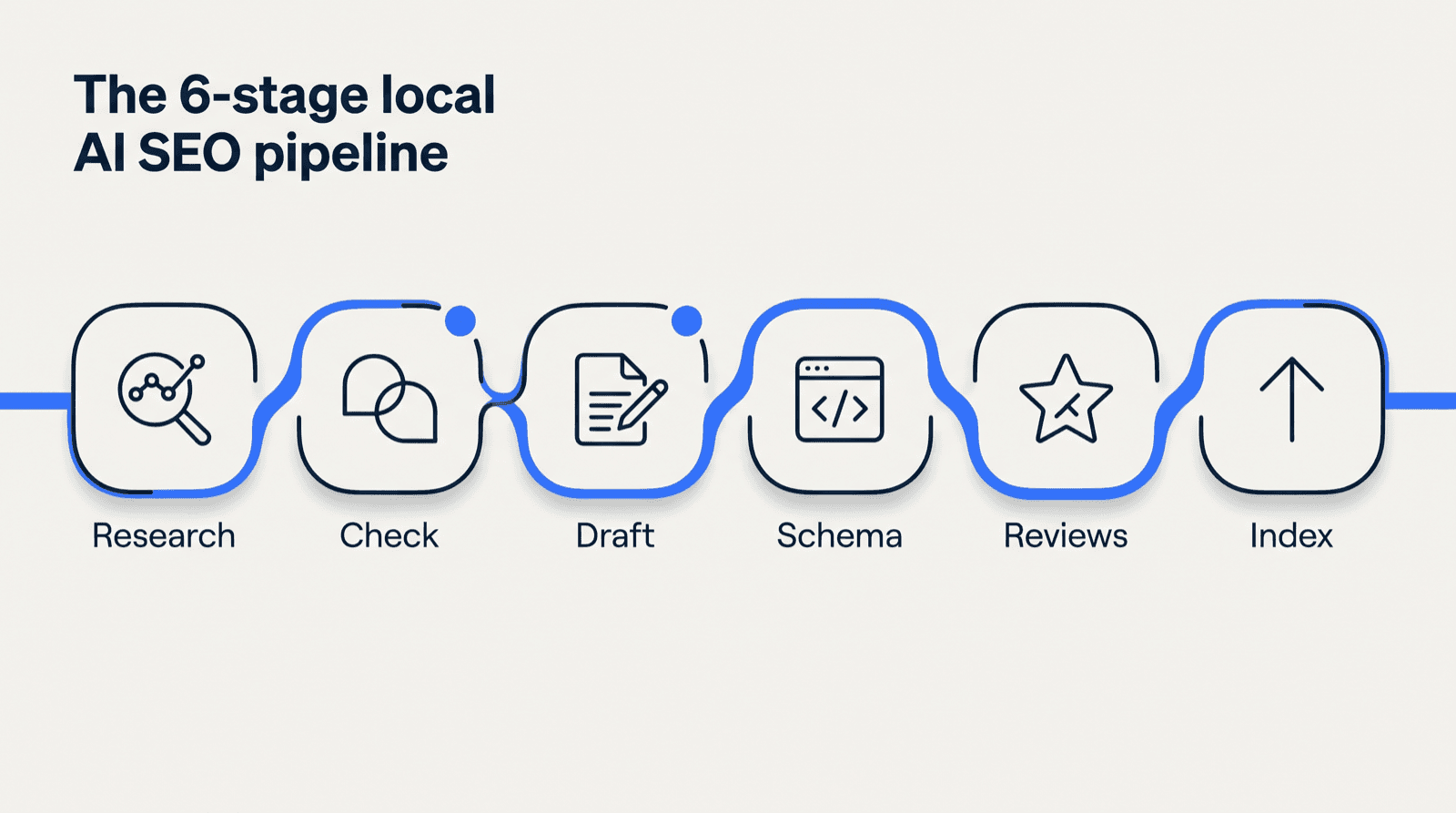
| Stage | What it does | Human in the loop? |
|---|---|---|
| 1. Entity research & data pulls | Pull structured local data per location (citation directories, genuine review data, public registries) to seed the five differentiation inputs. | No (automated); spot-check sources |
| 2. Cannibalisation pre-flight | Run an embedding-similarity check of each draft brief against the live sitemap. If two pages are too close, block before drafting. | No; auto-block above a similarity threshold |
| 3. Differentiated drafting | Generate copy anchored to each location's distinct entities and facts, not a single rotated template. | Yes, brand-voice sign-off on the first pages |
| 4. Schema generation | Apply the correct markup (LocalBusiness or Service + areaServed) and validate it before publish. | No; validated automatically in a Rich Results check |
| 5. Review & reviewer signals | Pull genuine review data into Review / AggregateRating only where it is real. | Yes, never synthesise reviews |
| 6. Indexing & monitoring | Submit via IndexNow, then track rankings and AI-answer appearances at 30, 60 and 90 days. | Review at each checkpoint |
Two stages carry most of the weight. Stage 1 is where differentiation is won or lost: each location gets its own data pull: local citation sources for consistent name, address and phone details; genuine review platforms; and, where relevant, public registries for verifiable local facts. The output is a per-location entity sheet, the raw material the draft is built from.
Stage 2 is the safety valve. Before a single word is written, the planned page is embedded and compared against everything already on the site; anything above a similarity threshold is held back. This one check stops the slow build-up of near-duplicate pages that bleeds cluster authority over time.
A note on the last stage: submission is not indexing. You can ping IndexNow for Bing and its partners, but Google's own Indexing API is still officially limited to JobPosting and BroadcastEvent page types. So for location pages, indexing is earned through internal links and crawl signals, then monitored. The 30/60/90-day window is where you catch a set that is sliding before a core update does it for you.
LocalBusiness vs Service + areaServed: which to use
This is the decision that sinks the most multi-location builds. The instinct is to stamp LocalBusiness on every page. Do that without a real address behind it and you have invented an address, which Google treats as a deception signal, not a markup convenience.
| Scenario | Use | Why |
|---|---|---|
| Real, staffed address in the city | LocalBusiness | Genuine NAP; eligible for the local pack and maps |
| You serve the area but have no office there | Service + areaServed | Defines coverage honestly; avoids fake-address risk |
| Multi-location chain, every branch staffed | LocalBusiness per branch + parent Organization | Each branch is a real, separate entity |
| Franchise network | LocalBusiness per franchisee + brand Organization | Distinct legal entities with distinct NAP |
The full field lists for each type are in the Schema.org LocalBusiness spec and Google's local business structured-data documentation. The rule above is the part most multi-location builds get wrong. Read it twice.
How AI Overviews and ChatGPT choose local businesses
Local SEO and local AI visibility are no longer the same project. Someone asking Google's AI Overview or ChatGPT for "the best physiotherapist near me" never sees your ranking position. They see a synthesised answer that either names you or doesn't.
Two patterns from our own monitoring matter for local pages. Across 55 live SERPs we tracked in this category, AI Overviews appeared on roughly 80% of US queries and 85% of UK queries, and the most-cited domains inside those answers were Reddit (24 citations) and YouTube (14), well ahead of any agency site. Generative engines reward content that reads like real practitioner judgement and is structured for extraction (Search Engine Land, AI Overviews guide; the foundational framing comes from the 2023 GEO: Generative Engine Optimization paper).
For local pages, that means a clear answer in the first 60 words, real local specifics worth quoting, and citation data that stays consistent across platforms. This is generative engine optimisation (GEO) applied locally, and it is why the pipeline's review and entity stages aren't optional decoration. They are the citation fuel. For the autonomy layer underneath, Backlinko's guide to agentic AI protocols and Search Engine Land's agentic SEO guide are the clearest current references.
The pre-launch quality gate
No location page in the set ships until it clears this gate. It is deliberately short, because a checklist nobody runs is worse than no checklist. Run it on a sample of every batch, and on every page where the schema differs.
- Does the page answer the query in the first 60 words?
- Remove the place name: is it still distinguishable from its siblings? (If not, stop.)
- Are at least five location-specific entities present?
- Is there one piece of genuine local proof: a review, case, or data point?
- Is the schema correct for the scenario (and is the address real)?
- Does the markup pass a Rich Results validation?
- Is the cannibalisation similarity score below threshold against the sitemap?
- Are the title and meta unique, not templated to the point of sameness?
- Do the internal links differ from sibling pages?
- Has a human read it end to end before publish?
What the pipeline does not replace
A pipeline raises the floor and lifts the ceiling. It does not make the strategic calls. Which locations are worth a page at all, what genuinely differs between two towns you serve, where the YMYL sensitivities sit: those stay human, and they are where the actual edge lives.
It also won't save a page that has nothing real to say. If a location has no staffed presence, no reviews, no local specifics and no real demand, the honest answer is not a thinner page: it is no page, or a single regional page with honest areaServed coverage. The pipeline is a force multiplier on real local substance. It is not a substitute for it. That is the line between local AI SEO that compounds and the kind that gets deindexed in the next core update.
FAQ
What is local AI SEO?
Local AI SEO is the use of AI-driven pipelines to research, write, mark up and monitor location-specific pages at scale, while keeping each page genuinely distinct enough to avoid Google's thin-content and scaled-content penalties.
Will programmatic location pages get penalised by Google?
Only if they add little value at scale. Google's scaled-content policy targets sameness, not automation. Pages that differ at the data level (real entities, real proof, correct schema) are assessed on their merit, regardless of how they were produced.
What is the minimum for a local page not to be thin?
A practical floor: a definition-first answer in the first 60 words, at least five location-specific entities, one piece of genuine local proof, correct schema, and a unique title and internal-link set. If removing the place name makes the page identical to a sibling, it is thin.
Should I use LocalBusiness or Service + areaServed schema?
Use LocalBusiness only where a real, staffed address exists. For service-area coverage without a physical office in that location, use Service with areaServed. Inventing an address to qualify for LocalBusiness is a documented penalty trigger.
How do AI Overviews and ChatGPT decide which local business to recommend?
They synthesise an answer from sources that read as credible and are easy to extract: definition-first passages, genuine specifics, and consistent citation data across platforms. Ranking position is not the signal; citability and consistency are.
Can AI write location pages without them sounding the same?
Yes, but only when the input data differs per location. The differentiation has to exist before drafting, in the entity research and cannibalisation stages. It can't be papered over afterwards by paraphrasing.
Further reading
Frequently asked questions
- What is local AI SEO?
- Local AI SEO is the use of AI-driven pipelines to research, write, mark up and monitor location-specific pages at scale, while keeping each page genuinely distinct enough to avoid Google's thin-content and scaled-content penalties.
- Will programmatic location pages get penalised by Google?
- Only if they add little value at scale. Google's scaled-content policy targets sameness, not automation. Pages that differ at the data level (real entities, real proof, correct schema) are assessed on their merit, regardless of how they were produced.
- What is the minimum for a local page not to be thin?
- A practical floor: a definition-first answer in the first 60 words, at least five location-specific entities, one piece of genuine local proof, correct schema, and a unique title and internal-link set. If removing the place name makes the page identical to a sibling, it is thin.
- Should I use LocalBusiness or Service + areaServed schema?
- Use LocalBusiness only where a real, staffed address exists. For service-area coverage without a physical office in that location, use Service with areaServed. Inventing an address to qualify for LocalBusiness is a documented penalty trigger.
- How do AI Overviews and ChatGPT decide which local business to recommend?
- They synthesise an answer from sources that read as credible and are easy to extract: definition-first passages, genuine specifics, and consistent citation data across platforms. Ranking position is not the signal; citability and consistency are.
- Can AI write location pages without them sounding the same?
- Yes, but only when the input data differs per location. The differentiation has to exist before drafting, in the entity research and cannibalisation stages. It can't be papered over afterwards by paraphrasing.
Methodology
How we wrote this. The architecture reflects how Aristral builds and maintains location pages for multi-location clients. The AI Overview figures (roughly 80% of US and 85% of UK SERPs in this niche, with Reddit and YouTube the most-cited domains) come from Aristral's own 2026 category research: 55 live SERPs pulled via DataForSEO in May 2026. Those numbers describe this niche, not search as a whole, and schema and policy claims are linked to primary sources inline. The deindexing figures are from publicly documented operator post-mortems and are included as illustration, not guaranteed outcomes. No affiliate relationships, no guaranteed-rankings claims, and no fabricated case studies. Where a term has weak or unverified search volume, we say so rather than imply demand the data doesn't support. Written and maintained by Taha Bilal, who runs Aristral's SEO and generative engine optimisation work. Questions or corrections: admin@aristral.com.
About the author
Taha Bilal
Co-founder, Aristral
Taha Bilal is a co-founder of Aristral, a UK AI automation and SEO agency based in Clifton, Bristol. He has been running SEO and digital-growth campaigns for SMB and SaaS clients since 2018, and now leads Aristral's combined SEO + GEO programmes for service businesses across the UK and US. Corrections and source requests: admin@aristral.com.
LinkedIn →