SEO
Clearscope Review: How We Use It Alongside Our Own AI Pipeline, and Why We Haven't Replaced It
Clearscope review from a paying customer who also builds the automation meant to replace it: what our AI pipeline took over, the three jobs we still route through Clearscope, what it costs, and why it stays a checkpoint, not a controller.
Key takeaways
- Clearscope grades a draft against the pages already ranking. It doesn't research, build schema, link, or publish, so it was never going to replace a full pipeline.
- We automated the manual optimisation work and kept Clearscope for the part automation shouldn't own: an independent grade.
- On the entry plan (about $129/month, roughly £102) you pay around £5 a report. Cheap as a check, expensive as your only optimisation layer.
- Term coverage and AI Overview citability overlap, but they aren't the same target. Clearscope scores the first, not the second.
- The verdict: keep it as a checkpoint, not a controller.
Short version of this Clearscope review: we still pay for it, we use it for a narrower job than we used to, and we're not dropping it. That's an odd thing for an AI SEO agency running its own content pipeline to admit, so it's worth setting out properly. Most Clearscope write-ups come from the vendor or from affiliates earning a cut. This one is from a paying customer who also builds the kind of automation that's meant to make a tool like Clearscope pointless.
Here's what actually happened when we built that automation: it replaced the manual part, not the judgement part. Below is which tasks moved into the pipeline, which three stayed with Clearscope, what it costs, where it runs out of road, and how it fits a workflow that now has to win in AI answers as well as classic search.
What Clearscope actually does
Clearscope is a content optimisation tool. It scores a draft against the terms and entities that currently rank for a target keyword, grades coverage from A++ down to F, and flags readability gaps so a writer can close them before publishing. It doesn't crawl your site, generate schema, map internal links, or push anything live. That one paragraph is the whole product, and knowing where it stops is the trick to using it well.
The grading model is the good bit. Clearscope builds its term list from live top-ranking pages for your query, so the score is an outside-in signal rather than a hunch. For a writer staring at a blank document, that's a genuinely useful target to aim at. The catch, which I'll come back to, is that term coverage is a proxy for relevance. It isn't the same as being relevant, and it definitely isn't the same as being quotable to an AI engine.
What our AI pipeline took over
We run an in-house agentic SEO content pipeline. Without naming the plumbing, it covers the full chain: SERP and competitor analysis, keyword and entity research, brief construction, drafting with a separate fact-checking pass, schema, internal links, publishing, indexing, and reporting. The category only picked up an industry-press name in early 2026 (Backlinko; Search Engine Land's agentic SEO guide), but the practice is just SEO an agent plans and executes end to end instead of a person doing it a step at a time.
A lot of what Clearscope used to anchor now happens before a draft ever reaches it. Entity research, the brief, and first-pass term coverage are all built from the same live SERP data, so a draft tends to land on a strong Clearscope grade first time rather than being optimised up to one afterwards. That quietly changes Clearscope's role from the thing that drives the work to the thing that checks it.
Clearscope grades content against what already ranks. Our pipeline decides what should rank. Those are different jobs, which is the whole reason both still sit in our stack.
The three jobs we still route through Clearscope
If the pipeline handles the research, the brief, and the draft, why keep paying? Because three jobs are ones automation shouldn't quietly swallow. Here they are, in the order they earn their keep.
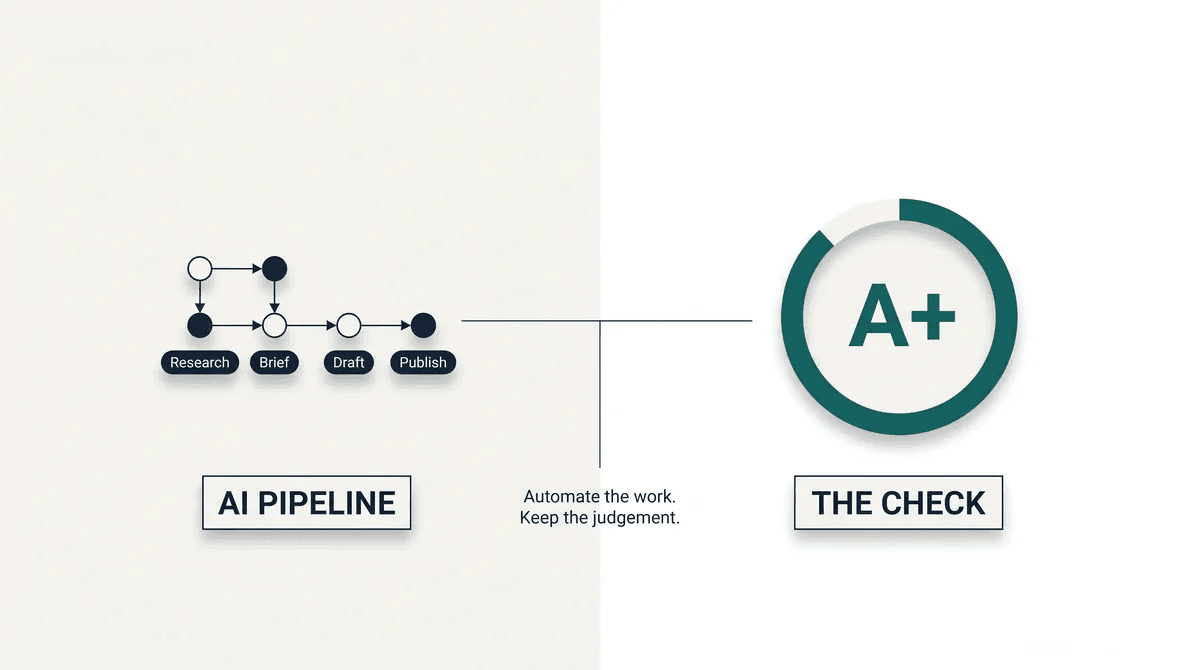
- An independent grade. A model that wrote a draft is a lousy judge of that draft. Clearscope's grade is calibrated on the live SERP, not on our own assumptions, so it's a second opinion we didn't generate ourselves. We automated the work Clearscope made manual and kept it for the one thing automation should never do: mark its own homework.
- A shared editor for human writers. Plenty of client content still passes through an in-house writer or a freelance subject expert, especially in regulated work like legal and aesthetics where a named human has to own the words. Clearscope's editor gives everyone the same surface to read. That beats handing a non-technical writer a raw entity list and hoping for the best.
- A benchmark clients recognise. "Our internal score says this is good" lands badly in a client meeting. "This graded A+ in Clearscope" is a recognised, vendor-neutral proof point. Same grade underneath, very different credibility.
Notice none of those are about speed. That's the pattern. We automated throughput and kept Clearscope for the verification we don't want a machine marking on its own.
Clearscope vs our pipeline, side by side
The clearest way to show the split is job by job: where each one is a real strength, where it's only partial, and where it simply doesn't do the job at all.
| Job | Clearscope | In-house AI pipeline |
|---|---|---|
| Content grading vs the live SERP | Core strength | We grade, but avoid scoring our own drafts |
| Keyword and entity research | Term list only | Full research and clustering |
| Brief generation | Outline and terms | Structured, intent-mapped briefs |
| Drafting | Not a writer | Drafts plus a separate fact-check pass |
| Schema and structured data | None | Generated and validated |
| Internal linking | None | Site-wide mapping |
| Publishing and indexing | None | Direct to CMS |
| Reporting | None | Search Console and analytics pulls |
| GEO / AI Overview structuring | Indirect, via coverage | Built into the brief |
| Cost model | Per report or per seat | Flat per output |
| Best for | A neutral quality check | End-to-end production |
Read down the Clearscope column and the shape is obvious. It's an excellent grader and nothing else, which is fine as long as you don't expect it to behave like an AI SEO services platform.
Clearscope pricing: is it worth it for an agency?
When I last checked, in May 2026, Clearscope's entry tier (Essentials) sat at around $129 a month, roughly £102, billed monthly, with about 20 content reports and unlimited users. The Business tier ran to roughly £315 a month. I confirmed the entry figure against Clearscope's own pricing page; treat any number here as a checkpoint rather than gospel, because pricing in this category moves around.
The number that matters is cost per report. At about 20 reports for ~£102, you're paying roughly £5 a report on Essentials. As a quality check on content you were producing anyway, £5 is nothing. As your main optimisation engine for an agency shipping dozens of pieces a month, the per-report model is the wrong shape, and the entry tier has no API, so you can't wire it into an automated workflow at the price most agencies start on.
The cheapest content tool is the one you don't have to second-guess. Clearscope clears that bar as a grader. It doesn't clear it as a pipeline, because there's no pipeline to buy.
Where Clearscope falls short
A fair review has to name the gaps. None of these are reasons to avoid it. They're reasons not to lean on it for things it was never built to do.
- The plan most teams start on has no API, which makes it awkward to automate anything around it.
- The per-report model rewards careful, lower-volume publishing and punishes scale.
- It grades term coverage, not citation-readiness. A page can hit A++ and still be poorly structured for an AI answer.
- It stops at the draft. No schema, no internal links, no publishing, no indexing, no reporting.
- It's English-first, so coverage scoring is weaker for multilingual or MENA work.
Clearscope and the AI Overviews problem
This is the part most 2026 tool reviews skip. Search isn't only about ranking any more; it's increasingly about being cited inside an AI answer. In our own SERP monitoring across the AI-SEO category, AI Overviews fired on roughly 80% of US queries and 85% of UK ones, and the most-cited sources were overwhelmingly Reddit and YouTube, then a handful of established SEO publications. Strong term coverage alone won't get you into that box.
Generative Engine Optimisation, the discipline of structuring content so AI engines will quote it, was first framed in a 2023 Princeton, Georgia Tech and Allen Institute paper (Aggarwal et al., "GEO: Generative Engine Optimization"), which found that how a passage is phrased and sourced changes its odds of being cited. Practitioner guidance since then, from WordStream to Search Engine Land's AI Overviews guide, points the same way: definition-first answers, self-contained passages, FAQ blocks, clean schema.
Clearscope optimises for term coverage. AI Overviews reward citable passages. The two overlap, but they're not the same target. Clearscope can confirm you've covered the topic. It can't tell you whether your first 40 words answer the question cleanly enough for an engine to lift them. That's a brief decision, not a grading decision, which is why we handle it upstream and treat the grade as a final sanity check. If GEO is new to you, our GEO work goes into it properly.
Clearscope review verdict: keep it as a checkpoint, not a controller
Clearscope earns its place in our stack, with conditions. It's worth keeping if you want an independent, SERP-calibrated grade, a shared editor for human writers, and a benchmark clients already trust. Don't expect it to research, structure for AI citation, build schema, link, publish, or scale cheaply, because it does none of that. And I'd only replace it if you genuinely trusted your own grade more than a vendor-neutral one, which, if you built that grade yourself, you probably shouldn't.
If you're weighing it against the alternatives, the short version: Surfer leans toward on-page term targeting and SERP analysis, Frase toward fast brief generation, MarketMuse toward topic-model planning, and Clearscope toward grading rigour and a clean editor. For a fuller picture of where each fits an automated workflow, see our agentic SEO work.
FAQ
Is Clearscope worth it in 2026?
Yes, as a content-grading checkpoint rather than a full SEO platform. At roughly £5 a report on the entry tier, it's cheap insurance on content you were producing anyway. It's poor value if you expect it to research, structure for AI citation, or publish, because it does none of those things.
Can an AI pipeline replace Clearscope?
It can replace the manual optimisation Clearscope automates, but not cleanly the independent grade it gives you. A model that drafted a page is a weak judge of that page, so a vendor-neutral grade calibrated on the live SERP is worth keeping as a second opinion.
Clearscope vs Surfer vs Frase: which is best for an agency?
It depends on the job. Surfer is strongest for on-page term targeting and SERP analysis, Frase for fast brief generation, and Clearscope for grading rigour and a clean editor for human writers. Agencies running content at scale usually pair one grader with their own research and publishing workflow rather than relying on a single tool for everything.
Does Clearscope help you rank in Google AI Overviews?
Only indirectly. Strong topical coverage helps, but AI Overviews reward citable, self-contained passages, FAQ structure, and clean schema, none of which Clearscope scores. Treat its grade as a coverage check and handle citation structure in the brief.
How much does Clearscope cost, and does it have an API?
When checked in May 2026, Clearscope's Essentials tier was around $129/month (~£102) with about 20 content reports and unlimited users; the Business tier was roughly £315/month. The entry tier doesn't include API access, which limits automated integration. Confirm current figures on the vendor's pricing page before budgeting.
Further reading
- Aristral: GEO vs SEO, what actually changed
- Aristral: how to build a local AI SEO pipeline
- Aristral: what the Google helpful content update means for service businesses
- Princeton, Georgia Tech & Allen AI: GEO: Generative Engine Optimization (foundational paper)
- Search Engine Land: how to optimise for AI Overviews
Frequently asked questions
- Is Clearscope worth it in 2026?
- Yes, as a content-grading checkpoint rather than a full SEO platform. At roughly £5 a report on the entry tier, it's cheap insurance on content you were producing anyway. It's poor value if you expect it to research, structure for AI citation, or publish, because it does none of those things.
- Can an AI pipeline replace Clearscope?
- It can replace the manual optimisation Clearscope automates, but not cleanly the independent grade it gives you. A model that drafted a page is a weak judge of that page, so a vendor-neutral grade calibrated on the live SERP is worth keeping as a second opinion.
- Clearscope vs Surfer vs Frase: which is best for an agency?
- It depends on the job. Surfer is strongest for on-page term targeting and SERP analysis, Frase for fast brief generation, and Clearscope for grading rigour and a clean editor for human writers. Agencies running content at scale usually pair one grader with their own research and publishing workflow rather than relying on a single tool for everything.
- Does Clearscope help you rank in Google AI Overviews?
- Only indirectly. Strong topical coverage helps, but AI Overviews reward citable, self-contained passages, FAQ structure, and clean schema, none of which Clearscope scores. Treat its grade as a coverage check and handle citation structure in the brief.
- How much does Clearscope cost, and does it have an API?
- When checked in May 2026, Clearscope's Essentials tier was around $129/month (~£102) with about 20 content reports and unlimited users; the Business tier was roughly £315/month. The entry tier doesn't include API access, which limits automated integration. Confirm current figures on the vendor's pricing page before budgeting.
Methodology
How we put this together. This review reflects our own use of Clearscope inside a working AI content pipeline, plus Aristral's live SERP and AI Overview monitoring across the AI-SEO category. Pricing was checked against Clearscope's public pricing page in May 2026 and is dated for that reason, because software pricing in this category changes often: treat the figures as a starting point and confirm the current numbers before budgeting. The AI Overview figures (AI Overviews firing on roughly 80% of US and 85% of UK queries in this niche, with Reddit and YouTube the most-cited sources) come from our own DataForSEO SERP monitoring and describe this category, not search as a whole. We hold no affiliate, partner, or commercial relationship with Clearscope and pay for it like any other customer. Where our own tooling comes up, we describe what it does rather than how it is built. Written by Taha Bilal, who founded Aristral in 2024 and still runs the agency's SEO and GEO work himself. Questions or corrections: admin@aristral.com.
About the author
Taha Bilal
Co-founder, Aristral
Taha Bilal is a co-founder of Aristral, a UK AI automation and SEO agency based in Clifton, Bristol. He has been running SEO and digital-growth campaigns for SMB and SaaS clients since 2018, and now leads Aristral's combined SEO + GEO programmes for service businesses across the UK and US. Corrections and source requests: admin@aristral.com.
LinkedIn →