AI automation agency, Scotland
AI Automation for Inverness Businesses: When Every Enquiry Peak Costs You Hours
By Taha Bilal, Founder of Aristral · Reviewed by Huzaifa Jan Asim, CTO (developer@aristral.com)
Last updated: 30 June 2026
Picture two businesses on opposite sides of Inverness. A small Highland tourism operator spends May through August drowning in repetitive booking questions: the same five queries sent by visitors who found the website at 11pm. A renewables-services company has two people manually pulling data from inspection reports into spreadsheets so they can file compliance submissions on time. Neither business has an IT department. Both are hiring to solve a problem that software should already be handling.
That is the pattern we see most often when we scope automation projects in Scotland: not a shortage of demand, but operational capacity eaten by repeatable manual tasks. Our approach is scope-first: we identify which workflows are worth automating, tell you plainly when a manual process is cheaper to keep, and deliver entirely remotely. This page sets out what AI automation can do for Inverness-area businesses, which workflows to target first, and how we get you from scoping call to working system.
Why Remote Highland Operations Make Automation Worth It
Workflow automation is software that runs a repeatable business process end-to-end without manual steps. A rule fires, data moves, a response goes out, a document is classified: nobody has to touch it. For a team of four or five people operating across a Highland service catchment that spans vast distances, that definition is not abstract. It is the difference between a member of staff spending a Tuesday morning chasing inspection forms or actually completing fieldwork.
The Highland capital sits at the centre of a wide service catchment. Tourism routes draw visitors in volume from spring through autumn. Renewables infrastructure spans enormous distances. Public-sector services cover communities that a larger city would reach with a depot around the corner. Thin staffing and high workload density are structural features of running a Highland business, not temporary growth pains. Automation is the practical answer.
The Highland Council Digital Strategy reflects this reality at the regional level. Inverness-area businesses that engage with it find the infrastructure and intent for digital adoption is there. The bottleneck is usually implementation: knowing which process to automate first, and building it in a way that connects to the tools and data the business actually uses.
Highland seasonal tourism is concentrated into a short summer window, which makes automated enquiry handling during peak months one of the strongest ROI cases we see in any UK context.
The Day You Realise You Are the Bottleneck
Tourism and Hospitality
When we scope a tourism or hospitality workflow, the first thing we look at is where the business owner becomes the single point of contact. Seasonal Highland tourism enquiry peaks are the clearest example. Between June and September, a well-reviewed Highland guesthouse, tour operator or visitor attraction can receive enough inbound enquiries to justify a full-time front-desk role. That role is often filled by the owner, or not filled at all.
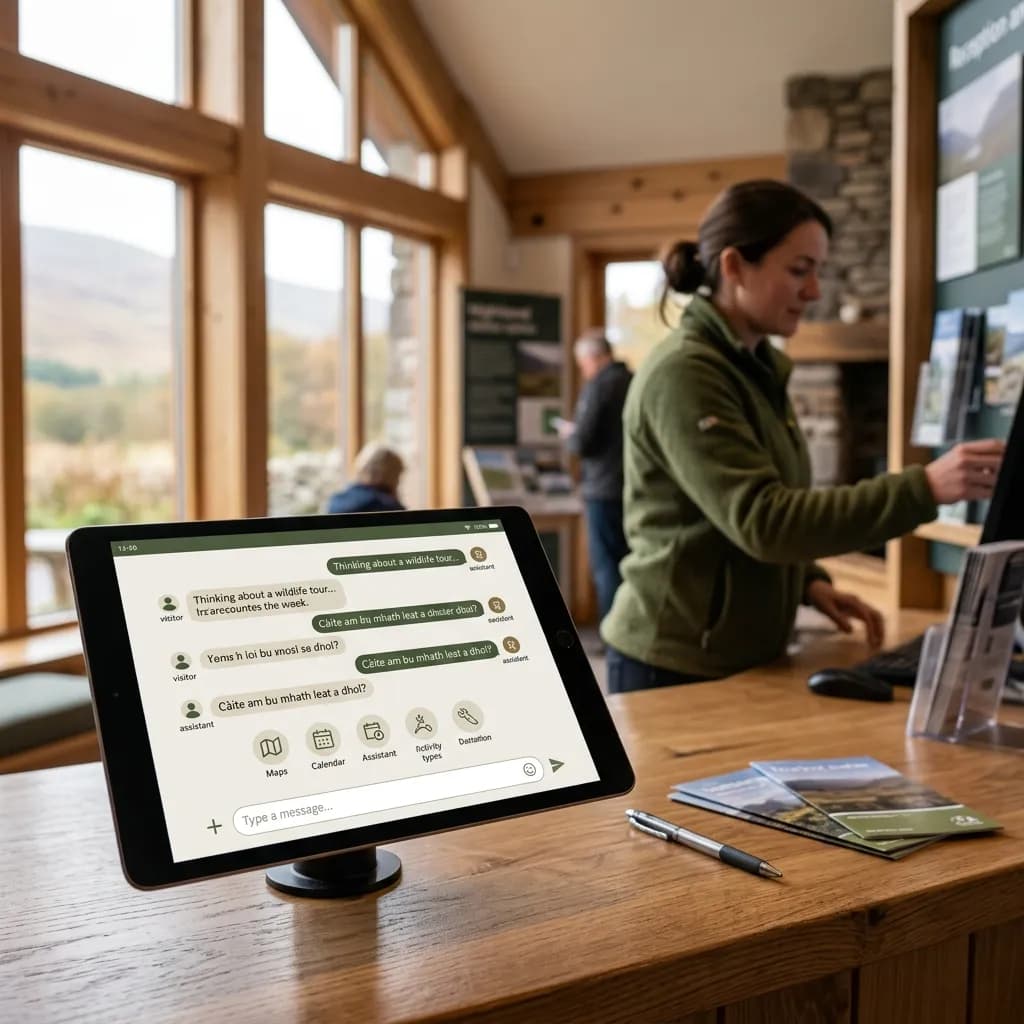
The result is predictable: enquiries sit unanswered for hours, potential bookings go elsewhere, and the team spends half the working day on questions the website should already have answered. An AI customer support chatbot handles first-contact booking enquiries, answers questions about availability, opening times and pricing, and passes genuinely complex cases to a staff member. It runs at midnight when you do not. Highland tourism draws visitors from across Europe and beyond, so a chatbot configured for multiple languages removes a barrier without requiring a multilingual hire.
Energy and Renewables
The renewables and energy services picture is different in character but shares the same root problem: time spent on administration that could be spent on delivery. Inverness sits at the gateway to a growing energy corridor, and the Highland region's renewables pipeline spans enormous distances. Compliance documents, inspection records and asset data reports arrive from engineers in the field and sit waiting for someone in the office to process them. Intelligent document processing uses AI to read, extract and route structured data from unstructured documents automatically. A field inspection report filed on a tablet becomes a formatted entry in the right system within minutes, not days. Document processing automation is rarely glamorous, but in a sector where compliance timelines are hard deadlines, it is high-value work.
Where to Start: Inverness Industries and Which Workflows to Tackle First
The three main verticals in the Inverness area each have a different automation entry point. The table below shows where the effort goes furthest.
| Vertical | Highest-frequency pain | First system to build | |---|---|---| | Tourism and hospitality | Enquiry volume peaks June to September | AI customer support chatbot with multilingual config | | Energy and renewables | Compliance paperwork from field to office | Document processing automation (inspection reports and submissions) | | Public sector and professional services | Case routing and acknowledgement delays | Lead routing automation and resident-enquiry triage |
Tourism and Seasonal Hospitality
We map our hospitality work closely to the seasonal demand patterns that define Highland tourism. Automation here is not about replacing staff. It is about making sure the staff you have are working on things that require a human: guest experience, local knowledge, problem-solving. The repeatable tier, enquiry handling, booking confirmation, review prompting, occupancy reporting, runs on systems that do not need a person to trigger them.
For most Highland hospitality operators, the chatbot is the right starting point: high volume, repeatable questions, and a genuine cost to leaving them unanswered overnight.
Energy and Renewables
For the energy and renewables sector, the automation opportunity is concentrated in two places. First, the document flow from field to office: inspection reports, compliance submissions, maintenance records. Document processing automation handles this at the extraction and routing layer. Second, the reporting and analysis layer: asset performance data that currently lives in spreadsheets and gets pulled together manually before a client meeting can instead be surfaced on demand via sales intelligence RAG.
Operators with rolling compliance deadlines should start with document processing. The reduction in manual extraction time is immediate and measurable.
Public Sector and Professional Services
Public-sector and professional-services organisations in and around Inverness face a third pattern: case handling and routing that creates delays for residents and staff alike.
Highland Council housing and planning triage
A resident submits a planning-permission enquiry or application acknowledgement request. It lands in a shared inbox, and someone must read it, decide which team handles it, log it in the case management system and send an acknowledgement. With an automated triage workflow, an inbound form submission is classified by enquiry type, routed to the correct planning officer's queue and an acknowledgement is sent to the resident, all before a staff member has opened their inbox. The response time drops from hours to minutes; the audit trail is automatic.
Regional grant application and digital-inclusion programmes
Regional grant-application and digital-inclusion programmes for rural Highland communities follow the same logic. An applicant submits a query form outside office hours. The automation classifies it, queues it for the right programme manager and sends the applicant a same-night confirmation that their query has been received. Neither interaction requires a staff member to be on call.
Broader resident and commercial enquiry routing
A resident-enquiry chatbot handles the broader first-contact triage step by topic, logs the case automatically and replies outside office hours. Lead routing automation applies the same logic to commercial operations: an inbound request is categorised, routed to the right person and logged without anyone manually deciding where it should go. The result is faster response times and a visible case trail that managers can audit.
The Aristral Approach: Scope First, Build What Is Worth It
Most automation projects fail not because the technology was wrong but because the scope was wrong. Someone automated a process that happens twelve times a year. The build took six weeks. The value was never there.
Our starting point is process discovery: identifying the workflows that are genuinely high-frequency, high-cost, or bottleneck-creating, and being direct about the ones that are not worth building. We tell clients when a manual process is faster or cheaper to keep as-is. That directness is part of the job, and it is why mid-funnel buyers who have spoken to other agencies come back to us. We deliver entirely remotely and client data stays in their control: it is never used to train external models.
Most agencies start with a product; we start with your process map.
Where a typical agency starts with a product and looks for a place to fit it, we start with your process map and work out whether a product is warranted at all. That means some scoping calls end with us recommending you do not build anything yet. It also means the builds we do recommend have a clear, agreed-upon reason to exist before a line of code is written. If you have already been through a vendor demo cycle that ended with a proposal for a platform you did not fully understand, this is the practical difference: you will know exactly what you are getting, why it solves the specific bottleneck we identified, and what it will not do.
For packaged solutions, including the AI customer support chatbot, lead routing and document processing systems, typical deployment is around 21 days from scoping sign-off. Custom builds, involving integration with sector-specific platforms or a bespoke document extraction pipeline for renewables compliance, take 4 to 8 weeks.
If you are an Inverness-area business considering automation for the first time, the right starting point is a scoping conversation, not a technology decision. The first call is a structured process-mapping session, typically under an hour, where we walk through your highest-frequency manual workflows and identify which are worth automating. Within five working days of that call, we deliver a written recommendation covering what to build, what to leave alone, and a realistic timeline. Most teams find that is enough to make a decision without any further sales process. To get that conversation started, talk to our team.
You can also see AI automation across the UK for context on how we work in different city-size and industry contexts.
Author
Taha Bilal is the founder of Aristral, a UK AI automation and SEO agency based in Clifton, Bristol. He has run SEO and digital-growth campaigns for SMB and SaaS clients since 2018 and now leads Aristral's AI automation and GEO programmes for service businesses across the UK and US. This page was reviewed by Huzaifa Jan Asim, CTO (developer@aristral.com).
Structured Data
Packaged solutions
Not every Inverness business needs a custom build. These solutions cover common automation needs and are scoped around your workflow, data and approvals.
AI customer support chatbot
Trained on your docs and tickets. Escalates when confidence is low or a human is requested.
Lead routing automation
Score, deduplicate, and route inbound leads to the right owner from forms, ads, or partner feeds.
Document processing automation
Turn PDFs and email attachments into structured data your CRM and workflows can act on.
Sales intelligence RAG
Assistants over playbooks, transcripts, and CRM notes for call prep and follow-ups.
More Aristral services in Inverness
AI automation can sit alongside our SEO, web development and CRM integration work.
Industries we serve in Inverness
Industry-specific automation patterns, not generic chatbot pitches.
FAQs: AI automation in Inverness
Can a chatbot actually handle seasonal Highland tourism enquiries?▼
Can automation process renewables and energy compliance documents?▼
Does your chatbot support multilingual visitor enquiries?▼
Do you work with remote Highland SMEs, or only larger city-based businesses?▼
How quickly can a first automation system go live?▼
Do I need to be in Bristol to work with you, or can the whole project happen remotely?▼
Areas we serve near Inverness
We also work with teams in these locations:
Ready to automate workflows in Inverness?
Book a free 30-minute strategy call. We review your operations, prioritise high-impact automation, and give a straight answer on what is worth building.