SEO
AI SEO Agencies in 2026: Honest Pricing, Real Stacks, and Where an AI SEO Agency Actually Helps
An honest look at what an AI SEO agency actually does in 2026, how the market prices itself, where AI helps, and how to choose one without getting burned.
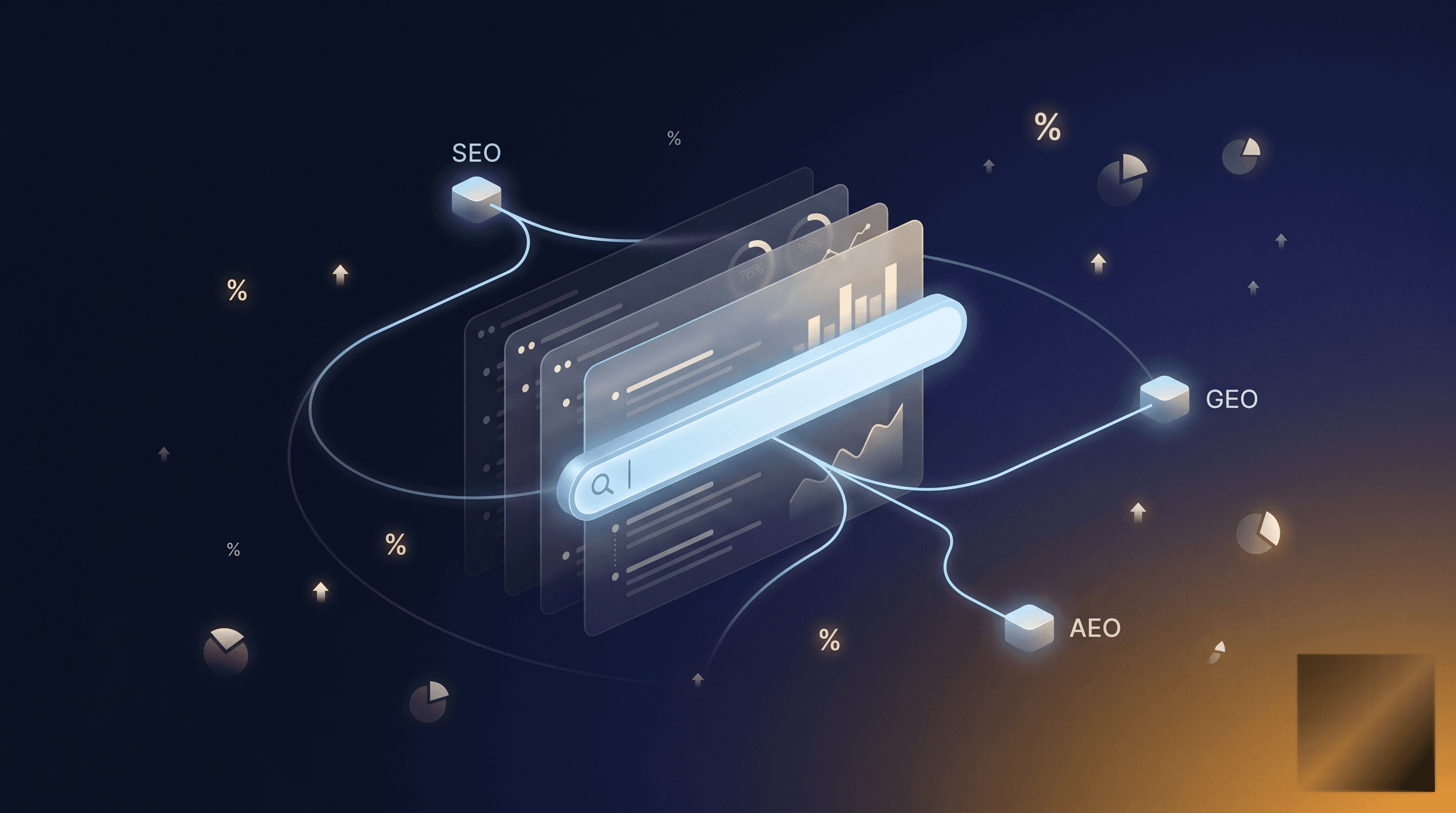
An AI SEO agency uses large language models, autonomous agents, and SERP-aware tooling to plan, write, optimise, and report on search work, usually for a fixed monthly retainer. By 2026 the category has split into three bands: agencies running genuine agent stacks end-to-end, a larger middle wrapping Surfer or Frase with a PDF report, and a tail selling ChatGPT subscriptions at a heavy markup. This article cuts through the marketing. It covers what these agencies actually deliver, how they price themselves, where AI earns its fee, and where you are still paying for human judgment dressed up as automation.
Key takeaways
- An AI SEO agency typically runs on a flat monthly retainer, delivering done-for-you SEO using LLMs and agentic workflows across research, writing, schema, and reporting.
- Most "AI" in this market is content generation. True agentic SEO (autonomous research, decisioning, and iteration) remains uncommon.
- AI works well for brief generation, schema markup, internal linking, cannibalisation checks, and report synthesis. It struggles with strategy, brand voice, and YMYL content.
- Cost comes from output volume, market scope, and whether Generative Engine Optimisation and Local SEO are included from day one: not from the word "AI" on the invoice.
- Hire an agency when you need done-for-you delivery. Buy tools if you have a writer and strategist in-house. Do neither until you have someone owning the brief queue.
Table of contents
- What an AI SEO agency actually is
- What buyers are really paying for
- The real stack behind most AI SEO agencies
- Where AI actually helps in SEO
- Where AI doesn't help: what still needs human judgment
- AI SEO agency vs tool vs in-house: when each wins
- Pricing models: what really drives cost
- Three tiers of buyer: match what you need to what you buy
- How to choose an AI SEO agency without getting burned
- Who should not hire an AI SEO agency
What an AI SEO agency actually is
An AI SEO agency is a delivery business that uses AI to do the work, not just talk about it. The "AI" usually means three things: LLMs that draft and optimise content, agentic workflows that automate research and publishing, and machine learning that scores or audits pages at scale. A genuine agency uses all three to varying degrees.
A few related categories get conflated with AI SEO agencies:
- AI-assisted SEO. A human SEO uses Claude or ChatGPT to write faster.
- Agentic SEO. Autonomous agents plan, execute, and iterate across the SEO lifecycle with tool-calling and decision loops (Search Engine Land, Agentic AI in SEO).
- Generative Engine Optimisation. Content written for citation inside AI Overviews, ChatGPT, and Perplexity.
- Programmatic SEO. Pages generated at scale from structured data sources.
- Rule-based automation. Deterministic tasks like IndexNow pings or sitemap regeneration.
A genuine AI SEO agency uses most of these. A weak one uses none and charges anyway.
What buyers are really paying for
Most buyers think they are paying for "AI." They are not. They are paying for four things, in order of what actually moves rankings:
- Brief quality and editorial judgment. A good brief beats a great writer. AI helps build briefs faster, but deciding which keywords to chase, which competitors matter, and what already lives on your site is human work.
- Production capacity. AI lets a small agency produce what a 10-person agency used to. That is real, but it shows up as output volume and turnaround time, not magic.
- A working delivery stack. Most agencies cannot describe their own pipeline. The ones running research-agent, brief-agent, draft-agent, fact-check-agent, and schema-agent pipelines are charging for the stack, not the seat.
- Reporting and accountability. AI Overviews changed what wins look like. A modern agency tracks citation visibility inside AI answers, not just position 1 on Google. If your agency only reports rankings, they are selling 2022's product.
The difference between a small retainer and a large one is almost never the AI itself. It is the volume of articles, the depth of strategy, and whether Generative Engine Optimisation and Local SEO are included natively.
The real stack behind most AI SEO agencies
Most credible 2026 AI SEO agencies run a variant of the same stack. Names change, but the layers do not.
| Layer | Function | Common 2026 choice |
|---|---|---|
| Orchestrator | Routes work across agents, holds state | LangGraph, custom Python, n8n |
| Models | Drafts, briefs, judging | Claude (Sonnet, Opus, Haiku), GPT-5, Gemini 2.5 Pro |
| SERP + keyword data | Volume, KD, SERP composition | DataForSEO, SEMrush API, Ahrefs API |
| Crawl | Site + competitor reads | Firecrawl, Apify, Screaming Frog CLI |
| Image | Hero + diagrams | Nano Banana (Gemini Image), Ideogram, Flux |
| Schema | Structured data generation + validation | schema-dts, Rich Results Test in CI |
| Internal linking | Cosine retrieval over site corpus | pgvector on Supabase, Turbopuffer |
| Reporting | GSC + GA4 + AI Overview tracking | Looker Studio, custom Next.js dashboard |
Cost discipline is where most agencies fail. Routing Haiku for crawl triage, Sonnet for briefs and drafts, and Opus only as a final judge saves significantly on token spend according to documented routing benchmarks (Morph LLM, LLM Cost Optimization). Agencies that do not route end up either burning margin or quietly downgrading to cheaper models without telling you.
Where AI actually helps in SEO
The honest list is shorter than marketing claims:
- Brief generation. A well-prompted LLM over a SERP top-10 snapshot produces a usable 1,500-word brief in 90 seconds. A human takes 2–4 hours.
- First drafts at scale. AI can produce a publishable-after-edit 2,000-word draft from a brief in under a minute. The bottleneck is the brief, not the writing.
- Schema generation. Structured data is repetitive and deterministic. This is where AI works best. Pair it with Google's Rich Results Test in CI and you eliminate the most common cause of lost rich results (Schema Engine, Schema Markup Validator Guide).
- Internal link suggestions. Embedding the live sitemap and running cosine similarity against new drafts surfaces internal link targets a junior SEO would miss.
- Report synthesis. Pulling GSC, GA4, and AI Overview mentions into a coherent monthly narrative is something AI does better than most account managers.
- Cannibalisation pre-flight. Embedding-similarity checks against the live site corpus before drafting catch duplicate-intent posts before they ship.
These wins compound. An agency automating all six gives a strategist back the majority of their week, which is where real margin comes from.
Where AI doesn't help: what still needs human judgment
The list of things AI is still unreliable at is longer than vendors admit:
- Strategy and prioritisation. Deciding which of three plausible content directions moves a business forward is a judgment call AI cannot make without losing focus.
- Brand voice on the first 5 drafts. New clients need human voice calibration. After that, retrieval-augmented drafting works. Before that, it hallucinates a tone.
- YMYL content. Legal, medical, and financial content carries regulatory exposure. Human review is non-negotiable.
- Fact-checking with real consequences. AI-generated answers are not reliable enough to ship unsupervised at scale (analysis via OpenPR on what core updates did to AI content sites). At agency volume even a small error rate means a real percentage of drafts shipping with confident factual mistakes.
- Schema mass-changes. One bad markup deployment can wipe rich results across 10,000 URLs. Human approval is non-negotiable.
- Disavow files. Irreversible at the Google Search Console layer. Never let an agent commit one.
Any agency claiming "fully automated SEO" with no human review is either lying or about to ship a Google update wipeout. HubSpot lost 70–80% of organic traffic between November 2024 and Q2 2025 partly through over-automation (ALM Corp, AI Overviews and Publisher Traffic). It happens to companies with infinitely more resources than your agency.
AI SEO agency vs tool vs in-house: when each wins
| Dimension | AI SEO tool | AI SEO agency | In-house SEO |
|---|---|---|---|
| Onboarding time | Hours | 1–2 weeks | 4–12 weeks to first output |
| Skill required in-house | High (needs strategist + writer) | Low (feedback only) | Highest (full SEO team) |
| Time-to-first-published-article | Days, if you have a writer | 5–10 days | 4–8 weeks |
| Strategy included | No | Yes | Yes |
| Content production speed | High (you write) | High (they write) | Medium (you write) |
| Risk if you stop paying | Workflows continue | Output stops | Output continues |
| GEO + Local SEO covered | Rarely | Sometimes | If staffed for it |
| Best for | Founder with a writer | SMB or SaaS scaling content | Brands above 8-figure revenue |
The right call usually breaks down by company stage. A pre-revenue founder should buy an entry-level SEO content tool and a small SERP optimisation credit. A scaling SMB should hire an agency. A larger brand should build in-house with one or two AI SEO services engagements as fractional support.
The hybrid model of tool subscription plus a fractional agency partner works better than people expect. It requires a single person inside the business owning the brief queue.
Pricing models: what really drives cost
AI SEO agency pricing in 2026 falls into four shapes.
| Pricing model | Common offer | Watch out for |
|---|---|---|
| Per-article | Fixed fee per published piece, often bundled into a monthly cap | Volume gets you priority, not quality |
| Flat monthly retainer | Fixed deliverables across content, technical, schema, and reporting | Vague scope. Confirm what is included in writing. |
| Task-based / credit | Usage-priced; pay per execution or per credit | Forecasting is impossible at scale; costs spike under load |
| Performance / pay-on-rank | Nothing upfront, percentage of ranking value or revenue | Misaligned for YMYL or brand-sensitive sites |
Three things drive cost more than anything else:
- Output volume. Ten articles a month differs materially from a hundred. AI shifts the slope of that curve down, but it does not flatten it.
- Market scope. Single market (UK only) costs less than multi-market (UK + US + DACH + MENA). Localisation, hreflang, and per-market SERP analysis stack up fast.
- Generative Engine Optimisation and Local SEO inclusion. Done-for-you GEO and multi-location Local SEO can materially increase the cost of a base retainer if they are not part of the core package. Many agencies advertise these as included, then quietly charge extra. Always confirm in writing.
Three tiers of buyer: match what you need to what you buy
Cost scales with what you actually need. Three buyer profiles cover most of the market. Identify yourself in one before you read a single pricing page.
Tier 1: Owner-operated business or pre-Series-A startup
Five to fifteen articles a month, single market, single CMS, light strategy because the business model is still simple. You need predictability, fast turnaround, and a partner who ships without a 20-tab project plan. The right buy is a small flat retainer, a senior fractional contractor, or a quality SEO content tool paired with one in-house writer.
Tier 2: Scaling SMB or early-stage SaaS
Thirty to eighty articles a month with Generative Engine Optimisation and Local SEO bundled, comparison pages on the roadmap, vertical landing pages going live, and a real monthly strategy review. You need a named account lead in your timezone, a contracted response window, and reporting that includes AI Overview citation, not just rankings. The right buy is a mid-tier agency retainer with multi-channel coverage, or a hybrid of tool stack plus fractional agency work.
Tier 3: Enterprise or multi-market brand
Two hundred or more articles a month, hreflang across markets, per-market SERP coverage, white-label or partner programme access, weekly delivery cadence, and regulatory review on YMYL pages. You need API access into your CMS, a dedicated golden set the agency evaluates against weekly, and an escalation path that is not Slack. The right buy is an enterprise retainer with a named delivery team, or an in-house team augmented by one or two fractional AI SEO agency engagements.
Match the tier to what you actually need, not what an agency wants to sell you. The fastest way to overpay is buying enterprise when you are SMB. The fastest way to underbuy is taking an owner-operated package when your volume needs are double what fits.
How to choose an AI SEO agency without getting burned
A practitioner's checklist. Use it on any agency you shortlist.
- Ask them to describe their pipeline in detail. If they cannot name their orchestrator, models, and data sources without an NDA, they do not have one. They are reselling Surfer.
- Ask which models they route to and why. Anyone running Opus on every draft is burning money. Anyone running only GPT-3.5 is selling 2023's quality. The right answer involves routing.
- Ask how they handle AI Overviews citation. "We optimise for AI Overviews" is theatre. Ask how they measure citation, which schema they ship, and which pages they have actually had cited in the last 30 days.
- Ask for their cannibalisation pre-flight process. If they do not check the live sitemap before drafting, you will end up with five pages on "best WordPress hosting" within six months.
- Ask what human review steps exist. Specifically: who reviews YMYL drafts, who signs off brand voice on the first 5 pieces, and who approves schema changes.
- Ask for raw GSC access on existing client sites. Not a Looker dashboard. The actual raw data. If they refuse, the screenshots in the case study probably do not represent the full picture.
- Ask what happens if a Google update wrecks a campaign. A serious agency has a documented post-update audit playbook (Backlinko, Agentic AI Protocols). A weak one will tell you to wait it out.
One extra-credit question: ask whether they pin model versions in config. If they can answer it without hedging, they are running a real operation.
Who should not hire an AI SEO agency
Honest filter for buyers. If any of these apply, agency-fit is poor and you will be unhappy in 90 days:
- Marginal budget. Real done-for-you SEO has production costs. Below a serious threshold you are getting templated output or burning runway.
- No internal owner. Someone has to receive briefs, approve drafts, and route feedback. An agency cannot replace that role.
- Brand-sensitive vertical with no editorial workflow. Law firms, clinics, and financial advisors who cannot review YMYL drafts within 5 working days will see content stall or ship with errors.
- Looking for guaranteed rankings. No legitimate agency will guarantee positions. If yours will, they are lying or about to.
- Wanting "AI" as the headline benefit. Buyers chasing the AI label rather than the SEO outcome get fleeced. AI is a delivery mechanism, not a product.
If three or more apply, buy a tool, hire a fractional SEO contractor, or wait six months. Both you and the agency will be better off.
Final word
The AI SEO agency market in 2026 has matured. Good operators exist and bad ones are visibly bad. The real signal is no longer "do they use AI." Everyone does. The signal is whether they can describe what their stack does, why they routed it that way, and which 10% of the work they kept human on purpose. Ask those questions on the discovery call. The agencies worth hiring will answer in detail. The rest will pivot to slides.
For deeper dives, the agentic SEO primer covers how autonomous agents change the delivery model, the GEO vs SEO companion piece covers Generative Engine Optimisation in practice, and our SEO services and AI automation agency pages have side-by-sides of how Aristral scores against the criteria above. And if you're weighing the writing tools those stacks are built on, our Koala AI vs Scalenut vs NeuronWriter comparison breaks down what each one is actually worth.
Frequently asked questions
- What is an AI SEO agency?
- An AI SEO agency uses LLMs, autonomous agents, and SERP-aware tooling to deliver SEO work (content, technical fixes, schema, internal linking, and reporting), usually for a fixed monthly retainer. The AI is the delivery mechanism, not the deliverable.
- How much does an AI SEO agency cost?
- It depends on output volume, market scope, and whether Generative Engine Optimisation and Local SEO are bundled. The three buyer tiers (owner-operated, scaling SMB, enterprise) each call for different shapes of engagement. Ask any agency to price against your specific tier, not against their headline brochure.
- Which AI tools actually work in SEO?
- LLMs (Claude, GPT-5, Gemini), SERP APIs (DataForSEO, SEMrush), crawl tools (Firecrawl, Apify), and dedicated SEO platforms (Surfer, Frase, AirOps) all use AI at different points in the pipeline. The real question is whether they are used coherently in an orchestrated stack or just bolted together with no coordination.
- Can ChatGPT do SEO?
- Partially. ChatGPT is good for brief generation, draft writing, and audit questions. It cannot crawl your live site, pull SERP data, deploy schema, or measure AI Overview citations on its own. For real SEO work it is one tool in a stack, not the stack.
- What is the best AI SEO agency?
- There is no single best AI SEO agency. The right choice depends on output volume, market scope, vertical, and whether Generative Engine Optimisation and Local SEO are bundled. A better question: which agency can describe their pipeline, route their models, and show raw GSC data from existing clients?
- How do you choose an AI SEO agency?
- Use a written framework rather than gut feel. A 7-step framework (pipeline description, model routing, AI Overviews handling, cannibalisation pre-flight, human review steps, raw GSC access, and post-update playbook) filters most weak vendors out within one discovery call.
- Is SEO dead or evolving in 2026?
- Evolving. Classic position-1 traffic is shrinking because AI Overviews intercept roughly 80% of US commercial queries in many niches, based on Aristral's 2026 DataForSEO SERP analysis. The work has shifted from 'rank for the keyword' to 'be cited in the answer.' Agencies still selling 2022's product have not kept pace.
Methodology
Every Aristral article is researched and written by the practitioners who build the systems they describe. We verify each statistic against its primary source at the time of writing, link out to that source, and date the claim. SERP and keyword figures are pulled from live commercial APIs rather than estimated. We don't accept affiliate revenue or sponsorship from any tool or vendor named in our content. Spotted something out of date? Email admin@aristral.com and we'll correct it.
About the author
Taha Bilal
Co-founder, Aristral
Taha Bilal is a co-founder of Aristral, a UK AI automation and SEO agency based in Clifton, Bristol. He has been running SEO and digital-growth campaigns for SMB and SaaS clients since 2018, and now leads Aristral's combined SEO + GEO programmes for service businesses across the UK and US. Corrections and source requests: admin@aristral.com.
LinkedIn →