SEO
Topical Authority SEO vs Keyword Targeting: What Actually Moves Rankings
Topical authority SEO vs keyword targeting, settled by a practitioner: what each actually moves, the inflection point where cluster depth wins, and a seven-step framework to run both in the right order.
Key takeaways
- Keyword targeting wins you a page. Topical authority wins you a category.
- Keyword targeting produces faster, single-page gains. Topical authority produces slower, compounding, update-resistant gains across a whole cluster.
- The rankings that last, the ones that survive core updates and get cited in AI Overviews, are usually owned by clusters, not standalone pages.
- Right sequence for most teams: target keywords to land your first money pages, then shift marginal effort into topical depth to compound.
- In our category research, AI Overviews fired on roughly 80% of US and 85% of UK commercial and informational SERPs. Comprehensive coverage, not keyword density, is what gets quoted.
Topical authority SEO and keyword targeting get framed as rivals. They are not. They move different things on different timelines, and the question that actually matters is not which one, but which one first, and when you switch from one to the other.
Most arguments about it are really two people talking about different units of work. Here is where each one earns its keep, the moment cluster depth starts to outrank single-page optimisation, and how to run both without burning a quarter finding out.
Topical authority SEO vs keyword targeting, defined
Definitions first, because these two get muddled constantly.
So topical authority SEO is the practice of building rankings by covering a subject comprehensively across a cluster of pages, rather than chasing one keyword per isolated page. The two ideas overlap: you build authority out of well-targeted pages plus the architecture that connects them. The "versus" is really a question of where the next hour of effort goes.
This distinction matters more now because the category itself is shifting toward agentic and AI-driven search, where engines synthesise answers from sources they judge to be complete, not whichever page repeated the keyword most.
What actually moves rankings: the short answer
Both move rankings. They move different things.
Keyword targeting moves a single page, fast. If a query has clear intent and your page matches it, tight on-page work can earn a position within weeks. That is real, and useful, especially for high-intent transactional pages where one page ranking is all you need.
Topical authority moves a whole cluster, durably. Once a subject is covered with enough depth and connected with sensible internal links, the cluster starts lifting pages you never directly optimised. It is slower to arrive and it compounds. It is also the stronger predictor of two things buyers care about in 2026: rankings that survive core updates, and citations inside AI Overviews.
So the honest verdict for most agencies and in-house teams: target keywords to land your first beachhead pages, then build topical authority to hold the ground and expand it. Treat keyword targeting as the opening move and topical authority as the compounding strategy. Doing only the first leaves you with a handful of fragile pages. Doing only the second starves you of early wins while the cluster matures.
The comparison, dimension by dimension
Where the two approaches genuinely differ, side by side.
| Dimension | Keyword targeting | Topical authority SEO |
|---|---|---|
| Unit of work | A single page | A cluster of interlinked pages |
| Time to result | Faster: weeks for low-competition terms | Slower: months, then compounding |
| Durability vs core updates | More fragile; thin pages get suppressed | More resilient; breadth absorbs volatility |
| Effect on AI Overview citation | Weak on its own | Strong; completeness is what gets quoted |
| Primary lever | On-page relevance and intent match | Coverage, internal links, entity depth |
| Main risk | Thin content and keyword cannibalisation | Slower payback; needs editorial discipline |
| Best for | Transactional and bottom-funnel pages | Categories you want to own long term |
Read the table as a sequence, not a fork. The fastest route to durable visibility is to win a few pages on tight keyword targeting, then convert that toehold into authority before competitors do.
The inflection point: when cluster depth overtakes single-page optimisation
There is a recognisable moment in a cluster's life when the maths flips. Before it, each ranking you earn is a page you optimised by hand. After it, pages start ranking that you never optimised individually, because the cluster around them is now trusted on the subject. That moment is the inflection point: cluster depth starts lifting pages you never directly touched.
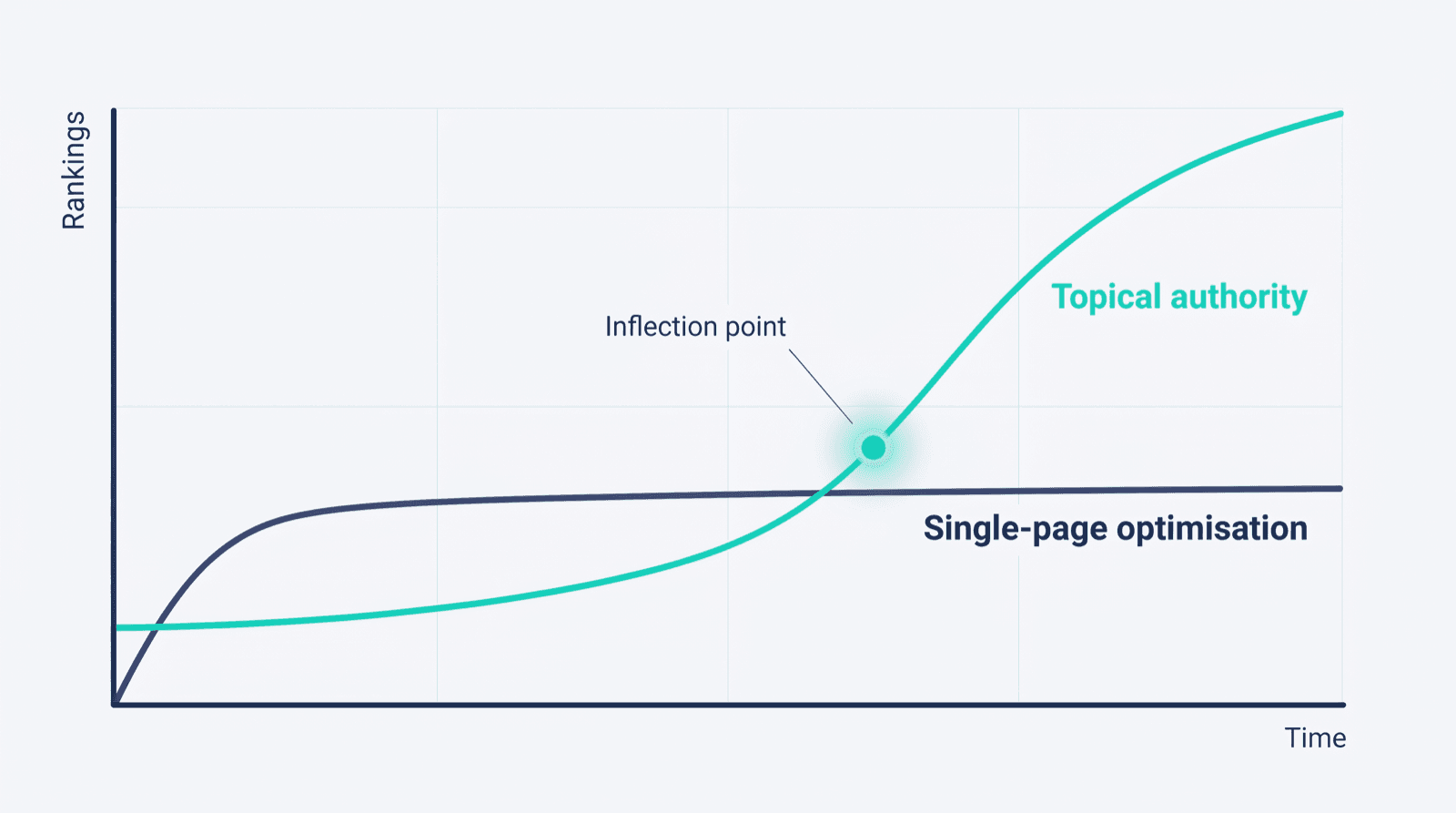
In practice it tends to arrive when three conditions hold at once:
- A clear pillar page exists for the subject and defines it well.
- Enough spoke pages cover the adjacent intents: the "what is", "vs" and "how to" questions a real searcher asks next.
- Internal links connect pillar and spokes both ways, so authority and crawl signals flow around the cluster instead of pooling on one URL.
How many spokes is "enough" depends on the topic's breadth and your competition, not on a magic number. As a working rule from our own builds, a pillar plus four to six genuinely distinct spokes is where we usually see the cluster begin to behave as a unit. The signal to watch is not a single page's position; it is the cluster's aggregate impressions climbing while you publish supporting pages rather than re-optimise existing ones.
Take our own agentic-SEO content. We mapped a hub-and-spoke architecture: a pillar on agentic SEO, a commercial pillar on AI SEO services, and a generative engine optimisation pillar, each with three or four spokes answering the obvious follow-up queries. Every spoke links up to its pillar and the pillar links back down. The point was never to chase a single head term. Some of those head terms are tiny: in our verified keyword set, agentic seo has a keyword difficulty of 1 and only about 90 monthly US searches. The cluster exists to catch the long tail around it, and to read, as a whole, like a complete source. That is what topical authority is.
How AI Overviews changed the maths
The case for topical authority got stronger the moment AI Overviews became normal.
In our 2026 category research (55 live SERPs pulled via DataForSEO), AI Overviews fired on roughly 80% of US and 85% of UK commercial and informational queries in this niche. When an AI Overview answers the question above the organic results, position alone stops being the whole game. You are either in the synthesised answer or you are not. That is the premise of generative engine optimisation, the discipline first framed in the 2023 "GEO: Generative Engine Optimization" paper by Aggarwal and colleagues.
The pattern in that data is blunt. AI Overviews don't cite the keyword-stuffed page; they cite the source that covers the topic completely. The domains quoted most often across those 55 overviews were Reddit and YouTube: community and first-hand sources that read as thorough and lived-in, not single-keyword landing pages. A page optimised narrowly for one query rarely has the surrounding coverage an answer engine wants to quote. A cluster does.
That is also why entity and protocol-level signals are rising in importance: engines increasingly resolve who and what your content is about, then judge whether you cover it fully. Topical authority is the on-site expression of that completeness. Keyword targeting is a tactic inside it.
A seven-step framework: both, in the right order
This is the sequence we use so that early keyword wins and long-term authority reinforce each other instead of competing for the same hours.
- Map the cluster before the page. Define the pillar subject and list the adjacent intents a searcher moves through. You are designing a territory, not a post.
- Win one beachhead page with tight keyword targeting. Pick the highest-intent term you can realistically rank for and optimise that page properly: title, intent match, on-page relevance. Bank an early result.
- Add depth with the supporting spokes. Publish the "what is", "vs", "how to" and vertical pages that answer the next questions. Each should satisfy one intent fully rather than half-answer several.
- Wire internal links pillar to spoke and back. Every spoke links up to the pillar; the pillar links down to every spoke. This is what turns separate pages into a cluster. Anchor variety and crawl depth matter, but the bidirectional rule is the non-negotiable.
- Cover entities, not just keywords. Name the tools, people, places, regulations and concepts a genuine expert would mention. Entity coverage is how engines verify completeness.
- Re-optimise on a freshness cadence. Revisit pages when intent shifts or rankings decay. A missing or stale publish date is one of the most common reasons an otherwise-citable page gets skipped by AI Overviews.
- Measure at cluster level, not page level. Track aggregate impressions, queries served and AI Overview appearances for the whole cluster. The inflection point shows up here first.
Which lever to lead with depends on your situation. This is the quick decision:
| Your situation | Lead with | Why |
|---|---|---|
| New site, low authority, need leads this quarter | Keyword targeting | Fast, concentrated wins on high-intent terms |
| A few pages ranking but plateauing | Topical authority | Depth unlocks the ceiling single pages hit |
| Competing with Reddit and forums in AI Overviews | Topical authority | Comprehensive coverage and entity signals get cited |
| One-off transactional page (pricing, contact, booking) | Keyword targeting | Single intent; no cluster required |
| YMYL or regulated vertical (legal, medical, finance) | Topical authority | Breadth plus E-E-A-T needed to be trusted at all |
Three mistakes that stall topical authority
When an authority push stalls, it is usually one of these three.
- Publishing breadth without depth. Twenty thin pages do not make a cluster; they make twenty cannibalisation risks. Since the Helpful Content System was folded into Google's core ranking in 2024, thin pages built to capture a keyword each are actively suppressed. Google's guidance on helpful content rewards pages that comprehensively serve a purpose, not pages that exist to hold a keyword. It is the same failure behind AI content that won't rank: volume without depth.
- Targeting the same query on multiple pages. Two pages chasing one keyword split signals and confuse the engine about which to rank. Map one primary intent per page before you write.
- Building pages but not the links between them. A cluster with no internal linking is just a folder. The links are what let authority flow between pages. Without them, a content cluster never compounds.
How to measure topical authority SEO so you know it's working
You cannot manage topical authority with a single-keyword rank tracker. Measure the cluster.
- Aggregate cluster impressions and clicks in Search Console, filtered to the cluster's URL path. Rising aggregate impressions while you publish supporting pages is the clearest early sign the inflection point is near.
- Number of unique queries the cluster ranks for. Authority shows up as a widening set of queries served, not just a higher position on the head term.
- AI Overview and AI-engine appearances. Track whether your pages are cited in AI Overviews, ChatGPT and Perplexity answers for the cluster's questions. This is the GEO-era equivalent of a featured snippet count.
- Internal link coverage. Every spoke should have at least one inbound link from the pillar and from a sibling. Orphan pages do not build authority.
If you want the deeper mechanics of how a cluster earns its rankings, that is the territory of agentic SEO: software that plans, drafts, links and re-optimises across the whole lifecycle. That is where the practice is heading, going by practitioner accounts like Fountain City's production guide. If running that loop in-house isn't realistic, it is the kind of work a done-for-you AI SEO agency takes on end to end.
FAQ
Is topical authority more important than keywords in 2026?
For durable, update-resistant rankings and AI Overview citations, topical authority is the stronger lever. But keyword targeting still wins the fast, single-page results you need early. The 80/20 of it: a small number of well-targeted pages get you started; topical depth is what compounds.
How long does it take to build topical authority?
Typically months, not weeks, and it varies with topic breadth, competition and publishing consistency. The inflection point, where cluster depth lifts pages you never optimised, usually appears once a pillar plus four to six strong spokes are live and properly interlinked.
Can you build topical authority with AI-generated content?
Yes, if the output is genuinely comprehensive, accurate and edited to expert standard. AI accelerates coverage; it does not replace the judgement that makes a cluster trustworthy. Thin, unedited AI pages trigger the same helpful-content suppression as thin human pages.
Does keyword targeting still matter?
Yes. Keyword targeting is how you match a page to an intent and win the position. Topical authority is the architecture those pages sit inside. You need both: keyword targeting is a tactic operating within a topical-authority strategy.
What is the difference between topical authority and a content cluster?
A content cluster is the structure: a pillar page plus interlinked spokes. Topical authority is the outcome that structure produces when it covers a subject completely enough to be treated as a trusted source. You build the cluster to earn the authority.
Further reading
Frequently asked questions
- Is topical authority more important than keywords in 2026?
- For durable, update-resistant rankings and AI Overview citations, topical authority is the stronger lever. But keyword targeting still wins the fast, single-page results you need early. The 80/20 of it: a small number of well-targeted pages get you started; topical depth is what compounds.
- How long does it take to build topical authority?
- Typically months, not weeks, and it varies with topic breadth, competition and publishing consistency. The inflection point, where cluster depth lifts pages you never optimised, usually appears once a pillar plus four to six strong spokes are live and properly interlinked.
- Can you build topical authority with AI-generated content?
- Yes, if the output is genuinely comprehensive, accurate and edited to expert standard. AI accelerates coverage; it does not replace the judgement that makes a cluster trustworthy. Thin, unedited AI pages trigger the same helpful-content suppression as thin human pages.
- Does keyword targeting still matter?
- Yes. Keyword targeting is how you match a page to an intent and win the position. Topical authority is the architecture those pages sit inside. You need both: keyword targeting is a tactic operating within a topical-authority strategy.
- What is the difference between topical authority and a content cluster?
- A content cluster is the structure: a pillar page plus interlinked spokes. Topical authority is the outcome that structure produces when it covers a subject completely enough to be treated as a trusted source. You build the cluster to earn the authority.
Methodology
The figures here come from Aristral's own 2026 category research: a verified dataset of 47 keywords and 55 live SERPs pulled via DataForSEO in May 2026, covering US and UK markets. The seven-step framework and the inflection-point observation reflect how we structure client and in-house clusters; they are practitioner heuristics, not laboratory results, and we flag them as such. Where a term has weak or unverified search volume, we say so rather than imply demand the data doesn't support. There is no affiliate relationship with any tool or publication named here, no guaranteed-rankings claim, and no fabricated case studies. Written by Taha Bilal, who runs Aristral's SEO and GEO work and built the keyword dataset this piece draws on. Questions or corrections: admin@aristral.com.
About the author
Taha Bilal
Co-founder, Aristral
Taha Bilal is a co-founder of Aristral, a UK AI automation and SEO agency based in Clifton, Bristol. He has been running SEO and digital-growth campaigns for SMB and SaaS clients since 2018, and now leads Aristral's combined SEO + GEO programmes for service businesses across the UK and US. Corrections and source requests: admin@aristral.com.
LinkedIn →