SEO
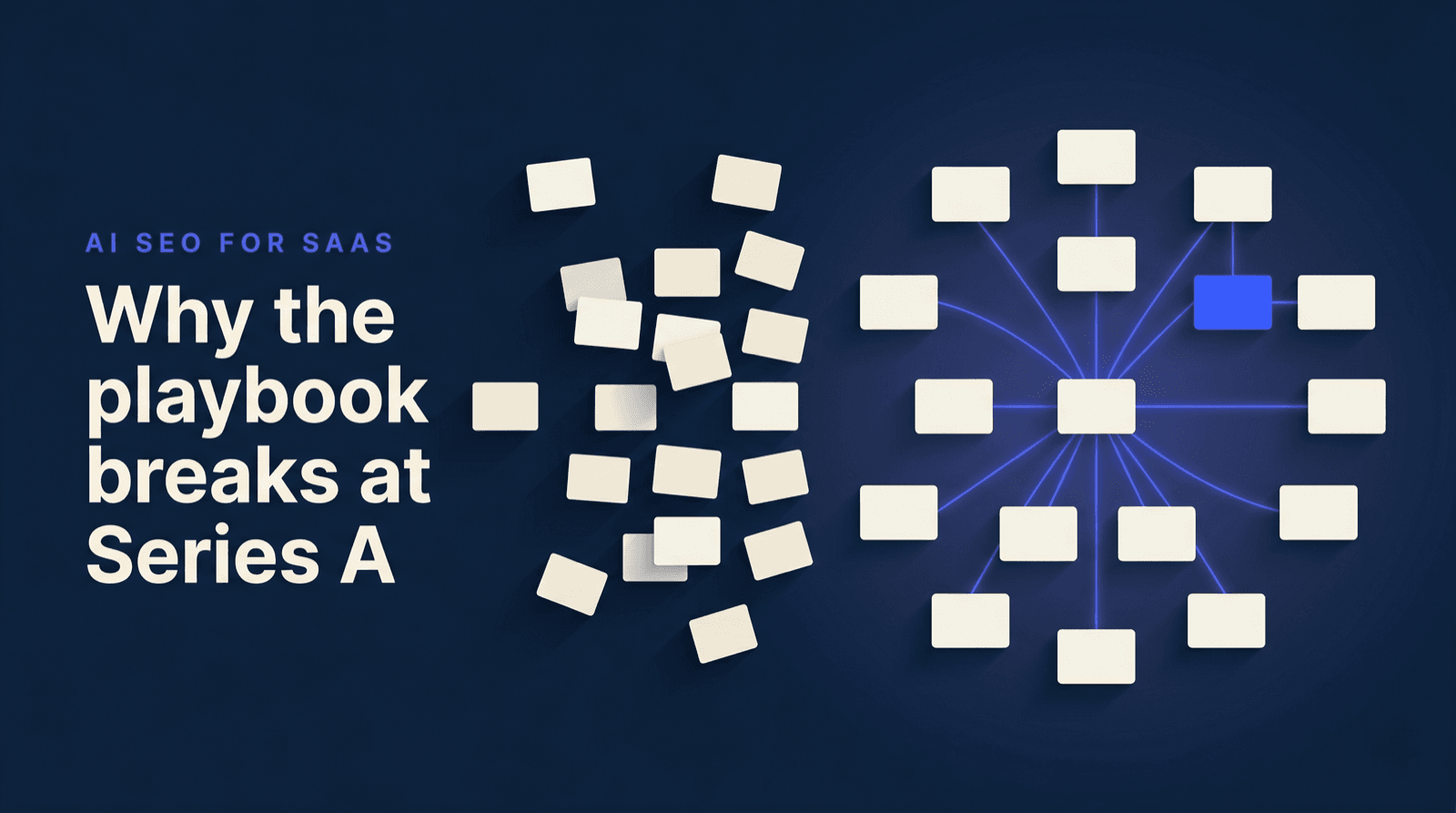
AI SEO for SaaS: Why the Playbook Breaks at Series A
AI SEO for SaaS changes at Series A: brand-safety, GEO, and AI Overviews now decide visibility as much as rankings. The architecture decisions that actually matter, and a 90-day sequence to rebuild the foundation.
Key takeaways
- The SaaS SEO playbook that works at bootstrap (high volume, weekly publishing, scattered keyword pages) fails at Series A, because brand risk, messaging alignment, and investor scrutiny all rise at once.
- AI Overviews now decide visibility as much as the organic rankings do. Appearing inside AI answers is a new job SaaS SEO has to do, not a bonus.
- Generative engine optimisation (GEO) for SaaS means optimising to be cited by answer engines, not only to rank. Reddit and YouTube are the dominant citation gateways.
- Agentic SEO compresses research and production at Series A scale, but it still needs human fact-check gates for any claim that touches product capability or compliance.
- A 90-day sequence (audit and entity map first, pillar build and GEO passages second, AI-visibility tracking third) rebuilds the foundation without thin-content penalty risk.
Your SaaS company has closed its Series A. The product works, the growth rate is healthy, and the SEO approach that got you here (publishing volume, keyword sprawl, a wall of comparison pages) is quietly becoming a liability.
AI SEO for SaaS is not a rename of the same work. It is a different job, because the constraints around organic growth change the moment you raise. AI Overviews have claimed a large share of the result page. Investors and a bigger team now read what you publish. And scaling content means scaling accuracy risk alongside it. This piece explains what changes and how to sequence the first 90 days after close.
Most published SaaS SEO guidance (including widely shared playbooks like Backlinko's SaaS SEO strategy) assumes a team still hunting product-market fit. At Series A the assumptions no longer hold.
What AI SEO for SaaS actually means
It is not the same as AI-assisted writing, and it is not a cost-cutting exercise. Treating it as either is the most common mistake teams make at this stage.
Generic SaaS SEO optimises for the ten blue links: keyword difficulty, backlinks, on-page factors, publishing velocity. AI SEO for B2B SaaS optimises for citation readiness, entity coherence, and answer-engine trust. You are building your product as an entity that AI systems can quote with confidence, not only a domain that ranks.
The shift is not optional. AI Overviews fire on roughly 80% of US queries and 85% of UK queries in the AI-SEO category, based on Aristral's DataForSEO SERP analysis in May 2026. The query "AI SEO for SaaS" itself returns an AI Overview. If your content is absent from those answers, a growing share of your market never sees you, even when you hold the number-one organic spot.
Why the bootstrap SaaS SEO playbook breaks at Series A
Bootstrap teams are bound by time and cash, so the playbook is rational: publish often, chase volume, build scattered keyword pages, capture whatever intent is cheap. Brand messaging is a founder's instinct rather than a cross-functional agreement, and legal review is somebody's spare afternoon. It works because the surface area is small and any organic win outweighs the downside of a loose claim.
Series A inverts that maths. The team is larger, the markets are plural, and the cost of a wrong claim is no longer trivial. Publishing cadence still matters (it always will), but volume without accuracy control becomes a risk that can surface in a diligence room. The table below maps the change.
| Dimension | Bootstrap stage | Series A reality |
|---|---|---|
| Publishing cadence | 3-5 pieces a week; volume is the lever. | 1-2 pieces a week; accuracy and topical coherence outrank raw output. |
| Keyword focus | Mid- and long-tail intent, competitor terms, comparison pages. | Clusters around core pillars; winning AI Overviews and answer-engine citations. |
| Brand safety and accuracy | Founder review is enough; speed over precision. | Legal, Product, and Marketing alignment; fact-check is non-negotiable for YMYL-adjacent claims. |
| Messaging alignment | Organic messaging can drift; each article stands alone. | The investor-facing narrative must hold across every brand-facing page. |
| Markets | One country, one language, one go-to-market. | Multiple territories; localisation demand; entity consolidation across regions. |
| Success metric | Organic traffic and organic signups. | Traffic plus AI-answer visibility, topical authority, and how often third parties cite your brand. |
The headline is simple. At bootstrap you optimise for ranking. At Series A you optimise for authority, trust, citation, and the multi-market entity work that keeps a brand coherent as it expands.
The five jobs SaaS SEO has to do after Series A
The work splits into five jobs. None of them is "publish more".
1. Protect brand accuracy and trust signals (E-E-A-T at real stakes for B2B buyers)
B2B buyers read SaaS content as procurement research. A misquoted statistic, an outdated feature claim, or a compliance slip compounds across the whole brand. By Series A your sales team is quoting the blog in deals and your compliance and legal exposure now extends to what you publish. Strong E-E-A-T (genuine expertise, clear authorship, accurate claims) stops being a ranking nicety and becomes risk management.
2. Keep messaging aligned with the investor-facing narrative
Your Series A deck committed to a market position and a set of claims about what the product solves. Every page either reinforces that narrative or erodes it. A post that contradicts a customer-facing claim, or frames the category differently from your homepage, creates friction a buyer can feel. You need a messaging playbook that every writer, reviewer, and automation respects.
3. Build genuine topical authority instead of scattered keyword pages
The bootstrap move was: find a gap, write a page, move on. Topical authority is being recognised (across the web and inside AI systems) as the source on your subject, which only interconnected content earns. SaaS-specialist firms like SimpleTiger have argued for years that depth beats keyword sprawl for software. Your pillars need deep, multi-page coverage and real internal linking, not islands.
4. Win AI search visibility, not just rankings
Traditional metrics measure position in the index. Generative engine optimisation measures whether your brand appears inside AI answers, how often it is cited, and how much traffic arrives from answer engines rather than the classic result page. If your AI search visibility for SaaS queries is zero, you are ceding share to competitors who structured their content for citation.
5. Scale a SaaS content SEO pipeline without producing thin pages
Scaling at Series A means more writers, more tooling, and more automation in the SaaS content SEO pipeline. Google's recent updates made the cost of templated, low-effort pages clear. Programmatic SEO for SaaS still works, but only with entity-rich, genuinely distinct pages (distinct research, distinct data, distinct angle) rather than template clones with swapped keywords. A disciplined B2B content pipeline is what makes that repeatable.
GEO for SaaS: why citation now beats ranking
Generative engine optimisation is a formal field, not a buzzword. WordStream's primer is a sound plain-English starting point. The term comes from a 2023 research paper from Princeton, Georgia Tech, and the Allen Institute for AI, which found that content enriched with citations, direct quotations, and statistics earned markedly more visibility in generative answers (up to roughly 40% in their tests), while classic keyword stuffing did not.
For SaaS, that reframes the game. You are not optimising first for rank position. You are optimising to be the source an answer engine quotes.
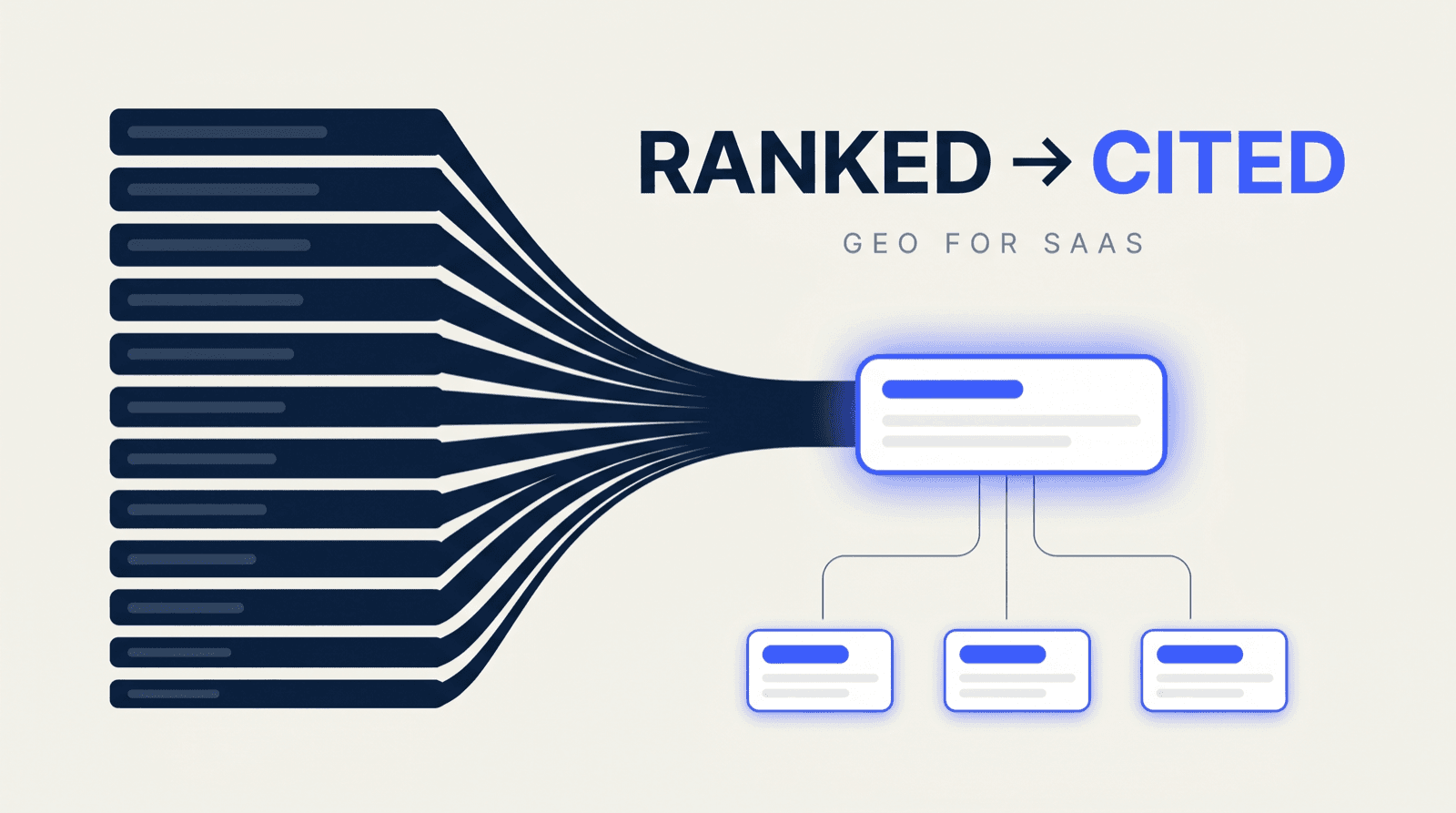
The citation gateways are narrow. Across the category, Reddit and YouTube are the most-cited domains inside AI Overviews, and practitioner-voice writing (content that reads like a person solving a real problem) is quoted more than polished marketing copy. Category guides such as ALM Corp's AI SEO for SaaS overview reach the same conclusion: structure and credibility signals decide who gets cited.
What makes a SaaS page citable in AI Overviews:
- A direct answer or definition in the first 100 words, not buried in body copy.
- Claims that carry a number, a date, or a quotable data point.
- FAQ or HowTo schema that mirrors the questions buyers actually ask.
- Present, recent datePublished and dateModified stamps.
- Clear, linked authorship: a named author, a role, a company domain.
- A direct, practical tone rather than aspirational marketing language.
This is not gaming the system. It is writing content an answer engine can trust and quote because it is accurate, attributable, and answering the question that was asked.
Where AI actually helps a SaaS SEO programme, and where it doesn't
Agentic SEO entered mainstream SEO press in early 2026. The working definition is a system that plans a task, calls tools to execute it, observes the result, and adjusts, without a human approving every step. For a Series A team, that kind of B2B SEO automation can compress a month of keyword research, topical mapping, and gap analysis into days, draft research briefs, surface fact-check candidates, and flag schema errors before publication.
What it cannot do is replace the human gates Series A now requires.
AI Overviews are factually correct in roughly nine answers out of ten. That residual 10% is small until it is your claim quoted wrong. For anything touching product capability, compliance, or competitive positioning, human fact-check is mandatory. Automation moves the bottleneck from writing to review; it does not remove it.
SaaS programmatic SEO (pages built around integrations, segments, or product variations) remains viable, but only when every page is genuinely distinct. Google's 2024-2025 core and spam updates wiped large templated plays, with publicly documented sites losing the majority of their organic traffic almost overnight. That is the cautionary backdrop. If your agentic system is shipping near-identical pages, it is building a penalty, not a pipeline.
The honest picture: AI accelerates research, drafting, and scale across AI SEO services, and it does not reduce the need for expert review, fact-check, or topical coherence. The teams that win treat it as an accelerator with guardrails, not an autopilot.
A 90-day sequencing approach for a Series A SaaS team
The quarter after close is the window to rebuild the SEO foundation before the next wave of product launches. This sequence works.
- Days 1-30: Audit, entity map, brand guardrails. Audit the existing estate: which pages carry YMYL-adjacent claims, which contradict the Series A narrative, which are thin. Map the brand as an entity: the core topics and clusters AI systems should associate with you. Draft messaging guardrails and run them past Legal and Product. It is slow, and it is the work most teams skip.
- Days 31-60: Pillar and spoke build, GEO passages, schema. Build the core pillars (for SaaS, usually 4-6: category education, product capability, integrations, customer segments, comparison, best practice) with one or two deep foundational pieces each. Layer in GEO passages (definition-first sections, FAQ blocks, author bios, modified dates) and implement FAQ and HowTo schema. This is where the topical authority backbone forms.
- Days 61-90: AI-visibility tracking, iteration, handoff. Stand up citation tracking: which pages appear in AI Overviews, and which queries name competitors but not you. Run agentic research against those answer-engine gaps. Set a calendar that balances quick keyword wins with pillar depth, then hand off with documented guardrails and a fact-check workflow.
It is three months of unglamorous foundation work, and it is the line between SEO that compounds and SEO that the next core update erases.
AI SEO for SaaS: FAQ
Is SEO still worth it for SaaS in 2026?
Yes. Organic search is still one of the largest acquisition channels for most B2B SaaS products, but it is now a brand-visibility game as much as a traffic game. You compete for presence in AI Overviews and assistant answers, not only for index position. The return is higher when you optimise for citation and authority, and lower when you chase ranking volume alone.
How is AI SEO for SaaS different from normal SaaS SEO?
AI SEO for SaaS treats answer engines as a separate channel with their own ranking factors: citation frequency, clear authorship, date freshness, and semantic coherence. Normal SaaS SEO targets the traditional result page. AI SEO adds citation readiness, GEO passages, and cross-domain mention tracking. It is a superset of classic SEO, not a replacement for it.
Does AI-written content rank for SaaS?
It ranks when it is fact-checked, unique, and topically coherent, and it fails when it is templated or sloppy. The real distinction is not AI-written versus human-written; it is accurate-and-distinct versus generic-and-thin. AI is a writing tool, not a ranking signal: depth and accuracy are what Google and answer engines reward.
How do you get a SaaS product cited in AI Overviews?
Answer the question directly in the first 100 words, add FAQ and HowTo schema, and include clear authorship and recent modified dates. Publish practitioner-voice content to channels that AI Overviews cite heavily, such as Reddit and YouTube. Then track which pages appear in AI answers and iterate on structure, depth, and credibility signals.
How much SEO content does a Series A SaaS actually need?
Less than most teams assume, if it is structured well. A practical baseline is 4-6 core topical pillars with one deep page each, 12-18 supporting spoke pages, and a page per major segment or integration: roughly 25-35 pieces of core content, plus an ongoing cadence. Authority comes from depth and interconnection, not sheer volume.
Further reading
Frequently asked questions
- Is SEO still worth it for SaaS in 2026?
- Yes. Organic search is still one of the largest acquisition channels for most B2B SaaS products, but it is now a brand-visibility game as much as a traffic game. You compete for presence in AI Overviews and assistant answers, not only for index position. The return is higher when you optimise for citation and authority, and lower when you chase ranking volume alone.
- How is AI SEO for SaaS different from normal SaaS SEO?
- AI SEO for SaaS treats answer engines as a separate channel with their own ranking factors: citation frequency, clear authorship, date freshness, and semantic coherence. Normal SaaS SEO targets the traditional result page. AI SEO adds citation readiness, GEO passages, and cross-domain mention tracking. It is a superset of classic SEO, not a replacement for it.
- Does AI-written content rank for SaaS?
- It ranks when it is fact-checked, unique, and topically coherent, and it fails when it is templated or sloppy. The real distinction is not AI-written versus human-written; it is accurate-and-distinct versus generic-and-thin. AI is a writing tool, not a ranking signal: depth and accuracy are what Google and answer engines reward.
- How do you get a SaaS product cited in AI Overviews?
- Answer the question directly in the first 100 words, add FAQ and HowTo schema, and include clear authorship and recent modified dates. Publish practitioner-voice content to channels that AI Overviews cite heavily, such as Reddit and YouTube. Then track which pages appear in AI answers and iterate on structure, depth, and credibility signals.
- How much SEO content does a Series A SaaS actually need?
- Less than most teams assume, if it is structured well. A practical baseline is 4-6 core topical pillars with one deep page each, 12-18 supporting spoke pages, and a page per major segment or integration: roughly 25-35 pieces of core content, plus an ongoing cadence. Authority comes from depth and interconnection, not sheer volume.
Methodology
How we wrote this. The frameworks here are the ones Aristral applies in client AI SEO work for UK and B2B SaaS teams. The AI Overview figures (roughly 80% of US and 85% of UK SERPs in this category, with Reddit and YouTube the most-cited domains) come from Aristral's own DataForSEO SERP analysis in May 2026, and describe this niche, not search as a whole. The GEO findings are attributed to the 2023 Princeton, Georgia Tech and Allen Institute paper; schema and policy claims are linked to primary sources inline. The templated-site traffic losses are from publicly documented operator post-mortems, included as illustration, not guaranteed outcomes. "AI SEO for SaaS" is a low-volume but AI-Overview-triggering query; this piece is written for citation readiness and topical depth, not head-term volume. No affiliate relationships and no fabricated case studies. Written by Taha Bilal, who runs Aristral's SEO and generative engine optimisation work. Questions or corrections: admin@aristral.com.
About the author
Taha Bilal
Co-founder, Aristral
Taha Bilal is a co-founder of Aristral, a UK AI automation and SEO agency based in Clifton, Bristol. He has been running SEO and digital-growth campaigns for SMB and SaaS clients since 2018, and now leads Aristral's combined SEO + GEO programmes for service businesses across the UK and US. Corrections and source requests: admin@aristral.com.
LinkedIn →