SEO
SEO Automation Agency vs In-House SEO: A Decision Framework
SEO automation agency or in-house SEO? A practitioner's decision framework that scores budget, content volume, technical complexity and brand risk, and tells you honestly when in-house or a contractor is the better call.

Choosing between an SEO automation agency and an in-house team is a budget, control and risk decision, not a technology one. The tooling on both sides is now broadly the same; what differs is who carries the salary, who owns the context, and who absorbs the risk when Google or a model provider changes the rules overnight. This framework scores four variables (budget, content volume, technical complexity and brand sensitivity) and tells you, honestly, when in-house or a contractor is the better call.
Key takeaways
- An SEO automation agency runs your full SEO workflow through AI agents and pipelines and bills a flat fee instead of hourly time.
- Hire an agency for volume and breadth, hire in-house for depth and control, hire a contractor for a fixed, well-scoped problem.
- Compare total cost of ownership, salary plus tools plus management time plus the cost of work not getting done while you hire: not headline price.
- High-stakes, regulated (YMYL) content is a veto variable. It pushes you to in-house, or to an agency with real human-in-the-loop sign-off.
- AI Overviews shifted the question from “where do we rank” to “are we in the answer”, which changes the skill set you are buying.
What an SEO automation agency actually does
The category sits a step beyond classic “AI SEO”. Per-prompt AI assists a human on one task; an automation pipeline chains those tasks; an agentic SEO system plans, calls tools, checks its own work and iterates with goal-level instruction. Industry press only gave the agentic layer a name in early 2026 (Backlinko, 13 Apr 2026; Search Engine Land's agentic AI in SEO guide), which is why the “automation agency” label still covers a wide range of delivery models.
That range matters. Some agencies run a genuine end-to-end pipeline; many wrap a single tool (Surfer, Frase or Clearscope) in a PDF report and call it AI. We pulled that pattern apart in what white-label AI SEO agencies actually sell. Knowing which you are buying is the whole game, and it is the first thing the framework below tests.
Three ways to run SEO: in-house, contractor, agency
Before scoring anything, get the three operating models straight. Most teams default to “hire someone” without comparing the alternatives on the terms that actually move the decision: cost shape, speed to output, and where the risk lands.
| Model | Best for | Cost shape | Speed to output | Main risk |
|---|---|---|---|---|
| In-house hire | Depth, daily context, brand control | Fixed salary + tool stack + on-costs | Slow (hire, onboard, ramp) | Single point of failure; key-person risk |
| Part-time contractor | A fixed, well-scoped project | Day rate or project fee | Fast for the scope, capped overall | Limited capacity; no continuity |
| SEO automation agency | Sustained volume across many pages or markets | Flat monthly retainer | Fast and sustained once briefed | Black-box delivery; generic output if unmanaged |
Note the second column. These models don't compete for the same job. They suit different jobs. The mistake is comparing an AI SEO agency retainer against a single salary as if they buy the same thing. They don't.
The four variables that decide the call
Four variables explain most of the right answers we see. Score your own situation against each, then read the dominant pattern.
1. Budget and total cost of ownership
Total cost of ownership is salary plus tools plus management time plus the cost of the work not getting done while you hire. A senior in-house SEO in the UK or US runs well past a headline salary once you add the software stack and on-costs; a comparable agentic SEO retainer folds the tooling and the management into one line. The awkward middle is exactly where an automation agency earns its keep: too much work for a freelancer, not enough certainty to justify a full hire and a five-figure annual tool bill.
2. Content volume and cadence
Volume is the cleanest signal. A few well-crafted pages a month is a job for one good person. Twenty to three hundred pieces a month across clusters and markets is a pipeline problem, and pipelines are what automation agencies are built around. If your roadmap needs sustained output rather than a one-off push, the economics tilt toward a retainer.
3. Technical and multi-market complexity
Repeatable, schema-heavy, multi-location or multi-language work rewards a system: entity differentiation at scale, structured-data generation, internal-link mapping and indexation handling. Deeply bespoke work tied to your own product and codebase rewards someone in the building who lives in that context every day. Ask which describes the next twelve months of work, not the next sprint.
4. Brand sensitivity and YMYL risk
This is the veto. If you publish in regulated, “your money or your life” territory, legal, medical, financial, generic automated output is a liability, not a saving. Automation lowers the cost of producing SEO work; it does not lower the cost of being wrong at scale. High brand sensitivity does not rule an agency out, but it does rule out any agency without genuine human-in-the-loop sign-off on what goes live.
The decision framework: score your situation
Read each row, pick the column that fits you best, and tally where you land most often. Mostly left points to in-house; mostly centre points to a contractor; mostly right points to an SEO automation agency.
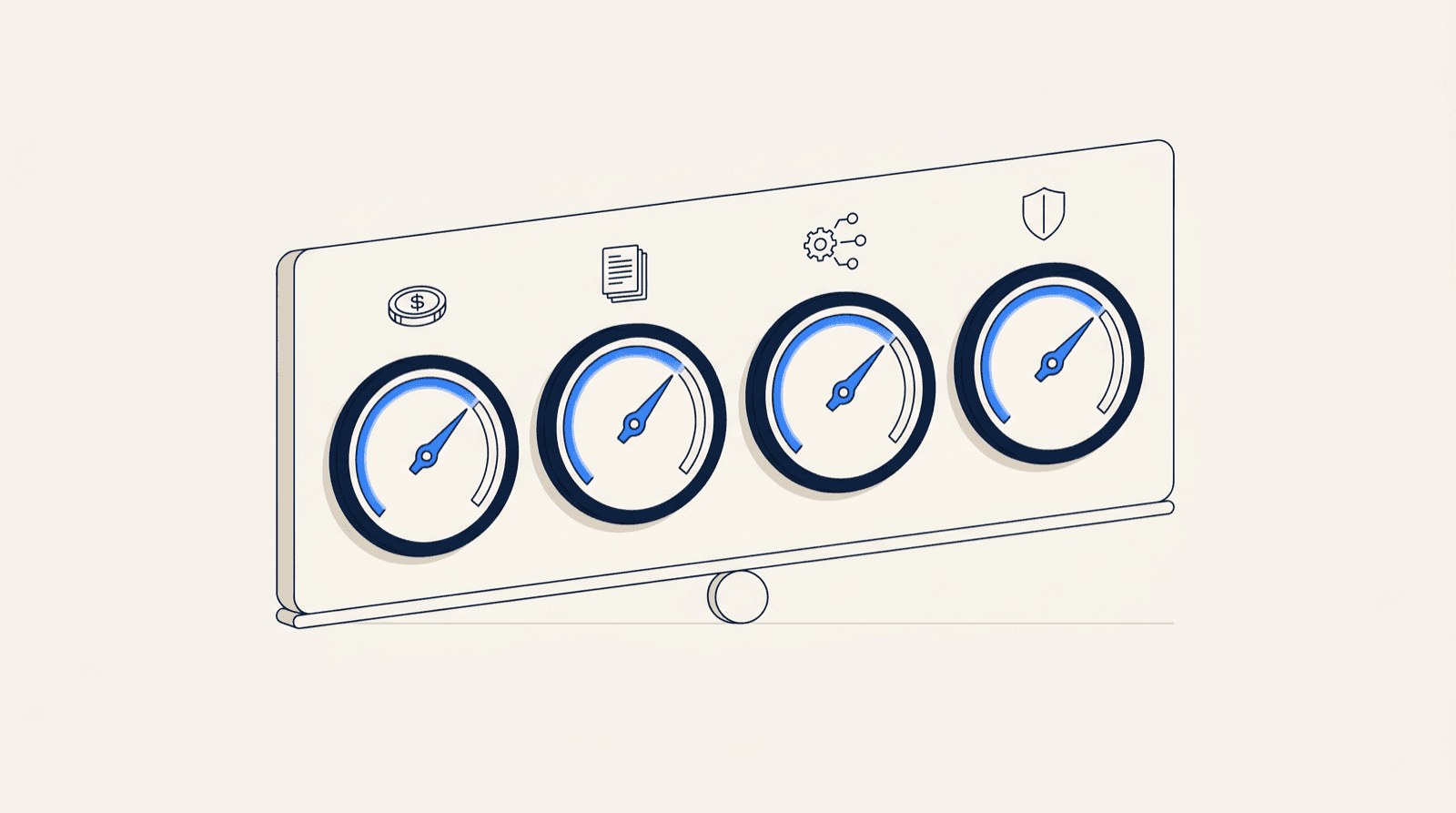
| Variable | Points to in-house | Points to a contractor | Points to an automation agency |
|---|---|---|---|
| Budget | Can fund a senior salary and the full tool stack comfortably | Small, fixed, one-off budget | Need agency-grade output but can't justify a full team plus tooling |
| Content volume | Low and steady (a few pages a month) | A single burst (a launch, a migration) | High and sustained (20–300+ pieces a month) |
| Technical complexity | Deep, bespoke, tied to your own stack | Narrow and well-scoped | Broad, repeatable, multi-market, schema-heavy |
| Brand sensitivity | High YMYL / regulated; needs daily context | Low-stakes content | Medium: manageable with human-in-the-loop sign-off |
How to use it, in five steps:
- Score each variable against the row that fits today, not your aspiration.
- Check for a veto. If brand sensitivity sits in the “high YMYL” column, that overrides a high score elsewhere: keep control in-house or insist on sign-off gates.
- Read the dominant column. Three or four rows agreeing is a clear signal; a split means a hybrid.
- Pressure-test against the hidden costs below before you sign anything.
- Pilot before you commit. Run a 30-day paid trial on a real, scoped deliverable and judge the output, not the pitch.
When in-house SEO is the better call
Keep it in the building when:
- SEO is core to the product and changes weekly with the roadmap.
- Your content is regulated or high-trust and needs an owner who lives in the context.
- You have the budget for a senior hire and the tool stack, and the volume to keep them busy.
- Institutional knowledge, your customers, your data, your voice: is the moat, and you want it to compound internally.
The trade-off is honest: in-house buys control and depth, and carries salary, tooling and key-person risk. One resignation can stall a programme for a quarter.
When a part-time contractor wins
A freelancer or contractor is the right tool when:
- You have a fixed, well-defined job: a technical audit, a migration, a one-off cluster.
- You need senior judgement for a short window, not a standing capability.
- Budget is capped and certainty is low, so a monthly retainer is premature.
The ceiling is capacity. A contractor cannot produce sustained volume across markets, and when they finish, the continuity leaves with them.
When an SEO automation agency is the right call
A done-for-you SEO automation agency earns the retainer when:
- You need sustained output, many pages, many clusters, multiple markets: without building a team to match.
- The work is repeatable and schema-heavy: location sets, programmatic pages, comparison and GEO coverage at scale.
- You want a flat, predictable fee that already includes the tooling, the pipeline and the management layer.
- You can name the agency's actual delivery model, and they can explain it without hiding behind “proprietary AI”.
The risk to manage is black-box delivery and generic output. The cure is the same on every retainer: insist on visible methodology, raw-data reporting, and sign-off on anything sensitive. If they won't show you how the work is made, that is your answer.
To see what an automated set-up looks like in practice, read how we run automated SEO reporting across 12 sites, including what broke and what we changed.
The hidden costs nobody prices in
Both sides of this decision carry costs that rarely make it onto the comparison spreadsheet. Price them in before you choose.
- Tool sprawl. Running SEO in-house in 2026 means a stack, not a seat: SERP data, crawling, content scoring, schema testing, reporting. The line items add up well past the headline of any single tool.
- Model deprecation. Providers now retire models on short notice; OpenAI gave roughly two weeks' warning before pulling several models in early 2026 (The Register, 30 Jan 2026). An in-house pipeline pinned to one model inherits that maintenance burden; a serious agency abstracts it away.
- Google update exposure. The March and August 2025 spam updates hit thin, templated content hard, documented cases lost the large majority of their organic visibility (SEO Sherpa on the 2025 updates). Volume without quality control is a liability whoever produces it.
- API cost blow-ups. Self-built automation can spike without warning, documented n8n SEO pipelines have jumped from a few hundred to nearly a thousand pounds a month after a single model upgrade, with no in-platform alert (Cledara on tracking AI API costs in n8n). A flat-fee retainer moves that volatility off your books.
- Management time. The least-counted cost. An in-house hire or a pipeline still needs a manager; a retainer needs briefing and review. Neither model is “set and forget”.
AI Overviews changed the brief
In our own SERP analysis of this niche (Aristral, May 2026), AI Overviews fired on roughly 80% of US and 85% of UK commercial and informational queries, and the most-cited sources were practitioner threads, video and established publications, not vendor brochures. That makes generative engine optimisation part of the core job now, not an add-on. The term has a real lineage: the foundational GEO paper from Princeton, Georgia Tech and the Allen Institute (Aggarwal et al., 2023), since popularised by outlets such as WordStream and Search Engine Land.
Practically, this raises the bar on whoever you hire. Whether in-house or an agentic SEO partner, they need to produce definition-first passages, clean structured data, and citable, claim-led content. Those are the patterns AI engines lift into answers. If a candidate or an agency still talks only about keyword rankings, they are pricing the last decade's job. The detail of what earns those citations is in our AI Overviews optimisation guide.
FAQ
What does an SEO automation agency actually do?
It runs your SEO workflow, research, briefs, drafting, schema, publishing and reporting, through AI agents and pipelines, and bills a flat monthly fee. You buy the output and the judgement around it rather than hourly seat time.
Is an SEO automation agency cheaper than hiring in-house?
Often, on a total-cost-of-ownership basis. A retainer folds tooling, the pipeline and management into one predictable line, where an in-house hire adds salary, on-costs and a five-figure annual tool stack. Compare like for like, not headline price against salary.
Can I just use ChatGPT or an AI tool instead of an agency?
For a small, steady volume of content, a capable person with good tools can do plenty. The case for an agency is sustained volume, multi-market complexity, and the maintenance burden, model changes, schema at scale, indexation, that a single tool does not handle.
When should I keep SEO in-house?
When SEO is core to the product, the content is regulated or high-trust, and you have both the budget for a senior hire plus stack and the volume to keep them busy. In-house buys control and depth at the cost of salary and key-person risk.
How do I choose an SEO automation agency without getting burned?
Make them explain their delivery model without hiding behind “proprietary AI”, insist on raw-data reporting rather than vanity screenshots, confirm human sign-off on sensitive content, and run a paid 30-day pilot on a real deliverable before committing.
Does an automation agency replace my need for GEO and AI Overviews work?
Only if it does GEO. AI Overviews now fire on most commercial and informational queries in this niche, so generative engine optimisation is part of the core job. Check that whoever you hire produces definition-first, schema-clean, citable content, not just rankings.
Frequently asked questions
- What does an SEO automation agency actually do?
- It runs your SEO workflow, research, briefs, drafting, schema, publishing and reporting, through AI agents and pipelines, and bills a flat monthly fee. You buy the output and the judgement around it rather than hourly seat time.
- Is an SEO automation agency cheaper than hiring in-house?
- Often, on a total-cost-of-ownership basis. A retainer folds tooling, the pipeline and management into one predictable line, where an in-house hire adds salary, on-costs and a five-figure annual tool stack. Compare like for like, not headline price against salary.
- Can I just use ChatGPT or an AI tool instead of an agency?
- For a small, steady volume of content, a capable person with good tools can do plenty. The case for an agency is sustained volume, multi-market complexity, and the maintenance burden, model changes, schema at scale, indexation, that a single tool does not handle.
- When should I keep SEO in-house?
- When SEO is core to the product, the content is regulated or high-trust, and you have both the budget for a senior hire plus stack and the volume to keep them busy. In-house buys control and depth at the cost of salary and key-person risk.
- How do I choose an SEO automation agency without getting burned?
- Make them explain their delivery model without hiding behind 'proprietary AI', insist on raw-data reporting rather than vanity screenshots, confirm human sign-off on sensitive content, and run a paid 30-day pilot on a real deliverable before committing.
- Does an automation agency replace my need for GEO and AI Overviews work?
- Only if it does GEO. AI Overviews now fire on most commercial and informational queries in this niche, so generative engine optimisation is part of the core job. Check that whoever you hire produces definition-first, schema-clean, citable content: not just rankings.
Methodology
This framework is drawn from how we resource and run SEO for clients, plus a live DataForSEO SERP and AI Overview sample taken in May 2026. The AI Overview trigger rates (~80% US, ~85% UK) come from that dataset; tool, model and algorithm-update references are linked inline. It is deliberately market-neutral, built to help you evaluate any provider, including us. We make no guaranteed-rankings claim, name no single best agency, and use no fabricated case studies or pricing. AI search behaviour shifts, so we date-stamp this page and revise it rather than presenting any tactic as permanent. Written and maintained by the Aristral Growth Engine team. Questions or corrections: admin@aristral.com.
About the author
Taha Bilal
Co-founder, Aristral
Taha Bilal is a co-founder of Aristral, a UK AI automation and SEO agency based in Clifton, Bristol. He has been running SEO and digital-growth campaigns for SMB and SaaS clients since 2018, and now leads Aristral's combined SEO + GEO programmes for service businesses across the UK and US. Corrections and source requests: admin@aristral.com.
LinkedIn →