AI Automation
AI Receptionist UK: Costs, What They Handle Well and Where They Fail
A practitioner's guide to the AI receptionist: real UK vendor pricing, what it handles well, where it fails, and an honest worth-it verdict.
Key takeaways
- What it does: Answers your business line, understands the caller, and books appointments into your calendar.
- UK cost range: Flat tiers run roughly £39 to £99 a month (IONOS); usage-based platforms like Retell AI bill from about $0.07 to $0.31 a minute.
- The honest verdict: Worth it for routine call volume; weak on complex requests and distressed callers.
- Where it wins: After-hours coverage, overflow capture, and answering the same five questions on repeat.
- When to go custom: Off-the-shelf covers generic booking; build bespoke when it needs deep CRM or booking-system integration.
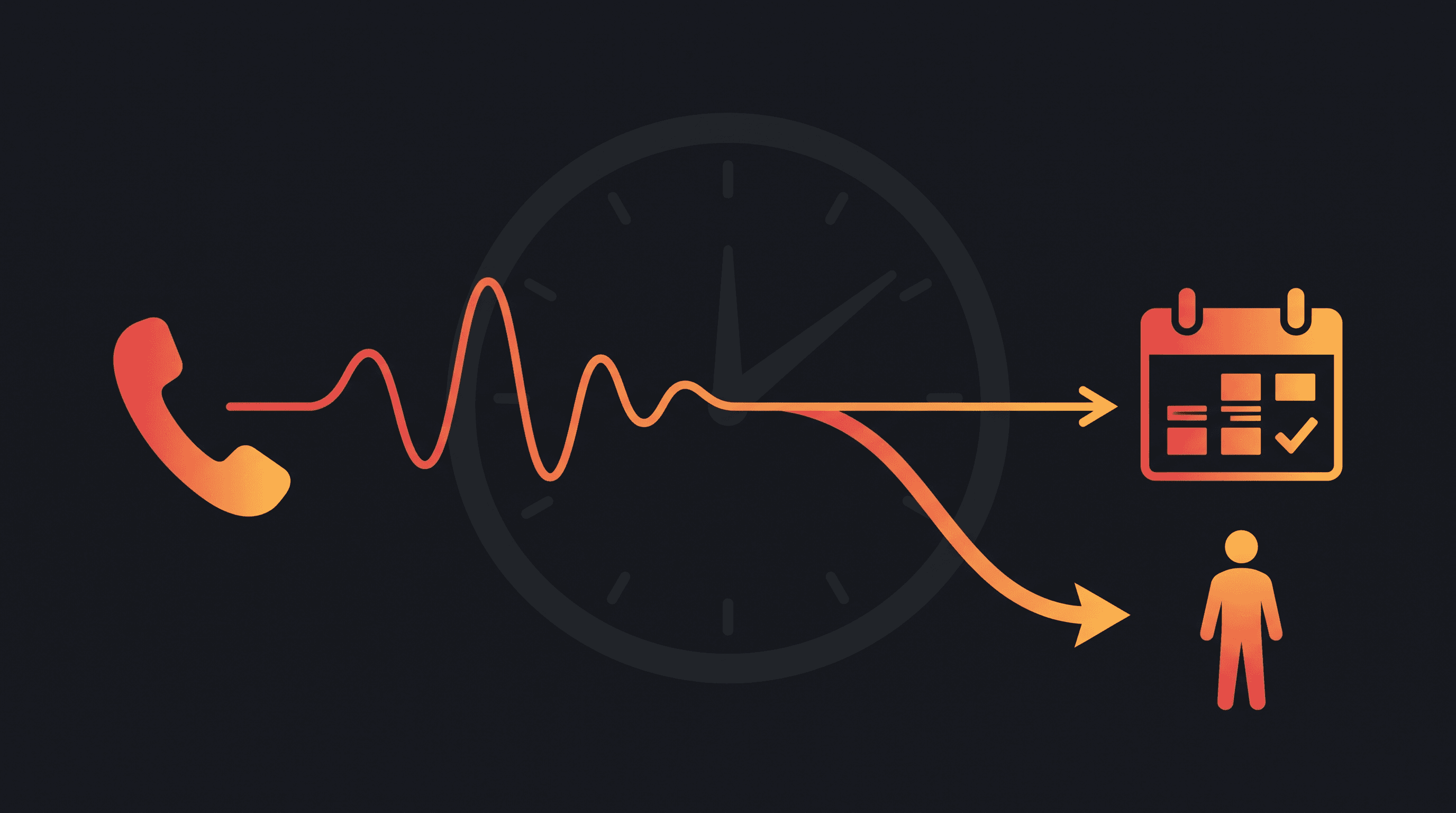
An AI receptionist is software that answers your business phone line using voice AI instead of, or alongside, a human, picking up 24/7, understanding what the caller wants, and handling routine requests on its own. For a UK small business that's missing calls during jobs, after hours, or at lunch, that means fewer voicemails nobody returns and fewer customers who hang up and ring the next name on Google. It's also marketed as a virtual receptionist or AI phone answering service: it plugs into your existing number, learns your business from your website or Google Business Profile, and routes anything genuinely complicated to a person.
The reality is more mixed than vendor pages suggest. An AI receptionist handles predictable, high-volume call types well: booking a slot, answering the same five questions, capturing details when you're unavailable. It struggles with anything that needs judgment: a distressed caller, a multi-step negotiation, a thick regional accent the model mishears. This guide covers what UK providers actually charge, what the technology is properly good at, where it falls over, and when building a custom voice agent beats buying one off the shelf.
How an AI Receptionist Works
Call answering: the AI receptionist sits on your existing business number, usually via call forwarding or a SIP/VoIP connection, so callers don't dial a different number or know they've reached software rather than a person. Natural language understanding turns the call into text, works out intent (booking, question, complaint, wrong number), and replies in a natural-sounding voice; the better platforms hold context across the whole call rather than resetting after every sentence. Once intent is confirmed, appointment booking checks your connected calendar or booking system for availability and confirms a slot there and then, the same job a human receptionist does, minus the small talk.
CRM integration is where quality diverges most between platforms: a receptionist wired into your actual CRM can log the call, tag the lead, and trigger a follow-up sequence, while one that only sends an email summary after the fact leaves you doing that work manually. See our AI agent examples for customer support for how this same pattern plays out on other channels. Human handoff matters just as much: when the AI can't resolve something, or the caller asks for a person, it should transfer live or take a message flagged for callback, rather than looping the caller through the same three questions. Most platforms also transcribe and log every call, so check how long transcripts are kept and who can access them before you sign up.
AI Receptionist Cost in the UK: What You'll Actually Pay
UK AI receptionist pricing splits into three models, and which one suits you depends on your call volume more than anything else. Flat monthly tiers charge a set fee for a call allowance, then either cap you out or charge per extra call. IONOS's AI Receptionist is the clearest UK example: Starter at £39 a month for 30 calls (then £0.49 a call), Professional at £69 for 100 calls (then £0.39 a call), and an Unlimited tier at £99. This model is easiest to budget against if your call volume is fairly predictable.
Usage-based, per-minute pricing charges for what you actually use, which suits businesses building their own agent or with spiky call volume. Retell AI's pricing runs from around $0.07 to $0.31 a minute for the voice agent itself, the range depends on which text-to-speech and language model you pick, plus $2 a month per phone number. You get $10 in free credit and 20 free concurrent calls to test with, but there's assembly required: you're picking components, not buying a finished product. Managed-service pricing wraps the AI into a human-supervised answering service rather than selling you the software directly. Moneypenny is the best-known UK example: billing is per minute rather than per call, and headline pricing isn't published, you get a quote based on expected volume. Expect this route to cost more than a pure-AI platform, in exchange for a UK-based team supervising calls it can't handle.
| Pricing model | Example provider | Typical cost | Best for |
|---|---|---|---|
| Flat monthly tiers | IONOS | £39-£99/month | Predictable call volume, simple budgeting |
| Usage-based (per minute) | Retell AI | $0.07-$0.31/min + $2/mo per number | Spiky volume, building a custom agent |
| Managed service (human + AI) | Moneypenny | Custom quote, billed per minute | Businesses wanting a supervised, UK-based service |
Whichever model you're comparing, verify the current figures on the vendor's own pricing page before you commit: usage-based and tiered pricing on all three of these changes often.
What AI Receptionists Handle Well
Across the providers we've looked at, the same call types come up again and again as genuine strengths:
- Routine appointment bookings: checking availability and confirming a slot without a human needing to touch the calendar.
- Answering FAQs from your own content: opening hours, pricing bands, service areas, anything already on your website or Google Business Profile.
- After-hours and overflow coverage: picking up the calls a small team physically can't, evenings, weekends, or when everyone's on a job.
- Missed-call text-back: sending an automatic text when a call can't be answered live, similar in spirit to how WhatsApp automation catches enquiries on a different channel.
- Simple call routing: getting the right department or person on the line first time, rather than a caller working through a menu.
- Restaurants and trades taking bookings on the go: a receptionist that answers while you're driving or mid-job, similar to AI phone booking for restaurants, covers a gap a lot of small businesses just eat as lost revenue.
Where AI Receptionists Still Fall Short
No vendor page will tell you this part, so it's worth being blunt about where the technology still struggles:
- Complex, multi-step requests: anything requiring several conditional steps ("only book Tuesday if the Thursday slot's also free") tends to confuse the model or produce a wrong booking.
- Distressed or angry callers: an AI receptionist can't de-escalate the way an experienced human can, and a bad experience here does more brand damage than a missed call ever would.
- Strong regional accents and background noise: speech-to-text accuracy drops with heavy accents, poor signal, or noisy environments, a building site, a busy salon.
- Anything needing genuine judgment: pricing exceptions, goodwill gestures, or reading between the lines of what a caller actually needs rather than what they literally said.
- Sensitive or high-stakes conversations: bereavement services, safeguarding concerns, or anything where a caller needs to feel heard by a person, not routed efficiently.
AI Receptionist vs AI Phone Answering Service vs a Human Answering Service
These three terms get used almost interchangeably in search results and marketing copy, but they're not quite the same product. An AI receptionist is the conversational, appointment-booking end of the spectrum: it holds a proper back-and-forth, checks your calendar, and is usually trained on your specific business. An AI phone answering service is often a lighter layer bolted onto a small business phone system: think smart voicemail-to-text, basic call screening, or a menu-driven IVR with some AI polish, useful, but rarely booking anything directly. A human answering service like Moneypenny keeps a real person on the line, often now AI-assisted rather than AI-replaced. If you've already weighed this trade-off for web chat, the logic is similar to AI chatbots vs live chat: automation for volume, humans for anything that needs a real conversation.
| AI Receptionist | AI Phone Answering Service | Human Answering Service | |
|---|---|---|---|
| What it is | Conversational voice AI, trained on your business | Lighter automated call handling, often IVR-based | Real people answering, AI-assisted |
| Typical cost | £39-£99/mo flat, or usage-based | Often bundled into a phone system plan | Custom quote, usually per minute |
| Best for | Booking, FAQs, after-hours cover | Basic screening and message-taking | Complex, sensitive, or brand-critical calls |
| Where it weakens | Judgment calls, strong accents | Anything beyond simple routing | Cost at high call volume |
Is an AI Receptionist Worth It for a Small Business?
Worth it, if you're currently missing calls regularly (during jobs, evenings, lunch), most of what comes in is routine (bookings, opening hours, pricing questions), and you don't have spare headcount to answer every call live. At that point, even the cheapest flat-tier plan usually pays for itself against what those missed calls would otherwise cost you.
Think twice if your call volume is genuinely low, a handful a day, since a personal mobile and voicemail probably still wins on cost. Or if most calls are high-stakes and relationship-driven: a law firm's client intake, a bereavement service, complex medical triage, where the trust cost of getting it wrong outweighs the convenience. Most trades, clinics, salons, and hospitality businesses sit closer to the first camp than the second: the calls that matter most, a new booking, a same-day cancellation, an out-of-hours enquiry, are exactly the routine type an AI receptionist handles competently, and the few it handles badly you can route to a human anyway.
Build vs Buy: When a Custom AI Voice Agent Beats an Off-the-Shelf Receptionist
Off-the-shelf platforms like IONOS or Retell cover the generic case well: answer, book, forward. For a lot of small businesses, that's plenty, and there's no reason to overbuild it. A custom voice agent earns its cost when the off-the-shelf option can't do what your business actually needs:
- Deep CRM or booking-system integration: if your booking logic lives in a system without a ready-made connector, a bespoke practice management tool, an industry-specific job scheduler, a generic receptionist will always be bolted on rather than built in.
- Multi-location or multi-brand routing: a custom agent can hold different scripts, calendars, and escalation rules per site without you juggling several separate accounts.
- Brand-specific call handling: matching your actual tone and the exact way you want edge cases handled, rather than adapting to a template.
We build custom voice and reception automation directly for UK SMB clients rather than reselling a single platform, which means the agent gets wired into whatever you're already running instead of the other way round.
Frequently asked questions
How much does an AI receptionist cost in the UK?
Flat monthly tiers run roughly £39 to £99 with providers like IONOS, covering 30 calls up to unlimited. Usage-based platforms like Retell AI charge per minute, from around $0.07 to $0.31, plus a small monthly fee per phone number. Managed services like Moneypenny quote per business rather than publishing fixed prices.
What does an AI receptionist actually do on a call?
It answers your business number, works out what the caller wants using natural language processing, and handles it directly where it can: booking an appointment, answering a common question, or taking a message. Anything it can't resolve gets handed off to a human, either live or via callback.
Is an AI receptionist worth it for a small business?
Usually, if you're missing routine calls regularly: bookings, FAQs, after-hours enquiries. The cost of even the higher tiers is small next to the value of calls you'd otherwise lose to voicemail. It's less clear-cut if your call volume is low or most calls need real judgment.
Can an AI receptionist book appointments directly into my calendar?
Yes, on most platforms, provided it's connected to your calendar or booking system. It checks live availability and confirms a slot on the call itself. The quality of this depends heavily on how well the platform integrates with the specific tool you use, not just that it claims to.
What happens when an AI receptionist can't handle a call?
A well-configured setup transfers the call to a person live, or takes a message and flags it for a callback. Badly configured ones loop the caller through the same questions or drop them into a generic voicemail, which is worth testing before you commit to a provider.
Is an AI receptionist the same as an AI answering service?
Not quite. An AI receptionist usually means conversational, booking-capable voice AI trained on your business. An AI phone answering service is often a lighter layer, smart voicemail or basic call screening, bolted onto a phone system. The terms get used interchangeably in marketing, but the capability differs.
An AI receptionist is a genuinely useful fix for the calls a small business loses every week to voicemail, but it's not magic: judge it on the routine work it takes off your plate, not the vendor promise that it handles everything. If off-the-shelf doesn't fit how your business actually books work, talk to us about a custom voice agent built around your own CRM and calendar rather than a generic template.
Methodology
This guide is built from the vendors' own published pricing pages, not third-party estimates: IONOS's AI Receptionist product page, Retell AI's pricing page, and Moneypenny's telephone answering service page, checked in August 2026. Usage-based and tiered pricing changes often, so verify current figures against each vendor's live page before you commit to one. Aristral builds voice and reception automation for UK SMB clients, so treat the build-vs-buy judgment in this guide as practitioner opinion from an interested party rather than neutral third-party advice; nothing here is a guaranteed outcome. Written by Taha Bilal, who founded Aristral in 2024 and runs delivery himself. Spot an error or an outdated price? Email admin@aristral.com.
About the author
Taha Bilal
Co-founder, Aristral
Taha Bilal is a co-founder of Aristral, a UK AI automation and SEO agency based in Clifton, Bristol. He has been running SEO and digital-growth campaigns for SMB and SaaS clients since 2018, and now leads Aristral's combined SEO + GEO programmes for service businesses across the UK and US. Corrections and source requests: admin@aristral.com.
LinkedIn →Filed under: AI Automation