AI Automation
AI for Restaurants: What UK Operators Are Actually Using
A UK operator's guide to AI for restaurants: front-of-house and back-of-house use cases, the POS integration hurdle, and what's hype vs real.
Key takeaways
- Two clear categories: AI for restaurants splits into front-of-house (phone, reservations, ordering) and back-of-house (inventory, labour, forecasting).
- The real bottleneck: POS integration decides whether a tool actually works, not how advanced the AI itself is.
- UK-specific: AI doesn't touch tronc or service charge legal handling, and Deliveroo, Just Eat and Uber Eats integrations add their own overhead.
- What's actually working: phone answering and reservation automation have matured; flashy novelty features rarely earn back their cost.
- Start small: pick the one highest-friction area and prove it out before overhauling your whole stack.
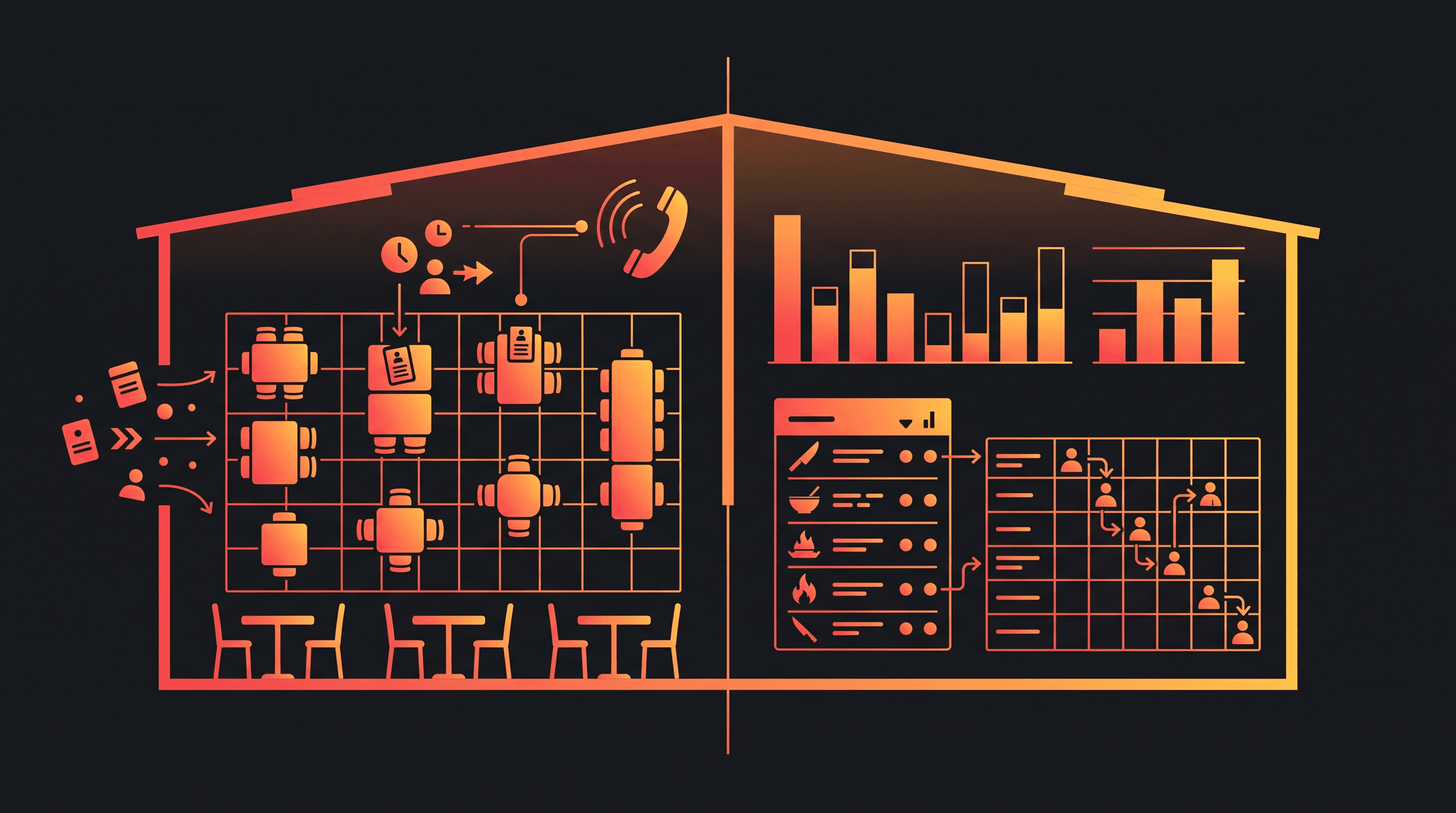
AI for restaurants covers two distinct jobs: automating what happens in front of the customer, and automating what happens behind the pass. Front-of-house tools answer the phone, take reservations, handle online ordering with upselling prompts, and send WhatsApp or SMS confirmations that cut no-shows. Back-of-house tools forecast demand from sales history and local events, build staff rotas, run kitchen display systems, and track waste. None of this is new in concept, restaurants have used booking software and stock systems for years, what's changed is that AI now does the pattern-matching a person used to do manually.
The part vendor pages gloss over is that most of this only works as well as your point-of-sale system lets it. A forecasting tool with no clean sales data feed is guessing; an ordering AI that can't write back to your POS creates a second system your staff have to reconcile by hand. UK operators carry two more layers most guides, written for the US market, skip entirely: tronc and service charge distribution stays a legal and payroll matter no AI tool should be relied on for, and delivery platforms (Deliveroo, Just Eat, Uber Eats) each need their own integration on top of whatever's already running. This guide covers what's working, what's still hype, and where to start, alongside our wider look at AI automations every UK SMB should run.
| Area | Use case | What it automates | Typical tool type |
|---|---|---|---|
| Front-of-house | AI phone answering & reservations | Call answering, availability checks, booking confirmation | AI receptionist / voice AI platform |
| Front-of-house | Online ordering & upselling | Basket-based add-on suggestions, time-of-day pricing | AI-enhanced ordering platform |
| Front-of-house | Booking confirmations | WhatsApp/SMS reminders, cancellations, rebooking | Messaging automation platform |
| Front-of-house | Review management | Drafting replies, flagging negative reviews | Reputation management tool (AI-assisted) |
| Back-of-house | Demand forecasting & inventory | Predicting stock needs from sales history, weather, local events | Forecasting / inventory software |
| Back-of-house | Labour & rota scheduling | Building schedules against forecast demand | Workforce management software |
| Back-of-house | Kitchen display & prep | Sequencing orders, flagging bottlenecks | KDS module (often built into POS) |
| Back-of-house | Waste reduction tracking | Logging and analysing waste patterns | Waste tracking software |
Front-of-House AI for Restaurants: What It Actually Does
AI phone answering and reservations
Phone answering is the most mature front-of-house use case in AI for restaurants, and the one operators report the most consistent value from. An AI phone system picks up during service when staff can't get to the phone, takes a booking or a takeaway order, checks a connected reservation system for availability, and confirms it on the call. It's the same technology covered in our guide to AI phone answering for restaurants: strong on routine bookings and FAQs, weaker on complex or distressed calls.
Online ordering and upselling
AI-driven online ordering suggests add-ons based on what's in the basket rather than a static "customers also bought" list, and can adjust pricing or promotions by time of day. The upsell only earns its keep if it's trained on your actual menu and margins: a generic model bolted onto a template ordering page tends to suggest combinations that don't make commercial sense for your kitchen, or push items you're already short on.
Booking confirmations via WhatsApp/SMS
Automated WhatsApp or SMS confirmations reduce no-shows more reliably than almost any other single change an independent restaurant can make, sending a reminder a day out and letting the guest cancel or rebook without a phone call. It's the same mechanic behind broader WhatsApp automation for UK businesses: message templates, two-way replies, and a human handoff when a guest needs something the bot can't resolve.
Review and reputation management
AI tools can draft review replies and flag negative reviews for urgent attention, saving time on the routine five-star "lovely evening, thanks!" volume. They shouldn't post unedited: a templated response to a genuine complaint reads as dismissive. Use AI to draft, keep a person reviewing before it goes live.
Back-of-House AI for Restaurants: What It Actually Does
Demand forecasting and inventory
Back-of-house forecasting pulls together sales history, weather, and local events (a nearby match day, a bank holiday, roadworks outside your door) to predict how much of each dish you'll sell, then flags what to order in. It's the single highest-value back-of-house use case in restaurant automation because the maths beats manual guesswork once it's tuned, but it needs at least a few months of clean sales data before it's more useful than a manager's gut feel.
Labour and rota scheduling
AI rota tools build staff schedules against forecast demand instead of last week's pattern, flag when you're overstaffed against predicted covers, and can auto-suggest cover for last-minute sickness from your existing team. The output is only as good as the forecast feeding it, and it still needs a manager's sign-off for anything involving staff preferences or fairness.
Kitchen display and prep automation
Kitchen display systems (KDS) replace paper tickets with a screen that sequences orders by prep time and station, and increasingly use AI to predict bottlenecks before they happen, flagging when the grill station is about to fall behind service. Most modern POS systems now offer a KDS module already.
Waste reduction tracking
Waste tracking tools log what gets binned and why, over-prepped, spoiled, sent back, then feed that pattern back into ordering and forecasting so it doesn't repeat week after week. It's unglamorous compared to a forecasting dashboard, but for a lot of independents it's the fastest payback of anything on this list.
AI and Your POS: Why Integration Is the Real Hurdle
Every AI tool in this piece, forecasting, ordering, phone answering, rota scheduling, is only as useful as the data it can pull from your point-of-sale system. Most restaurant AI software marketing skips this entirely and talks up the model, when the actual constraint is almost always integration: does the tool have a clean, real-time connection to your sales, stock and booking data, or is someone manually exporting a spreadsheet once a week? Legacy or heavily customised POS setups are the most common blocker. Some simply don't expose an API a third-party AI tool can read from, which means the AI ends up working from stale or partial data.
This is why POS integration, not the AI itself, gets flagged as the main implementation hurdle for this exact search. Before buying any restaurant AI software, the first question isn't "how good is the AI", it's "what does this actually connect to, and how". We built our POS engine specifically because most off-the-shelf AI tools assume a clean, modern POS that a lot of UK independents simply don't have, and a mismatched integration costs more in staff time than the AI ever saves.
UK-Specific Realities: Service Charge, Tronc and Delivery Platforms
Two things generic ai for restaurant content, most of it written for a US audience, skips entirely. First: tronc and service charge distribution. Under the Employment (Allocation of Tips) Act 2023, which came into force on 1 October 2024, employers must allocate tips, gratuities and service charges fairly among staff and keep records of how they're distributed, with gov.uk guidance setting out what counts as fair. That's a legal and payroll process, and no AI tool automates or should be relied on to handle the allocation decision itself. Where AI does genuinely help is adjacent: feeding accurate rota and hours data into an honest tronc calculation, not making the calculation's legal judgment call.
Second: delivery platform integration. Deliveroo, Just Eat and Uber Eats each run their own order-management system, and getting AI forecasting or inventory tools to see delivery orders alongside dine-in and takeaway means integrating with all three separately, or through a middleware layer, on top of whatever POS you're already running. Skip this step and your demand forecasting is blind to a chunk of your actual sales, which defeats the point of running it. The AI model itself is rarely the hard part: wiring it into three delivery platforms and a POS that wasn't built for any of them usually is.
What's Actually Working vs What's Hype
Here's the honest split on what's earned its place and what's still mostly marketing:
- Phone answering and reservations: mature. Handles routine bookings reliably; the failure mode, a missed edge case gets escalated to a human, is low-risk.
- Demand forecasting: useful, not autonomous. Genuinely beats manual guesswork, but still needs a manager's override for one-off local events outside its training data, a road closure, a one-night pop-up next door.
- AI menu design: mostly hype. Promises to optimise your menu for psychology and margin, but rarely earns back its subscription cost for an independent site with a few dozen covers.
- Autonomous kitchen robotics: hype for most UK independents. Remains a large-chain proposition, not a realistic near-term buy.
If a tool's pitch leads with the AI rather than the specific problem it solves, that's usually a sign it's solving a problem you don't actually have.
Getting Started Without Overhauling Everything
Don't try to run every use case in this piece at once. Pick the single area causing you the most friction right now, usually phone and reservations if you're missing calls, or inventory and forecasting if waste and over-ordering are eating margin, and prove that one out before adding anything else. Check what your current POS actually exposes before you buy anything: a tool that looks perfect on a vendor demo can underdeliver badly against a system that won't share clean data. Our own restaurant AI product exists because most of what we see going wrong with restaurant AI adoption is a POS integration problem dressed up as a "the AI isn't good enough" problem. If you're weighing up where to start, talk to us about your restaurant's setup: the honest answer is usually a narrower first step than the vendor pitch you've been sent.
Frequently asked questions
Which AI is best for restaurants?
There's no single best AI for restaurants: it depends on the problem you're solving. For phone and reservations, look at dedicated AI receptionist platforms; for forecasting and inventory, look at tools that plug directly into your POS. The best tool is whichever integrates cleanly with what you already run, not whichever has the longest feature list.
How can AI be used in restaurants?
AI for restaurants covers front-of-house use cases (phone answering, reservations, online ordering, review management) and back-of-house use cases (demand forecasting, rota scheduling, kitchen display systems, waste tracking). Most independents get the most value starting with one high-friction area, commonly phone answering or inventory, rather than adopting every use case at once.
What AI does McDonald's use?
McDonald's tested AI voice ordering at the drive-thru with IBM for over two years, then ended the partnership in June 2024 after viral ordering errors, misheard orders, wrong add-ons, showed the technology wasn't reliable enough at scale (Restaurant Dive). It's a useful reminder that even a chain with McDonald's resources found restaurant voice AI harder than the demos suggest.
Do I need a new POS system to use AI tools?
Not always, but you need a POS that exposes clean data through an API or export the AI tool can actually read. A modern cloud POS usually integrates fine; an older or heavily customised system might need middleware, or genuinely need replacing, before an AI layer works properly on top of it.
Is AI for restaurants worth it for a single independent site?
Often, yes, for the mature use cases: phone answering, reservation confirmations and waste tracking tend to pay for themselves quickly even at one site. It's less clear-cut for forecasting, which needs a few months of sales data to be useful, and for anything requiring deep POS integration your current system doesn't support well.
Can AI handle service charge and tronc in the UK?
No, and it shouldn't be relied on to. Fair allocation of tips and service charges is a legal requirement under the Employment (Allocation of Tips) Act 2023, and the distribution decision stays a payroll and compliance matter. AI can feed clean hours and rota data into that process, but the allocation itself needs proper payroll handling, not an AI tool.
AI for restaurants works best as a scalpel, not a full-stack overhaul: fix the one thing costing you the most calls, covers or wasted stock, and prove it out before adding the next layer. If you're not sure where your own setup actually needs it, talk to us about your restaurant's setup.
Methodology
This guide draws on Aristral's own restaurant and POS product work (/restaurant, /pos-engine), current UK vendor and platform documentation, gov.uk guidance on tips and tronc, and Restaurant Dive's reporting on the McDonald's-IBM drive-thru AI story, checked in August 2026. Aristral builds restaurant AI and POS integration for UK operators, so treat the practical judgment here as opinion from an interested party rather than neutral third-party advice; nothing here is a guaranteed outcome, and nothing here is legal or payroll advice. Written by Taha Bilal, who founded Aristral in 2024 and runs delivery himself. Spot an error or an outdated figure? Email admin@aristral.com.
About the author
Taha Bilal
Co-founder, Aristral
Taha Bilal is a co-founder of Aristral, a UK AI automation and SEO agency based in Clifton, Bristol. He has been running SEO and digital-growth campaigns for SMB and SaaS clients since 2018, and now leads Aristral's combined SEO + GEO programmes for service businesses across the UK and US. Corrections and source requests: admin@aristral.com.
LinkedIn →Filed under: AI Automation