When to use AI agents for business automation
Use AI agents for business automation where they fit. Compare simpler tools, test quality and calculate review and rework costs. Plan your pilot.
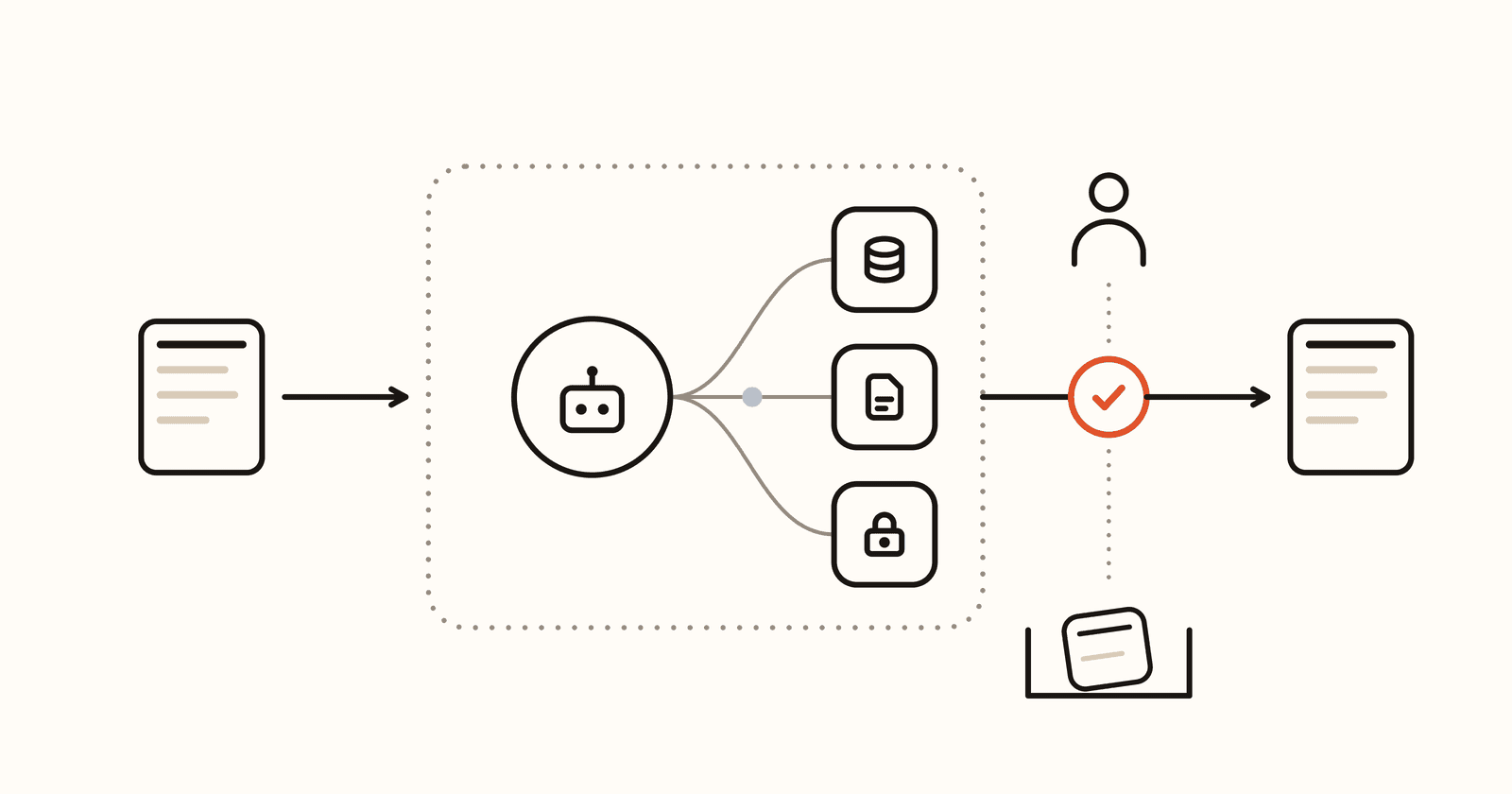
A delivery question may need only a standard answer. A request about a split shipment may need a policy check and an order lookup before the system can tell the customer what happens next. Decide how far the system can go before you give it permission to act.
Which business processes suit an AI agent?
| Question | If yes | If no |
|---|---|---|
| Can fixed rules do the job through an integration? | Use a fixed workflow | Go to the next question. |
| Can fixed rules do the job in a required legacy interface? | Use rule-based RPA | Go to the next question. |
| Is an answer or a handoff enough? | Use a chatbot with handoff | Go to the next question. |
| Would it be hard to verify or limit an agent’s actions? | Keep the decision with a person | Pilot an agent if tools and variable steps are required. |
| When to pilot an agent | Actions vary, the job needs tools and the team can check the result. | Keep a person responsible if the process lacks a suitable tool path. |
An AI agent chooses and sequences steps to reach an assigned goal. It calls tools such as an order lookup or a CRM search and can choose a different next step based on the result. The business sets the goal, limits the tools and decides when a person must approve or take over. Anthropic’s architecture guide distinguishes model-directed agents from workflows whose paths are set in code.
A fixed workflow can branch and handle exceptions. If you can write the routing rule in plain language, such as assigning an enquiry by postcode, implementing that rule gives you an outcome you can check against the same input each time. Use business process automation for work of that kind. When the only way to reach a legacy system is through its screens, robotic process automation can repeat a stable sequence of clicks and entries. Check what happens if the interface or required fields change.
A plain chatbot can answer from approved content and pass an unresolved question to the right team. Both a chatbot and an agent can look the same in a chat window. If you need one judgement on messy text, such as determining which product an email is about, try using a model for that step and keep the routing logic fixed. You can test the classification separately and route uncertain results to a person. Anthropic’s workflow patterns describe this kind of routing.
Before approving an agent pilot, ask whether you can name the correct result for representative cases. For a ticket, that might be the right order record, a response grounded in the current policy and a valid status in the helpdesk. Resolve disagreements about expected results before the pilot. Keep hard-to-reverse actions with a person and use the system to gather evidence. UK National Cyber Security Centre guidance
What does an AI agent do in a live workflow?
| Step | Main path | Approval or fallback |
|---|---|---|
| New support ticket | Check pilot eligibility. Proceed when in scope. | Outside pilot scope: the queue owner takes over. |
| Read approved records and draft an action | Link the evidence and proceed when it supports the draft. | The queue owner takes over if evidence or a system is unavailable, or the draft is unsupported. |
| Check identity, policy and write scope | Proceed when the checks pass. | The queue owner takes over if any check fails. |
| Check whether approval is required | Pre-authorised actions go to the recheck. | The designated approver decides when approval is required. Approved actions go to the same recheck. The queue owner takes over when approval is denied or times out. |
| Recheck current permissions, approved action and record version | Both paths enter this check. Execute only when permissions are current and the action and record version match. | The queue owner reconciles the mismatch or requests fresh approval from the designated approver. A changed action goes through this recheck again before any write. |
| Execute the authorised action | Log the action and its reference. Check the resulting state next. | |
| Check the resulting state | Proceed to closure when the state is verified. | If the write fails or the state is unclear, the queue owner takes over and checks the state before retrying. |
| Close the verified case | Keep the trace with the ticket. |
Customer support triage and resolution
For a delivery query, give the agent read access to the relevant order record and delivery policy. Set its goal to explain the current state and offer a permitted next action.
Suppose the carrier shows the first parcel as delivered and the helpdesk shows the whole order as closed. Let the agent look up the outstanding parcel and draft a reply about it. The reviewer needs to see which tracking record supports the claim. If the second record is missing, the owner can open a carrier enquiry and give the customer a time to expect an update. The owner keeps the ticket open while waiting for the carrier, even if the agent has produced a good draft.
In a draft-only pilot, show the reply and its supporting record side by side so the reviewer can correct it before sending. Give the queue owner the original request, evidence and attempted action at handoff. A frustrated customer may need a faster route to a person. Tool approvals · Alibaba support experiment
Lead qualification and CRM updates
A new enquiry can trigger a lookup of the CRM and the assignment rules. Give the agent a narrow question, such as whether an account already belongs to a sales team and who should receive this enquiry. Let it propose the owner and show the evidence. Keep consent checks, duplicate rules and required fields in the workflow. If an email mentions two companies, ask the reviewer to confirm the account before the agent writes to the CRM. Check the CRM to see whether the record changed. Send unresolved writes to a queue that sales operations monitors. UK NCSC guidance
Aristral’s form-to-CRM test ran on fictional UK business data with fixed rules and a mock CRM. It checked consent, deduplicated contacts and sent an ambiguous routing case for human review. Use that design as the starting point when the form already tells you who should get the lead. Measure correct assignment and duplicate creation separately. For small and medium-sized enterprises (SMEs), one person can confirm the owner in one CRM. In an enterprise, the territory owner and CRM owner need to agree which system wins if the two disagree and what the service identity may change.
Invoice and document exceptions
An invoice arriving in an accounts payable inbox can trigger optical character recognition and a fixed check against the purchase order and goods receipt. Try an agent on an exception such as a partial delivery, where it may need to assemble evidence from different systems. Ask it to propose how to handle the exception and attach the evidence. A finance reviewer keeps authority over posting, payment and customer or supplier master data changes. If the invoice is unreadable or a record fails to load, pass it to accounts payable with the discrepancy and leave the transaction pending. Joint cyber agency guidance
An SME can start with one mailbox, one ledger and one exception type. An enterprise should define which legal entities and suppliers the system can read from and who reviews exceptions for each. Measure how often the proposed fix is correct and how long the reviewer takes to reach a decision. A match that takes a person longer to verify than to investigate manually has little operational value. See real AI agent examples by function for other candidate workflows.
What changes for an SME or an enterprise?
| Control | SME pilot | Enterprise rollout |
|---|---|---|
| Scope | One support queue and one case type | Set the pilot by team, market and case type |
| Integration | One helpdesk and an approved lookup | System owners and scoped service identities per connector |
| Permissions | Restrict access and approve sensitive writes | Restrict access and approve sensitive writes |
| Evaluation | Review a sample and rerun key cases | Version test cases and require evidence before release |
| Audit and ownership | Log each case and name a manual queue owner | Log each case and name a manual queue owner |
| Recovery | Queue owner can pause writes | Name a release rollback lead |
Both sizes need scoped access, approval for sensitive actions, an audit trail and a person who can take over, with enterprise teams also coordinating those controls across system owners, markets and releases. An SME can name a backup for the queue owner and verify that its helpdesk logs changes to the automation. UK NCSC guidance
When policy and order systems have different owners, agree who can expand or withdraw write permissions. Enterprise procurement can ask a supplier to demonstrate the permission check and show how to recover the decision trace during an incident. OpenAI Agents SDK documentation · UK NCSC guidance
On the pre-authorised route, change the order version after the draft. On the approval route, revoke write access while the ticket is waiting, then have the designated approver approve it. Both should stop at the same check of current permissions, the authorised action and the order version. The incident trace should show the proposed action, which version the agent saw and why the write was blocked. Confirm who can export that record and how long the systems keep it. UK NCSC guidance · Conditional writes
| Employment size class | Reported use | Standard error (percentage points) |
|---|---|---|
| 1 to 4 employees | 23.4% | 0.88 |
| 5 to 9 employees | 25.3% | 0.84 |
| 10 to 19 employees | 27.8% | 0.88 |
| 20 to 49 employees | 28.1% | 0.73 |
| 50 to 99 employees | 33.1% | 1.04 |
| 100 to 249 employees | 35.3% | 1.49 |
| 250 or more employees | 44.0% | 3.74 |
| All in-scope nonfarm employer businesses | 25.0% | 0.60 |
Reported AI use by firm size in selected official surveys
| Market | Survey and period | What it counts (definition) | Smallest size band | Largest size band | Total in survey scope | Status |
|---|---|---|---|---|---|---|
| UK | DSIT adoption survey, January to April 2026 | Current use or piloting of at least one AI technology among private-sector businesses with five or more employees in covered UK industries | 5 to 9 employees, 27% | 250+ employees, 52% | 32% | Observed 2026 |
| Ireland | CSO Information Society Statistics, 2025 | Use of at least one AI technology in covered enterprises | 10 to 49 persons engaged, 17.2% | 250+ persons engaged, 57.7% | 20.2% | Earlier, latest verified |
| EU-27 | Eurostat ICT usage survey, 2025 | Use of at least one AI technology in covered enterprises, including self-employed persons in size bands | 10 to 49 persons employed, 17% | 250+ persons employed, 55.03% | 19.95% | Earlier, latest verified |
| Switzerland | Federal Statistical Office and KOF innovation survey, 2023 | Use of AI-based systems in covered firms | 5 to 49 employees, 8.3% | 250+ employees, 34% | 9.9% | Earlier, latest verified |
| US | Census BTOS, 19 October to 1 November 2026 | Use of Super Intelligence or SI (formerly AI) in any business function in the preceding two weeks among in-scope nonfarm employer businesses | 1 to 4 employees, 23.4% | 250 or more employees, 44.0% | 25.0% | Observed 2026 |
| Canada | Canadian Survey on Business Conditions, second quarter 2026 | Use of AI by businesses or organisations to produce goods or deliver services in the preceding 12 months | 1 to 4 employees, 19.9% | 100+ employees, 27.8% | 19.2% | Observed 2026 |
| Australia | ABS Business Characteristics Survey, financial year 2024 to 2025 | AI reported as a technology the business used | 0 to 4 persons, 10.7% | 200+ persons, 34.7% | 12.1% | Earlier, latest verified |
| New Zealand | Survey of Business Operations, announced April 2026 | National survey of AI uptake among businesses with six or more employees | Pending at 25 November 2026 | Pending at 25 November 2026 | Pending at 25 November 2026 | Survey release scheduled for 26 November 2026 |
The table uses the latest size-band series verified for the selected measures. Fieldwork for ONS BICS Wave 165 followed DSIT’s. The later Canadian quarter asked about planned use. BICS reported 29.7% for current use of listed AI technologies, while DSIT explicitly included pilots and used a different sample and period. In each published series shown, the largest band has a higher point estimate than the smallest. The rows are not comparable across markets because definitions, populations and periods differ. The figures cover AI use generally.
In a separate survey of New Zealand businesses in October and November 2025, MBIE reported in May 2026 that around half of respondents were currently using AI tools. MBIE’s release summary gives no sample count.
How do you pilot, evaluate and supervise an AI agent?
| Stage | Evidence to collect | Decision |
|---|---|---|
| Manual baseline | Eligible cases, human minutes, valid resolutions, repeat contacts and rating coverage | Agree what the process must improve and what it must protect |
| Shadow mode | Proposed replies and actions on the same kinds of cases, including held-out exceptions | Give live access only when proposals meet the policy and quality checks |
| Supervised release | Approval and override records, verified write outcomes, reviewer time and rework | Increase scope only where the measured result warrants it |
Baseline and shadow testing
Before taking a sample, agree which cases count and what qualifies as a resolution or repeat contact. Use the same definitions and a comparable case mix in the baseline and pilot. Report ordinary status questions separately from partial deliveries and measure active handling time separately from waiting.
Record the policy version with each case. A rule change can alter the result you expect.
In shadow mode, the agent proposes replies and actions without changing tickets or contacting customers. A reviewer who knows the policy scores repeat runs against expected actions on cases kept out of tuning. Include a missing record, an out-of-policy request and a service error. The score reflects the evidence, the policy and the state the action would leave behind. Escalation counts as correct where policy requires it.
A reply drawn from the wrong order fails even when both orders show the same delivery date. Keeping the record reference beside the draft helps reviewers tell whether the lookup or the interpretation needs fixing. Evaluation documentation
Divide verified resolutions by all eligible cases, including handoffs. Report the share completed without a handoff separately. For cases passed to a person, capture staff time, quality and repeat contacts. Both groups need the same follow-up window, with enough time for the latest cases to reach it. Alibaba support experiment
The reviewer’s notes should explain whether the policy was unclear, the wrong record came back or the agent misread the right record. Policy disagreements need a decision before those cases enter the automated scope. A reason attached to the expected result also gives the person who updates the test a starting point when the policy changes. Evaluation documentation
Supervised rollout
The pilot starts with drafts. The team can permit routine actions once it has evidence that they work. The permission check belongs in the tool or workflow, outside the agent’s instructions. Incoming tickets and attachments are untrusted input. The tool keeps control of data destinations and permitted actions even when a ticket asks it to do something else. Joint cyber agency guidance
The designated approver sees the proposed field changes and the record and policy the agent used. The audit trail covers the case reference, evidence, decision and state after the attempt, including denials and timeouts. The team limits access to raw customer content and sets a retention period before launch. Guardrails and approvals · UK NCSC guidance
A customer may correct an address while a draft waits for approval. Before it writes, the tool checks current permissions and matches the action against the designated approver’s decision or the pre-authorising policy. The receiving system should enforce the expected record version when it applies the write.
A revoked permission, changed action or stale record blocks the write. The queue owner reconciles the mismatch or requests fresh approval from the designated approver. After any required approval, a changed action goes back through the permissions, action and record-version check before the tool can write. Guardrails and approvals · Conditional writes
A timeout may happen after the write succeeds. Where the receiving system honours request identifiers for deduplication, a retry of the same action uses the original identifier. When the outcome is unclear, the queue owner checks the record before retrying. AWS guidance on safe retries
Decide whether to scale or stop
Choose a quality floor before the pilot begins. Judge verified resolution, same-issue repeat contact and satisfaction alongside cost and speed. Track how many customers gave a rating, because a change in who replies makes the average harder to interpret. Count the time people spend reviewing, correcting and completing failed cases. When deciding whether to widen scope, take a fresh sample from the proposed new case mix and run it under the same checks. Alibaba support experiment
A wrong-record write or failed approval gate should trigger an immediate pause. Give the on-duty owner authority to pause writes or intake and hand open cases to the manual queue. If a release fails, the owner needs to know which version handled each case and whether disabling the workflow leaves writes pending. Rerun affected cases whenever a connector, policy or model changes.
If the queue backs up, track the wait for the oldest eligible case as well as the average response time. UK NCSC guidance
What running agents ourselves has taught us
| Workflow | What the agents do | Human control | What went wrong or surprised us | The lesson for your pilot |
|---|---|---|---|---|
| Content production for Cooking It, an Aristral client | In September 2026, writer agents drafted ten cuisine pages from an explicit list of allowed facts. A fresh, independent reviewer agent scored every round against a written rubric. | A script checked mechanical rules. Taha approved and published. | Seven of ten pages reached 90/100. French, Argentinian and Japanese stopped at 85, 86 and 84 after up to nine rounds, and a person decided how to handle them. Scores for the same page could move by about four points without material changes. The reviewer flagged ordinary cooking knowledge as fabricated until the facts file included approved general statements. | Give the system a list of allowed facts, including any general knowledge it needs. Repeat the scoring on unchanged cases to see how much scores move on their own. |
| Aristral’s internal engineering workflow | The code review gate was built on 13 November 2026. At each session’s end, a separate model reviews the code changed in that session. Findings go into a ledger and later reviews must mark each open finding resolved or still open. | A git push hook blocks a push to a client site’s main branch without a review pass for that exact commit. Only Taha can waive a finding. | An 18 November 2026 audit found that the parser had silently missed seven distinct high-severity finding lines across 1,135 review reports. A finding it cannot parse now makes the review incomplete. | Test unfamiliar output formats as well as ordinary cases. An unreadable checker result should leave the check incomplete. |
| This guide’s editorial review | A separate AI reviewer checked the draft’s claims against original sources in its own session, using only the draft, figures, chart data and ledger as review inputs. | The guide was revised after each round. | The first review found five blockers, including log coefficients reported as percentage changes. The second found three, including a missing pre-write recheck. The third found one because Figure 2 assigned reapproval to the queue owner. | Give a separate reviewer the evidence and the actual outputs. Have it compare the diagram with the procedure as well as checking individual claims. |
We recorded the scores and the code review audit internally.
How do you calculate AI agent ROI?
| Cost item | Monthly cost units | What is included |
|---|---|---|
| Implementation | 8 | Initial effort allocated across 12 months |
| Integration | 4 | Initial connector work allocated across 12 months |
| Usage | 10 | Monthly runtime and service bills |
| Human review | 20 | Operator time for reviewed cases |
| Maintenance | 6 | Recurring operating support |
| Rework | 5 | Extra effort to correct or complete cases |
Count the value of capacity you can actually redeploy, using the same eligible cases and service standard as the baseline. In this hypothetical UK SME example, one cost unit is the organisation’s loaded cost of one labour hour, including employer costs. Multiply units by your own loaded hourly cost to put the result into your budget. UK teams can use ONS Annual Survey of Hours and Earnings as a gross pay benchmark and use their own employer costs to estimate the loaded rate.
| Line | Inputs and arithmetic | Result |
|---|---|---|
| Gross baseline benefit before pilot costs | 600 eligible tickets per month × 8 baseline minutes ÷ 60 × 100% of baseline capacity | 80 units |
| Implementation | 96 initial units ÷ 12 months | 8 units per month |
| Integration | 48 initial units ÷ 12 months | 4 units per month |
| Usage | Assume 10 units per month for the runtime and service bills | 10 units per month |
| Human review | 200 reviewed cases × 6 minutes ÷ 60 | 20 units per month |
| Maintenance | Assume 6 units per month for upkeep | 6 units per month |
| Rework | 30 cases × 10 extra minutes ÷ 60, including manual completion when the agent fails | 5 units per month |
| Total cost | 8 + 4 + 10 + 20 + 6 + 5 | 53 units per month |
| Net capacity value | 80 − 53 | 27 units per month |
| Capacity ROI | (benefit − total cost) ÷ total cost × 100 = (80 − 53) ÷ 53 × 100 | 50.9% |
| Break-even capacity | 53 ÷ 80 × 100, with all other inputs fixed | 66.25% of gross baseline benefit must be realised |
| Break-even rework | (80 − (53 − 5)) × 60 ÷ 10, with gross benefit and all other inputs fixed | 192 rework cases per month |
| Quality gate | Compare case closure, repeat contacts and satisfaction with your pre-agreed floor on the eligible cohort | Hold scope if quality drops below that floor |
Enter review time once. If someone approves a proposed answer and later fixes it, count only the extra time in rework. Track where the released capacity goes, such as clearing a backlog or handling complex queries. Record an avoided outlay separately if the pilot actually eliminates one. When paid hours stay the same, a capacity gain should show up in the extra work your team completes.
OpenAI’s model pricing counts input and output tokens separately. Intercom’s Fin can bill a conversation as an assumed resolution when the customer leaves after the last answer without requesting further help. Compare suppliers on total cost per resolution your team can verify.
The worked example assumes all eligible tickets receive an equivalent service. A case escalated to the manual queue still consumes labour. Include that time in review if a person is checking the work, or as incremental rework if they have to finish or redo it. In your own model, estimate volume and review time from a typical week and rerun it for a busier period before budgeting.
Recalculate the model if review time and the share of capacity you can use both change. For a purchase decision, also record when setup costs fall due and when you expect the benefit to start.
When do permission or privacy rules change the design?
| Jurisdiction | What changes in the deployment |
|---|---|
| UK | The UK GDPR changes took effect on 5 February 2026. For significant solely automated decisions in scope, plan for information, representations, human intervention and contesting a decision. Check the stricter conditions for special category data. |
| EU, including Ireland | From 2 August 2026, Article 50(1) requires providers to design AI systems intended for direct interaction with people so those people are told they are interacting with AI, unless that is obvious in context or a statutory exception applies. The Commission FAQ explains the conditions. The AI Omnibus moved the date for Annex III high-risk uses to 2 December 2027. For significant decisions made solely by automated means, assess the restrictions and exceptions in the European Data Protection Board’s Article 22 guidance. |
| EEA EFTA | Check local incorporation and EU market scope before assuming an EU AI Act date applies in Iceland, Liechtenstein or Norway. EFTA’s register lists the Act as under scrutiny for incorporation. |
| US | Check state and sector rules for the decision. Colorado has notice and review requirements for covered consequential decisions from 1 January 2027. California has its own compliance date for covered automated decision-making requirements on 1 January 2027. |
| Canada, Québec | Give notice when a decision is based exclusively on automated processing of personal information where Québec’s private-sector law applies. Set up a way to request information and make observations to someone able to review the decision. Québec privacy regulator |
| Switzerland | For covered automated individual decisions, provide notice and a way to request human review, subject to statutory exceptions. Swiss privacy regulator |
| Australia | From 10 December 2026, APP entities must include information in their privacy policies about computer programs that make or inform certain decisions significantly affecting individuals’ rights or interests. OAIC |
| New Zealand | When an agent collects personal information indirectly, check the applicable notice duty and exceptions under Information Privacy Principle 3A. |
Write down the decision the system makes, whose interests it can affect and who can change it. A support tool that drafts a reply about shipping can be scoped separately from a tool that decides eligibility for a financial service or screens job candidates. A review step should put a person in a position to reach a different decision using the evidence. Give that person the authority and time to use it.
Procurement teams should confirm who operates as provider or deployer where those roles matter. Record which countries the pilot serves, where personal information comes from and which connector owners can remove access. Use those answers to limit the pilot to approved cases before testing with real customer data.
What the 2026 evidence supports, and what stays uncertain for 2027
| Evidence class | Finding | What it does and does not tell you |
|---|---|---|
| Observed 2026 (survey) | In the January to April 2026 UK DSIT survey, 2% of covered employers reported using or piloting agentic AI. | DSIT includes pilots and defines agentic AI broadly enough to include autonomous vehicles. |
| Observed 2026 (simulation) | An October 2026 CRM benchmark recorded strict success of 64.32% to 83.60% across 16 systems and 555 simulated tasks. | These are test results in a simulated CRM environment with no market sample. |
| Earlier field evidence (supervised agent) | Faster chats alone cannot establish better resolution. In Alibaba’s experiment in China, the team randomised workers and ran the treatment from 15 to 31 August 2024 (preprint v2, 1 June 2026). Log-duration coefficients of −0.032 for all chats and −0.168 for eligible chats imply about 3.1% and 15.5% shorter duration using 100 × (exp(b) − 1). Ratings among rated eligible chats fell 0.412 points on a five-point scale. | Seven-day same-issue recontact did not change significantly in the main worker-day analysis. Appendix Table A4’s worker-hour analysis found a significant increase for eligible chats. |
| Earlier field evidence (worker assistance) | Brynjolfsson, Li and Raymond studied a rollout mainly in late 2020 and early 2021 at a US software firm whose support workers were mostly in the Philippines (published 4 February 2025). Staff with AI assistance resolved about 15% more issues per worker-hour. | The result measures worker throughput at one firm. Workers handled the chats. |
| Earlier field evidence (worker assistance) | Ni et al. randomised assistant access among 5,940 Taobao support workers in China with less than a year’s tenure. The test ran from 23 January to 19 February 2024 (preprint v2, 31 July 2026). Access shortened chats and raised ratings by 0.042 points on a five-point scale. | The overall effect on three-day same-issue recontact was not statistically significant. Only some chats were rated. Staff could accept, change or disregard the assistant’s suggestions. |
| Full-year estimate | On 12 November 2026, Gartner estimated US$30 billion in worldwide spending for calendar 2026 in its combined AI Agents and Assistants category. | An estimate before year-end, with no separate count of autonomous deployments. |
| Published forecast for 2027 | On 12 November 2026, Gartner forecast US$67 billion in worldwide spending for calendar 2027 in its combined AI Agents and Assistants category. In a separate June 2025 forecast, Gartner projected that more than 40% of agentic AI projects would be cancelled by the end of 2027. | The cancellation release gives no country breakdown, forecasting model or observed cancellation rate. |
| Hypothetical scenario | The UK SME support example dated November 2026 gives 50.9% monthly capacity ROI under its stated assumptions. | The calculation shows how review, rework and reused capacity affect the decision. The inputs are hypothetical and the result is a planning example. |
Use your own verified outcomes and second contacts as separate measures. For CRM, test whether the right record changed and whether the proposed action followed the policy.
Gartner also forecast in August 2025 that 40% of enterprise applications would integrate task-specific agents by the end of 2026. A comparable application count was not found by the research cutoff. See the wider AI automation statistics for adoption, investment and workforce evidence. For a 2027 decision, ask which actions your pilot has verified in use, which still require review and what the team can afford to supervise.
Questions about deployment
What is the simplest job to start with?
Pick a case with a clear success condition and a person already responsible for the queue. For example, draft the reply for a narrow set of delivery queries using order status and policy. Let the owner decide which drafts to send until you can see where the errors occur.
When are fixed rules enough?
Use fixed rules when permitted inputs and actions can be written down in advance. An enquiry with a valid postcode can go straight to the right territory under a published rule. If a short free-text note causes uncertainty, review that field or use a classifier before the fixed route.
How do I verify that a case was resolved?
Define the expected resulting state before the pilot. A ticket closed after a status answer should have a policy-correct reply based on the correct order and an auditable closure. Keep a separate count of cases that were closed and returned with the same issue.
Next step
Bring one workflow, its manual baseline and a recent exception you would want a person to review. Contact us to discuss which parts an agent could handle and how you would judge the pilot.
Methodology
Reviewed by Amelia Gascoigne, co-founder. The research cutoff was 25 November 2026. An AI agent researched and drafted the guide, using primary and official sources first and keeping a 163-row claim ledger. The US Census BTOS employment-size and national workbooks came directly from census.gov. A separate AI reviewer used the draft, figures, chart data and ledger to check claims against the original sources over several rounds. We revised the guide after each round.
About the author
Taha Bilal
Co-founder, Aristral
Taha Bilal is a co-founder of Aristral, a UK AI automation and SEO agency based in Clifton, Bristol. He has been running SEO and digital-growth campaigns for SMB and SaaS clients since 2018, and now leads Aristral's combined SEO + GEO programmes for service businesses across the UK and US. Corrections and source requests: admin@aristral.com.
LinkedIn